Friday, March 16, 2018

Erratic behavior of online newspapers

I sent the following email to the publishers and editors of the Star Tribune and the Duluth News Tribune.

Good afternoon,

If this email is upsetting the end of your day, I’m sorry.  But the erratic behavior of the online versions of your newspapers has been upsetting my month and many months before.

In the case of the Star Tribune, it has unwanted pop-up ads that are difficult, if not impossible to delete. Several days earlier in the week it occurred almost every day and I was ready to cancel my subscription.  The telephone chain to do so was ridiculous.  Yesterday, the eEdition worked fine, and I relented on cancelling my subscription.  Today the pop-up ads were back.

Jon of Feedback was very patient and supportive, but one piece of advice I should never have followed: resetting my iPad.  That wound up clearing all my saved passwords.  Now I have to look these up for my next visit to any of a number of password-protected sites.  And the problem of unwanted pop-ups is back.

In the case of the Duluth News Tribune, it may or may not come up with the eEdition.  On my iPad it was going in a circle of getting halfway to the eEdition and then wanting me to put in my password again.

At the moment, the eEditions are working on my MacBook Air, but I would rather eat breakfast with an iPad by my side: it takes up much less space on the table.

See my blog entry: "A newspaper’s takeover of subscribers’ computers"

I am not alone in enduring these, but I wonder how many of your users have the knowledge and patience to work through this annoyance.  I know my wife who has over twenty years of computer experience wouldn’t and she is growing very impatient with my repeated complaints.  I know that I no longer wish to be an unpaid debugger of your software.

So, please cancel my subscriptions to the Star Tribune and the Duluth News Tribune.  I’ll renew them when you have fixed this problem.

Oh, yes!  I will post this email to my blog.

Wednesday, March 14, 2018

A newspaper’s takeover of subscribers’ computers

Given the increasing complexity of software and its decreasing user-friendliness, I think 1984 has arrived.  We are supposed to follow robotically through the latest commands of the software designer, aka Big Brother.  And like in 1984, we have no idea what we are doing or should be doing.

I have almost 59 years of computer experience.  I started with a summer job in which I used a textbook to learn to program an IBM 650.  That was a set of large refrigerator size boxes with punched cards in and punched cards out.

Over the next twenty-plus years I went on to program and debug larger and larger computers.  I was often an advocate of newer techniques, like using compilers instead of machine code or using email instead of typed memos.

Then personal computers appeared on the scene.  Some of them easy to use, some of them opaque to use.  In 1984, the Macintosh appeared.  It was a real break-through in ease of use.  Many laughed at WIMP (Windows, Icons, Menus, Pictures).  They preferred the complex set of coding that had to be done for the simplest tasks.

I was hooked and became a Certified Macintosh Developer.  I was eager to get the latest Mac with many great features: color, faster and smaller storage devices, and more.

Then OS-X (operating system 10) appeared.  It had many nifty features except ease of transferring older programs to it.  I never got around to rewriting my genealogy program and have lost all that data (except that which I had printed out).  On the other hand, there were many new features that were a delight to use.

But as one OS X after another followed, the Mac started being persnickety.  Printers that were easy to use became a nightmare.  Where is the setting to print an envelope.  Why does the scanner work well with an old OS but gives dark blobs on a newer OS?

Then sin of sins, without asking me, Apple decided I should install the latest operating system just because I was using wi-fi at a coffee shop.  Not only did Apple decide that I should upgrade, it decided that all my files in the Document folder should go to iCloud.  But that was more data than my free 5GB.  It asked me to upgrade my account to 50GB.  The extra $0.99 a month was no big deal, but I still haven’t completely reorganized my Document file so that I don’t need be hooked up to the web to use those files.

The same increasing difficulty has struck many web-sites.  I now subscribe to four newspapers.  Most of them generally work well with only a few quirks that take awhile to figure out.  Just like the print versions, the newspapers are filled with ads.  Generally you can just scroll past them.

But sometime last year, the Star Tribune began to have intrusive ads.  They would take over the computer with no obvious way out.  Not only would the ad page take over the tab slot on a browser, there was no way to get out of it except close the tab or follow it on to other pages in the ad chain.

A similar annoyance is a side-bar ad with a misleading message: “Log In”.  It is not a log in to the newspaper, but an ad for using a Google product for signing in to web sites.

A friendly guy at Star Tribune’s support department helped me try to clear things up.  But it was drastic, including resetting my iPad.  Guess what that did?  It wiped out all my cookies so that I had to enter saved passwords all over again.  Good thing I have the passwords stored in an obscure place.

Rather than making my life simple by easily accessing my bank accounts, reading the latest news, and sending email to friends, I seem to have gone into standby debug mode.

Unfortunately, one of those pop-ups appeared again this morning.  That’s it.  I asked the Star Tribune to cancel my subscription.  Bye to “The Brilliant Mind of Edison Lee” and many other comics that are not in the Duluth News Tribune.  Good-bye to many in-depth state stories and editorials.

I do have relatives who spend a small fortune calling Geek Squad every time time they need to make some software change.  Do you think the Star Tribune would pay me for all my efforts?  Do you think your phone will run forever without re-charging?

P.S.  Well, maybe I'll keep the Star Tribune subscription for a few more days.  It worked fine this morning.

Thursday, March 08, 2018

Gun Control

I wonder what the writers of the Constitution and the Bill or Rights would think of the Second Amendment being interpreted as:
The people have no right to regulate a militia of one person.
If you read through the Constitution you will find that the writers knew quite well the difference between “the people” and “a person”.

Posted to Nicholas Kristof's 2018-03-08 column on the Florida school shooting.
http://www.nytimes.com/2018/03/07/opinion/parkland-florida-gun-control.html?comments#permid=26247237

Tuesday, March 06, 2018

Stay-aways gave the election away

We really should pay attention to the stay-aways who might have given the election away.  Were there more “Democrats” who stayed away because Hilary Clinton was not the best possible candidate, or were there more “Republicans” who stayed because Donald Trump was the worst possible candidate?

My comment to  “Trump King of Chaos” at  http://www.nytimes.com/2018/03/04/opinion/trump-king-of-chaos.html?comments#permid=26207463:26212200.

Also scroll down for “Quote of the day” to
“Remember no drama Obama---how I long for those days.”
ACJ, Chicago
2018-03-05

Monday, March 05, 2018

Tweet of the Day: AR-15 and Marco Rubio

“We should change the names of AR-15s to “Marco Rubio” because they are so easy to buy.”
Sarah Chadwick, 2018-02-23.

294K likes compared to Rubio’s 23K likes

Included in Helaine Olen’s “The Parkland kids are revealing America’s failings for all to see”.https://www.washingtonpost.com/blogs/plum-line/wp/2018/03/05/the-parkland-kids-are-revealing-americas-failings-for-all-to-see/

One of the commenters (kdog_wnc) quotes the Rev. Dr. William Barber: "There are those who say so much about which the Bible says so little, and say so little about which the Bible says so much."

No Apple today keeps the bill collector away

Some time ago I bought a Timex from a local jeweler, but I soon became annoyed with it.  I found it hard to reset the time, especially when the day of the month had to be reset on non-31 day months.  I had had a previous Timex that was a bit easier to use, but it wore out.

I started lusting after an Apple watch because I thought, like my other devices, the calendar would be reset automagically at the end of the month and that it would always be synched with some time standard.

But $250 for just that feature seemed a bit steep.  I wouldn’t use the exercise features, and I have an iPhone for listening to podcasts as I exercise.  It would be nice to say, “Hey Siri, when is the bus coming.”  The big drawback for me was that the Apple Watch had to be recharged every 18 hours in a special stand.  Best Buy did have an ad for the Misfit Vapor that was about $200, and Misfit’s website had smart watches for less.  But still…

I decided that I would visit our local Target store to look for some of the less “exciting” watches I bought years ago.  I remember them having a watch counter with dozens and dozens of styles.

Well, the watch counter with its helpful, knowledgeable clerk is gone and has been replaced by a set of shelves in a narrow aisle.  I saw some of the Seiko models that I had years ago.  I think these were in the range of $50.  But then I saw a familiar Casio among the Seiko watches.  It was only $19.99.  It had all the easy to use buttons to change the time, day, and month.  As I stepped away from the shelf, I saw the next shelf to the right was filled with Casios.  Many thanks of the person who left the Casio with the Seikos.

Once I got the Casio home, I found its most serious drawback: instructions that are very hard for seniors to read.  I remedied this by visiting the Casio site and downloading the direction to a PDF file.  I expanded the file to a comfortable viewing size and started in on the electronic playground.  The only foreseeable problem is the band wearing out and a replacement being hard to find.

I also found out that it has a replaceable battery with a seven-year life.  Also I can change the over-the-counter battery myself with a jeweler’s screwdriver, which I have.  That certainly beats charging every night.

Tuesday, February 27, 2018

“Real Republicans”

Should we even call “Republicans” “conservatives”?  They certainly aren’t concerned with “Res publica” (public things) and the only thing they want to conserve is their power.

I think real conservatives from Edmund Burke to Dwight Eisenhower would not want to be associated with them.  Remember Eisenhower’s warning about the “military-industrial complex”.

Posted as a comment: http://www.nytimes.com/2018/02/26/opinion/the-force-of-decency-awakens.html?comments#permid=26131193:26134931.

Monday, February 05, 2018

Taxes are not a one-way transaction

We all complain about taxes and we all would like to pay less taxes or none at all.

But what happens when we pay less taxes?

We won’t have the public streets and highways that we want to be in pot-holeless condition.

We wont’t have fire departments coming to put out our house-fires or the neighbors’ house-fires that might expand to our house.  Does that give you a clue why tax supported fire departments are a good idea?  If not, consider how safe your house would be if you were the only one on your block who paid the fire department.

The same holds for police and snowplowing and street cleaning and …  Would you want to be responsible for clearing the snow from the street in front of your house?

And the irony of ironies is that the “conservatives” who complain the loudest about taxes for things they don’t like want to to throw money at the military, especially if it means a military base in their district.

Oh, yes!  If you can read this, thank a teacher.  If you're rich, maybe your daddy paid the teacher.  If you're not rich, hundreds and thousands of tax-paying citizens paid the teacher.  Or, the poor kid whose education you helped pay for in your middle-age may be the doctor that saves your life in your old age.

Wednesday, January 24, 2018

Vanguard feedback

Sent to Vanguard after email notice of tax documents:

1) Finding feedback is a bit of a chore.
2) The instructions in your emails do not match what is on the screen when a user signs in to his or her account.
3) I have had more debugging experience than I care to remember.  I really don't wish to spend my time debugging third party software.

Or better yet, I tried to send the above to Vanguard.  The window for feedback wouldn’t scroll down all the times, including “Submit” if that was an option.

I did discover that I could move to non-visible sections with the tab key.

Hm!  I noticed typos in the Notes copy.  I wondered if I sent uncorrected text.

Gli italiani sono tornati (English speakers please read on)

For several weeks there has been a big spike in usage of this blog.  It was almost like clockwork every two days.  It was at the same time as a large number of visits "from" Italy.  And then it stopped.

Hurray, maybe the Italian/Russian reverse spammers had gone away.

Then today there was another spike.

You, my legitimate readers, can help make them go away by telling your friends and relatives about this blog.  If the ranking of visits to this blog goes way up, then the hopes of reverse spammers will go do away.  The reverse spammers hope I'll click on their links and ...

But I don't hold much hope about word about this blog spreading.  My comments to the New York Times and Washington Post don't get many "likes" either.

Sunday, January 21, 2018

Why we should have universal health care!

We should have universal health care to increase public health.

Many readers have health insurance, have a certain number of sick days, and generally stay home if we are sick.  About the only thing we will infect other people with are colds or flu.  We will stay home if we have the flu but not in the early stages when we think it is a cold.

But there are lots of people who have no health insurance and no sick days.  These are people who drag themselves to work to make sure their incomes stay steady.  They are the ones who can infect the rest of us on the bus or as restaurant servers or store clerks.

At a gym, many people clean off every surface they touch before and after using a machine.  But do they, or we, clean off every door handle, including on the lockers.  If we take a bus, do we clean off the seat before we sit down.  Do we wear masks in elevators, especially in a medical facility?

How many Typhoid Mary’s are out there serving us even when they know they are sick?

Universal health care will not eliminate all cases of passing an illness on, but it can certainly reduce our risk of catching a disease.

Monday, January 08, 2018

Friday, January 05, 2018

Quote of the day: Trump and John Wilkes Booth

“Donald Trump is the John Wilkes Booth of the Republican Party of Abraham Lincoln.” - Paul A. Fleming, “With so much stupidity, question everything”, Letters to the Editor, Duluth News Tribune, 2018-01-04

Monday, January 01, 2018

Edmund Burke and Sarah Palin thinking alike?

“The occupation of an hair-dresser, or of a working tallow chandler, cannot be a matter of honor to any person–to say nothing of a number of other more servile employments.  Such description of men ought no to suffer oppression from the state; but the state suffers oppression, if such as they, either individually or collectively, are permitted to rule.”

Quoted in The Reactionary Mind: Conservatism from Edmund Burke to Sarah Palin, Corey Robin

I can’t see how he can equate a thinker like Edmund Burke to a clueless person like Sarah Palin.

The above quote is taken very much out of context.  Burke was commenting on the French Revolution where everything was torn down to start anew.  Burke's comments were often directed at Thomas Paine who thought each generation should start governance from scratch.  Burke was very much for change in the context of continuity.  People should keep what works and fix what is no longer working.  To do so, you can't just take people off the street and expect them to understand what changes should be made and how.

I gave up reading The Reactionary Mind after that quote.

I do recommend Edmund Burke: The First Conservative by Jesse Norman and The Great Debate: Edmund Burke, Thomas Paine, and the Birth of Left and Right by Yuval Levin.  Both have a more nuanced understanding of "conservatives" and "liberals".  Although Levin describes himself as a conservative, he gives fair hearing to both Burke and Paine.

Ironically, both Paine and Burke favored the American Revolution.  However, the United States was founded on a Burkean conservatism.  The French revolutionaries imprisoned Paine for about a year and the French Revolution fell to a military government under Napoleon Bonaparte.

Unfortunately, I don't think there are any Burkean conservatives in the U.S. government, unless they are Democrats.  The only thing conservative about Republicans is conserving their own power and that of large corporations.

Ironically, our first conservative wrote a well-thought treatise on how to govern and what dangers to watch out for.  Current "conservatives" not only ignore the lessons in George Washington's Farewell Address, but they don't even attend its annual reading in the Senate!!

Saturday, December 30, 2017

Trump is not a conservative

Are “conservatives” really conservative?  About the only thing “conservatives” want to “conserve” is their power.

They are definitely not like Abraham Lincoln, Teddy Roosevelt, or Dwight Eisenhower.  They certainly don’t take Eisenhower’s advice about the “military-industrial complex.”

And they are definitely not like the “First Conservative”, Edmund Burke.  See “Edmund Burke: the first conservative” by Jesse Norman or “Great Debate: Edmund Burke, Thomas Paine, and the Birth of Right and Left” by Yuval Levin.

They are more like the French Revolution, tearing down everything that went before than Burke’s Whigs who made small changes to an existing order as needed.

This was intended for “Why I’m Still a Never Trumper”. Bret Stephens, New York Times, 2017-12-29, https://www.nytimes.com/2017/12/29/opinion/why-im-still-a-nevertrumper.html.  Unfortunately, comments were cut off before I could get it sent. 


Wednesday, December 20, 2017

Sleepwalking to war, quote of the day

“The sleepwalkers of 2017 should consider: On the brink of conflict, you never know just where the edge of the cliff may be.”

- David Ignatius, “What North Korea told a U.N. envoy trying to prevent war”, Washington Post, 2017-12-19

"Sleepwalkers" is a reference to "The Sleepwalkers: How Europe Went to War in 1914", Christopher Clark

Saturday, December 16, 2017

Warm greetings from the Northland

Originally published in the
Reader Weekly
December 2, 2004


To hug or not to hug: that is the question:
Whether ‘tis nobler in the mind to suffer
The clings and squeezes of joyous greeters,
Or to hold arms against a sea of babbles
And by opposing end them?  To lie, to shriek.

Customs of greeting and congratulations vary across the world from a cursory acknowledgment of the presence of others to an effusive extravaganza of hugging and kissing.  And, of course, the customs vary within the U.S. among families and other social groups, and even among individuals in a family or a group.

I reflected about hugging as our family gathered for Thanksgiving and I saw the photo of President Bush kissing Condoleezza Rice on the cheek to congratulate her on her nomination as Secretary of State.  I thought it was a bit condescending but I will say no more; I’m not Karl Rove.

Hand-shaking on first meeting others has been a custom in Europe and America for a long time.  Some insist on a firm handshake with a direct look in the eye, others give a limp hand and look elsewhere.  In the recent BBC “David Copperfield”, Uriah Heep not only gave a limp handshake and looked “humble”, but people wiped their hands after shaking his.

Once Americans are familiar with one another, they generally don’t shake hands daily with the same people.  On the other hand, the French shake hands on first meeting colleagues each day.  I remember being at a French company in one group approaching another group in the hallway.  People started shaking hands with the members of the other group.  One man who had already seen me that day started to shake my hand but quickly withdrew it, saying “Déja vu (already seen).”

If Americans see an acquaintance outside of work, many shake hands on meeting.  For example, people who work together and don’t shake hands each day may do so when they meet at church.

Other than business situations, hand shaking by women has changed almost exclusively to hugs, hugs even for introductions to women or men.  About the time I was married, hugging seemed to done only among relatives – women hugged women, women hugged men, and men shook hands with men.

I know I shook hands with my dad and stepfather, my grandfather, my brother, and my father-in-law; and I hugged my wife, mother, mother-in-law, and sisters-in-law.  Of course, I hugged my wife, and after forty-four years each hug seems more precious.

On the other hand, I dreaded seeing my mother because of her extremely emotional hugs.  We moved to Europe when I was thirty and stayed six years; I came back to the U.S. only once in that time.  Whenever I visited my mother after our return she would run out of the house wailing and hug me as if I been lost and gone forever. I finally had to ask her to calm down, and she did so reluctantly, making snide comments each time we met again.

I started seeing more hugs when women’s sports became more popular.  The enthusiasm of the sports victory seemed to carry over to other victories or moments of pride.  Women giving certificates or awards to other women didn’t shake hands anymore, they gave hugs.  Then hugging became the standard greeting between women, sometimes even of the remotest acquaintance.

Now some women hug on the slightest pretext – do something moderately well and you are hugged, make a big or small mistake and you are hugged, have an unhappy event in your life and you are hugged, have a happy event in your life and you are hugged.  Generally these women hug other women on these occasions but rarely other men.  I may think this because I seem to be mostly in groups that are predominantly women.  Hm!  Women in their sixties and older don’t seem to hug as much as women in their fifties or younger.

At some time or other, many women all but stopped shaking hands with men, they hugged them.  Two or more couples get together, the men shake hands with one another and the women hug everyone.  Now this is where the fun begins.  Just how do you hug someone of the opposite sex?

Some people bend at the waist, put one arm over the shoulder of the other, and briefly touch cheeks.  It seems more like a formality than any friendly interest in the other person.  Other people stand tall, put both arms around the other and squeeze chest to chest.  I often wonder if some women are oblivious to what they are doing or if they are sending a message that I’m not getting.

No, I’m not a grouch about people’s enthusiasm for others.  I’m not going to be cold to others who want to hug me as a greeting; I will continue to be reluctant to initiate it.  On the other hand, I will initiate hugs in certain circumstances.  When someone has done a good job and I am standing close, I will stand beside him or her and give a one-hand hug to his or her far shoulder.  If someone has a setback or is exhausted from some task, I will put his or her head on my shoulder and put both arms around his or her back.  I will give back rubs whenever needed and when my hands can still knead.

Excuse me, my wife just came home and I want to give her a good hug.

©2004, 2007 Melvyn D. Magree

Thursday, December 14, 2017

Russian collusion and Donald Trump

If you have a few hours free, read the Washington Post’s long article on Donald Trump and the Russians.

If you still have time read all the comments.  This is a bit more time consuming because the Washington Post allows instant commenting.  It’s great to have instant posting rather than waiting hours for arbiters to approve comments, but some people criticize others over and over again, often with insult rather than insight.

Tuesday, December 12, 2017

Edmund Burke asks that people stop calling him a "conservative".

“I’ve heard there is a grave in England that is smoking. It is the grave of Edmund Burke, "The First Conservative", spinning in his grave. I am reading Jesse Norman's book on Burke, and what Burke believed is not what any current Republican believes (or if they believe like Burke, they are keeping very, very quiet).

“Among other things, he believed in a separation of powers so that they could be a check on one another. By contrast, Donald Trump believes that Congress and the Supreme Court should be subservient to his wishes.”

Comment to Jennifer Rubin’s “Be wary of what you wish for in Alabama”.

Monday, December 11, 2017

Net Neutrality and the best Congress money can buy

Open Secrets had a link to a list of Senators and Representatives who took money since 1989 from AT&T, Comcast, and Verizon and whether they voted for or against net neutrality.  Every Senator took some money and only a handful of Representatives took no money from these three.

We have the best Congress money can buy” is attributed to Will Rogers.

Maybe we need a Constitutional amendment that politicians can only accept money from individuals who can vote for them.

Sunday, December 10, 2017

Right on about voting

Sadly, so-called "conservatives" show up to vote for "flawed" candidates, but so-called "liberals" stay home if they perceive a "liberal" candidate as "flawed".


Supporting two commenters from Arizona who support Tuscon's police chief, Chris Magnus, in his even-handed law enforcement.

Counter to “Republicans” and facts

Comment to Paul Krugman’s “Facts Have a Well-Known Liberal Bias”, New York Times, 201-12-08

I think a counter-attack to these distorters of facts should be repeating over and over again their misinterpretation and misrepresentation of so many ideas.

To them, a free market means corporations are free to do what they please.  But a true free market is:

Many buyers and sellers.
Both buyers and sellers are free to enter or leave the market.
Both buyers and sellers have all the information they need.
There are no externalities (all costs are paid for in the transactions

They cherry-pick “sacred” texts to suit themselves.

Adam Smith in “On the Wealth of Nations” observed the England had laws the prevent the workers from organizing to raise wages but none to prevent the masters from organizing to keep wages down.

Adam Smith warned that those who live by profit are not to be trusted.

“Originalist” judges have changed the Constitution to mean that corporations are people.

Martin Luther King, Jr., prejudice, and Frank Bruni

My response to Frank Bruni’s “An Abominations. A Monster. That’s Me”.http://www.nytimes.com/2017/12/09/opinion/sunday/villifying-white-men.html?comments#permid=25166570

Martin Luther King, Jr. must be spinning in his grave:

"When we are judged not by the color of our skin but the content of our character."

Ordered to bake?

Comment to Ross Douthat's "Baker vs. Empire", New York Times, 2017-12-09

"...designed for specification" is a phrase that I have never seen in any arguments pro-baker or pro-buyers.  My own question was if he had been asked to put two male figures on the top of the cake.  If he was to be forced to do so, could he then be forced to put a nude male-female couple on a cake?

The same kind of arguments could be applied to photographers.  If they are forced to take photos of a gay wedding, could they be forced to take photos of a nudist wedding?

My understanding of the case is that the baker was not refusing to sell them a cake but refusing to make a cake to their specifications.


Tuesday, December 05, 2017

Third Party candidates, another false equivalency

A Los Angeles Times article on the death of John Anderson blames his candidacy for Jimmy Carter’s loss in the 1980 Presidential Election.

These articles rarely, if ever, blame the losing major party candidates for the loss.  A more thorough analysis would include the turnout.  How many Jimmy Carter, Al Gore, and Hilary Clinton lukewarm supporters stayed away?  I think poor turnout has far more to do with a major party candidate’s loss than anything else.

Patents, schools, and false equivalency

I posted the following two comments to "Lost Einsteins, the Innovations We Are Missing", David Leonhardt, New York Times, 2017-12-03.

One could also make a correlation between innovation and the type of industries in the area.

The Minneapolis-St. Paul area once drew a lot of people to work in the computer industry.  I was one of them.  Then the medical device industry drew a lot of people.

Rochester MN has been drawing medical talent for generations.  It also once had a large IBM facility.

I wonder what all the patents in NW Minnesota were for.  Snowmobiles, fishing gear?

And then there is politics.  Do the local governments make their places nice places to live, and so many people move there?


Follow-up comment

Well, I looked up several facts about Roseau County, MN, way up north on the Canadian border.  It was where Polaris snowmobiles were invented.  For more seehttp://www.polaris.com/en-us/company.

The Census 2016 estimate of Roseau’s population is 15,629 with 18% of school age 2813 students.  So, it would be quite “easy” for Polaris to have three patents.

The research triangle of North Carolina is another high patent area.  The triangle is University of North Carolina, North Carolina State University, and Duke University, all well-known research universities.

I think a more interesting correlation would be how much people were open to new ideas.  I think the willingness to do something different would have a better correlation than number of children.

Sunday, December 03, 2017

The Woman Who Cost Clinton the Election

See “The Men Who Cost Clinton the Election”, Jill Filipovic, New York Times, 2017-12-01.

Jill Filipovic wrote an interesting column about the bad treatment that Hilary Clinton got from several male interviewers.  I don’t watch TV and so I don’t know the details, but I believe she is right about their bias towards Clinton and their misplaced bias in favor of Trump.

However, in many ways Clinton was her own worst enemy.  Many felt she had a sense of entitlement to the presidency.  I can think of several women who would have made better candidates: Elizabeth Warren (who supposedly decided against it), Amy Klobuchar, Kathleen Sebelius, and many others others who are already prominent in politics.

I would have gladly voted for any of them over Clinton.  However, given that her opponent was Donald Trump, I reluctantly voted for her.

Unfortunately, too many others who thought that she was not the best possible candidate stayed away and gave the election to the worst possible candidate.

Remember, the only way you throw your vote away is to stay away.

Saturday, December 02, 2017

A thinly disguised attack on "liberals"

Posted to Al Franken's Senate page.

After reading Gary Burt’s defense of you in the Reader Weekly of Duluth (2017-11-30), I think you, Garrison Keillor, and other “liberals” are the victims of a witch hunt.  A witch hunt to distract from more serious allegations against "conservatives".

The exposé of Project Veritas by the Washington Post is just the tip of the iceberg of orchestrated deceit.

I think you are very correct in asking for a Senate hearing.  I just hope that you can be successful in exposing what is really going on.

Friday, December 01, 2017

Some words to pass on to your Senators

Given the rush to pass a budget, please pass the following to your Senators.  They had it read in January and probably ignored it the next day.

“All obstructions to the execution of the laws, all combinations and associations under whatever plausible character with the real design to direct, control, counteract, or awe the regular deliberation and action of the constituted authorities, are destructive of this fundamental principle and of fatal tendency.They serve to organize faction; to give it an artificial and extraordinary force; to put in the place of the delegated will of the nation the will of a party, often a small but artful and enterprising minority of the community; and, according to the alternate triumphs of different parties, to make the public administration the mirror of the ill concerted and incongruous projects of faction, rather than the organ of consistent and wholesome plans digested by common councils and modified by mutual interests. However combinations or associations of the above description may now and then answer popular ends, they are likely, in the course of time and things, to become potent engines by which cunning, ambitious, and unprincipled men will be enabled to subvert the power of the people and to usurp for themselves the reins of government, destroying afterwards the very engines which have lifted them to unjust dominion.”

- George Washington, "Farewell Address"

Wednesday, November 29, 2017

A fortune teller, Donald Trump, and George Washington

I visited a fortune teller to ask what Donald Trump would be doing for the next year or two.  She refused to take my money; she said Trump is too unpredictable.

She did offer to let me talk to George Washington for his thoughts.

Washington did say that the city of Washington should be renamed because it has gone against all of his hopes and advice.  He said that Trump reminded him of Pete Seeger’s song “The Big Muddy” in which “the big fool says to push on.”

Washington said that he and Seeger had struck up quite a friendship.  In fact, Washington said that Seeger is a true populist.

Washington saved his great scorn for the Senate.  He complained that every year they read his “Farewell Address” and every year they ignored it completely, especially the parts about factions, excessive military, and avoiding foreign entanglements.  He started to list “enemies” who should be our friends and “friends” we should hold at a distance, but the time I paid the fortune teller for ran out.

Tuesday, November 28, 2017

Donald Trump is no Theodore Roosevelt

Theodore Roosevelt used the phrase “bully pulpit.  He meant that the Presidency gave him a good venue to promote his agenda, an agenda that he believed would make the country better.

With Trump, he is the bully in the pulpit lashing out at anybody who contradicts him in any way.  Trump believes his bullying will “Make America Great Again”, but he is only dragging it down, making the world and America grate again.

See “CNN stars Blitzer, Cooper, Amanpour and others fire back at Trump in a day of rage.

Blamestream media?

Many so-called conservative media complain about the lamestream media.  I guess they don't like the glare of reporting that is more truthful than their own "reporting".

A case in point is Veritas' distortion of what the Washington Post reported about Veritas' truly false news.  See https://www.washingtonpost.com/news/post-nation/wp/2017/11/27/james-okeefe-tweeted-about-his-confrontation-with-a-post-reporter-heres-what-really-happened/.

Veritas?  What truth?

Real conservatives don’t use “liberal” as a pejorative

Probably the last real conservative on the national stage was Dwight Eisenhower.  In his farewell address he did not use either liberal or conservative.  See http://www.americanrhetoric.com/speeches/dwightdeisenhowerfarewell.html.

The most famous assertion he made was his warning about the “military-industrial complex”:

“In the councils of government, we must guard against the acquisition of unwarranted influence, whether sought or unsought, by the military-industrial complex. The potential for the disastrous rise of misplaced power exists and will persist. We must never let the weight of this combination endanger our liberties or democratic processes. We should take nothing for granted. Only an alert and knowledgeable citizenry can compel the proper meshing of the huge industrial and military machinery of defense with our peaceful methods and goals, so that security and liberty may prosper together.”

Just like Washington’s “Farewell Address”, so-called “conservatives” completely ignore the advice of two of the most prominent, believable, and thoughtful conservatives.

I hope you can take the time to read Eisenhower’s farewell address.  If you do, you may agree that Eisenhower was among the last of the true conservatives.  In Minnesota they were rejected by the Republican Party as RINOs (Republican in name only).

Although John B. Anderson was a bit quixotic and supported some radical candidates, like Ralph Nader, I consider him more a true Republican than almost any other prominent Republican.  i think Rep. Bill Frenzel and Governor Arne Carlson represent true conservatives.  Arne Carlson still blogs at http://govarnecarlson.blogspot.com.

Sunday, November 26, 2017

I love(d) my pickup truck

I love my pickup truck
Melvyn D. Magree
Originally published in the
Northland Reader
now the
Reader Weekly
September 14, 2000

Several writers in various publications complain about the number of SUVs and pickup trucks; their major complaint is that these vehicles have much worse gas mileage than sedans.  Other complaints include that these vehicles do not meet the same safety standards, that they cost a small fortune, and that they block the view of drivers behind them.  As a former SUV owner and a current pickup truck owner I agree with most of these points.

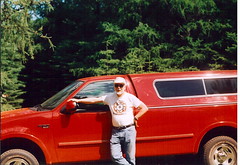
Mel and his pickup truck 2000I do wish my truck had better gas mileage.  Because trucks and SUVs were viewed as tools for many workers Congress exempted them from the fuel economy mandates.  Don’t ask me the reasoning behind the exemption.  Maybe Congress thought the increased cost of achieving the better fuel economy would not offset the reduced fuel costs, or it thought the vehicles would not be powerful enough.

I haven’t followed all the safety standards but one I really appreciated not being in my pre-air bag SUV: automatic seat belts.  I prefer to fasten my seat belt myself, thank you; not be nearly strangled by a seat belt with a mind of its own.

Boy, do they cost a small fortune!  The price for the used SUV was the most that I had ever paid for a vehicle up to that time.  I have less than one year to go on the payments for the pickup, and those payments exceed my tiny pension check from Unisys (my own fault it is tiny).

I disagree strongly about SUVs and pickup trucks blocking the view of drivers behind them.  It is the following drivers’ own fault; they are driving too close.  Remember that sign on semis: If you can’t see my mirrors, I can’t see you.  And there is some fool in a tiny car one car length behind that sign.  The same goes for following an SUV or a pickup truck.  I’ve had people so close behind me that not only can’t I see them in my side mirrors but I can barely see their car roof over my tail gate.

So, if I don’t like the fuel economy and I don’t like the cost, why did I buy these larger vehicles?  Simply, they are tools for me.  I use them to carry things.  I have carried a half-ton in my half-ton pickup many times.

Since we sold the eight-year-old 1952 DeSoto my father-in-law had given us, the largest vehicle we had owned was a Volvo 245 station wagon.  We had gone on vacations with two kids in a Fiat 850 (smaller than a VW Beetle) and Ford Falcons.  We later owned a Fiat 124 sport coupe, two Escorts, a Dodge Colt, and three Volvos (not all at the same time).

But this all changed when we bought property in the Superior National Forest.  Our first contact with the property nearly broke my teeth.  The Oldsmobile a friend was maneuvering down the driveway came to an abrupt halt when the steering assembly hung up on a big rock.  Between that rock and the probability that we would have to drive an unplowed drive and road, we decided we needed a four-wheel, high clearance vehicle.  Our choice was a used Jeep Cherokee Sport.  “Sport” meant among other things that it had a skid plate on the bottom.  And we did clear that rock and we did get into an unplowed drive.

We kept the Jeep for four years and 90,000 miles but its maintenance costs were getting out of line.  We also were often filling it to capacity for our trips to our cabin.  And I didn’t like all that stuff sitting right behind our heads.  We started looking at pickup trucks.

I thought a Ford F-150 would be great but my wife thought it was “overkill” in size.  When we found a dealer who give us a decent price for our Jeep, we took a Ranger for a test drive.  I couldn’t see the top of the speedometer and turned around before I even left the lot.  We wound up driving off as the proud owners of a 1997 F-150 XLT with more doodads than we ever dreamed of having.

The F-150 has been the most useful and reliable vehicle we have owned.  Four years and 60,000 miles later people think it is new.  I can count on one hand the number of unexpected repairs we have had and we were able to drive to the shop for all of those.  Yeah, I know most modern cars are just as reliable (aren’t we glad they don’t build them like they used to).  But most cars don’t carry as much.

I have carried 14-foot boards without worrying about dropping them on the road.  I have carried half-ton loads of an old wall to the dump and half-ton loads of blocks to rebuild the wall.  I have moved a good portion of our goods from our former house in Plymouth to our current house in Duluth.  I carry most of my tools from house to cabin and back, plus our food, clothing, books, and any needed building materials.  And I don’t worry about the load hitting me in the back of the head.

Last month I carried half-ton loads of cement for a sauna, the last 100 feet was over rocks.  Between the low-range of the four-wheel drive and the high clearance, I had no problem getting to where we would mix the cement.  I would not have been very happy carrying 80-pound bags that distance, even in a cart.

As a bonus, I have pulled vehicles out of ditches and mud, including another pickup truck.

However, the best thing about it is that I can get into it without folding myself in half and I can wear a hat without the bill bumping the top of the windshield (and I’m of average height).

Nevertheless, I drive my wife’s Dodge Stratus on errands around town or on long trips because of the better gas mileage.  My pickup truck is a godsend for sixty pieces of lumber, but it is definitely “overkill” for six bags of groceries.

P.S. August 19, 2007, my F-150 now has 112,000 miles, is a bit slower, and people still think it is new.  However, I just spent $800 to have hidden rusty areas on the doors and back panels repaired.  That cost beats making payments for a new vehicle.  I drive it much less now because I carry big loads less often.  We now drive my wife's 70,000 mile 2002 Prius whenever we don't take a bus.  In fact I drive my truck so little that I have to get the oil changed at three months well before I've driven it another 3,000 miles.

©2000, 2007 Melvyn D. Magree

Well, the truck is long gone.  I traded it in for a used 2008 Trailblazer.  I bought the Trailblazer at a Chevy dealer from the same salesman (Dean Melbostad, now retired) who sold my the F-150 at a Ford dealer which had since gone out of business.  I did see the buyer at the Post Office and he was pleased.

And now the Trailblazer is gone.  I traded it in for a leased Toyota RAV4.  The RAV4 has more gizmos than I ever dreamed of for the Trailblazer.  The only fault I find with it is that the dial speedometer is hard to read with the headlights on, a practice I have had since I lived in Sweden.  "Headlights on for safety."

What is a real Christian?

One who

Doesn’t throw the first stone,
Doesn’t pray in public to be seen by man,
Forgives others as he or she wants to be forgiven,
Helps someone not like him or her.

I won't say who follows or doesn't follow these guidelines: judge not lest ye be judged.

Submitted as a comment to Roth Douthat's "Is There an Evangelical Crisis".

Saturday, November 25, 2017

I Was a Federal Bureaucrat

Originally published in the
Northland Reader
now the
Reader Weekly
July 20, 2000

It is popular to complain about government bureaucrats, either as picky, intrusive inspectors or lazy, can’t-be-bothered office clerks.  I’ve always felt these complaints were overblown because most of my dealings with government employees have been with friendly people trying to provide a service.  After years working for a large corporation and running my own tiny business, I finally went over to the “other side.”  I became a federal bureaucrat.

In December I took the test to become a Census worker.  I didn’t hear anything until March when I was asked if I would like to work part-time in the evening; I declined.  I was called again for part-time evening work and I declined.  The last week in April I was called to be a payroll data entry clerk from 12 to 9.  I thought that I had better accept on the third try or I might never be called again.  I was to start May 1 at $7.50/hour with a night premium of 75 cents for work after 6:00 p.m.

I first filled out a stack of forms on my own behalf including deductions for income tax, an electronic payroll deposit form, and a confidentiality agreement.  Because I signed this last form, I can’t tell you anything about the information that I saw without permission of the legal counsel of the Bureau of the Census.

I was shown how to check enumerators’ and clerks’ daily time sheets and then batch them for data entry.  My job was a control to make sure people were not paid too much but also not too little and that they were reimbursed for any expenses that they incurred.  When I had no time sheets to check, I filed just about every piece of paper an employee signed.  The time sheets were the highest priority so that employees would be paid on schedule.

After a week I was transferred to “Field” where another group of clerks audited the census returns.  Our job was to check that the number of people on the front was the same as number of people named inside and the same as number of people on the back.  If no people were at the residence, we were to check that other appropriate information was given such as the enumerator couldn’t find the address or that it was a vacation residence.  We also had to check that a minimum number of questions were answered.

This work was far more interesting, almost too interesting.  It was hard not to read the forms for the variety of information people gave.  I soon developed a soft focus that allowed me to just check if sufficient information was given.

On the other hand this work was sporadic.  We would sit around reading or chatting because we had processed all the returns.  Then a courier or a crew leader would come in with a small stack or a cartload of forms, and away we would go.  Some nights we would complete everything by quitting time; other nights we would leave some to the day staff.

But far more interesting than the information on the census returns were the people who worked for the Census.  Not only were we diverse in the political sense of black, white, and Indian, but the real sense of a wide range of backgrounds, interests, and hopes.  We had veterans who had been all over the world and people who never left the region.  We had people who never went to college and a Ph.D.  We had school teachers, choral singers, and political activists.  Each of them had interesting stories and I’m sorry that I don’t have space for more.

Will, not his real name, was an air traffic controller.  Will was a “gypsy”, meaning that he would be assigned to various airports on an as needed basis.  His most harrowing experience was when he had just plugged in his microphone and headset when a DC-10 lost an engine at O’Hare.  He was at Oshkosh handling the big fly-in when President Reagan fired all the air traffic controllers.  The Experimental Aircraft Association, an organizer of the Oshkosh flyin, returned his application and check.

Carla Bayerl was with the Air Force for 22 years.  She started as an Integrated Avionics Components Specialist (electronics technician).  She spent the last 14 years on a mobility team.  The team was on call for search and recovery after a crash.  At the same time, she also managed base residences, food services, and a recreation and fitness center..  She had assignments in Arizona, Alaska, California, Germany, Italy, and Greece.  She is a country music fan and is now developing a business booking country and other bands.

Cade Raukar is a recent graduate of University of North Dakota in Criminal Justice.  He took some additional courses in his field this spring.  He is also in the National Guard as a tanker, his current position is as a gunner.  He is now working as corrections officer in the St. Louis County Jail.

Jerry Hess was a newspaper and magazine editor.  He had worked for the Austin (MN) Daily Herald , the Ft. Wayne (IN) Journal-Gazette, and the Star Tribune.  He was the editor for many years of Snack Food Magazine, a trade journal, when the publisher decided to move it to another state.

Chuck Thompson was a country and pop DJ and talk show host in Litchfield and Willmar for five years.  He was dropped from one station when his ratings dropped.  He jokes that his successor lasted two weeks.  One of his highlights was interviewing Kevin McHale, general manager of the Timberwolves.  He is now a freshman basketball coach at Esko.  He plans to start next fall at University of Wisconsin at Superior to finish his degree in elementary education.

So, the next time that someone complains about government bureaucrats, remind that person that the bureaucrats are employees like most of the rest of us.  They have a wide range of hopes and concerns, needs and interests.  And like the rest of us, they are doing the best they can in a situation in which somebody else made the rules.

©2000, 2007 Melvyn D. Magree

More computer woes

After I installed Norton Anti-Virus, I decided to upgrade to put it on some other devices.  I have yet to successfully do so.  I sent the following letter to Symantec:

I thought adding new devices to my Norton Anti-Virus subscription would be a piece of cake.  It has been a nightmare of changing circumstances.  Somewhere along the line, even the email address on my subscription was changed to I know not what.

I really prefer using email to ask questions, but your only choices are Chat Room or telephone call.  Both of these put the customer and employee under pressure to keep doing something.  Haste makes waste.

I have been going around and around trying to follow the directions for installing Norton on additional devices.  It has devolved into just giving me the choice to buy it from the App Store.

Please email me detailed instructions on how to get my email account recognized again and to install Norton Anti-Virus on an iPad mini, and iPad, and an iPhone.

- End of letter

I tried again today at a coffee shop to put Norton Antivirus on my wife’s iPad Mini.  Everything worked fine until I was taken to the App Store.  I forget the details, but the App Store hung up after I put in my wife’s credit card info.  Why a credit card was needed for a free download, I don’t know  I finally turned her iPad off.

Later I tried to make a donation to a local charity.  I made a mistake typing in the credit card number, and it turned to box to a rose background.  It was really hard to see what corrections I was making.  I eventually got all the correct information in and pressed the “Donate” button.  Nothing happened.   The only way I got out of that as to close the window.  This is the first time that such a glitch has occurred on the site.

After reading many of the comments to https://www.yahoo.com/finance/news/many-apples-design-innovations-make-products-worse-195651509.html, I don’t feel so badly.  But Apple doesn’t see to be listening to “The Rest of Us”.

Tuesday, November 21, 2017

A comedy of frustration

Almost two weeks ago we drove to our cabin to get more firewood and change the blade on our chipper.  The latter was to set it up for winter storage.

After I hit a deer in March, I’ve been leery of driving alone.  I try to go only when my “eagle-eye” wife can also watch for deer.  She is pretty good at seeing deer dozens of feet from the road and even calls attention to deer busy eating dozens of feet from the road.

But, probably close to where I hit the deer in March, another deer was in front of the car.  I slammed on the brakes, hit the deer, and then it was standing well off the road wondering what happened.  I got out and checked the front end but found nothing even scratched.

We continued on to our cabin and discovered a snowplow mound of snow across our drive.  OK, I’ll get out the shovel in back and clear it off.

Except there was no shovel in the back.  We hadn’t put it in before we left.

OK, I’ll get the snowblower.  It had started with only a couple of pulls a few  weeks ago.  I uncovered it, pushed the primer a few times, and pulled the starter cord.  One times, two times, three times… Nothing!

I pushed it back to the cabin in order to plug it in.  Even though there was not much snow, it still was an effort to get the wheels to turn.

i unburied the cord from under the splitter and plugged it into the outside outlet and into the snowblower.  The power-on light on the cord didn’t come on.  With a bit of wiggling, I got it to come on.  I plugged it into the snow blower and pushed the ignition button.  Nothing!  Not even a few turnovers.

So, I grabbed a snow shovel and went back to the road.  My wife had used a little shovel that belongs in her car to clear a goodly amount of the snow.  I used the bigger shovel to get more out of the way.

Finally we were able to drive into our parking space and unload the car.

We ate our lunch and then I went back out to put the snowblower back by the parking space.  As I started to heave it along, I noticed that the electric cord was not attached to the spark plug!

I put the cord back on the spark plug, and I think I had the snowblower going in three pulls.

The good news was that I was able to work on getting the chipper blade off.  I had already spent three weekends trying to loosen the nuts holding it in place.  I used two different kinds of penetrating oil.  Now I came armed with acetone and a ten-inch breaker bar.  The hardware store recommended acetone to loosen the blue Loctite, supply the level that could be loosened with hand tools.

I decided to try the breaker bar first.  It is long-handled socket wrench.

Would you believe that the nuts loosened with only three or so pushes?

I took the nuts and bolts off the flywheel and the chipper knife, the latter well-nicked.  And I managed not to drop the knife to the bottom of the housing as I pulled it out.  That would be lots finagling to get it past the flywheel.

I didn’t put the sharp knife on.  Our time was running short.  I sort of stuffed all the tools and parts into the shed and covered the chipper up.  I did take off the battery and the solar charging panel to take home to a warm basement.

Putting the chipper back together will have to wait until spring.  ’Tis a pity!  We have a huge pile of balsam boughs to chip.

Friday, November 17, 2017

Would you rather pay low taxes or be happy?

The AARP latest news page has a list of the five happiest states.  Minnesota is number one.  Minnesota is also among the higher taxed states.

Justice Oliver Wendell Holmes supposedly said, “I like taxes; they buy me civilization.”

The other four states are Utah, Hawaii California, and Nebraska.  The full list is at https://wallethub.com/edu/happiest-states/6959/.  I’ll let you draw your own conclusions about the rankings.  This site also has the best and worst rankings for a few more categories; taxes were not among them.

Tuesday, November 14, 2017

Bus driving, long hours but interesting times

Bus driving, long hours but interesting times
Melvyn D. Magree
Originally published as
Oh, the bus driver's lot is not a happy one
in the
Nortland Reader
now the
Reader Weekly
August 31, 2000


Would you like a job that may pay over $18,000 per year that requires a moderate skill level, has some variety, and let’s you meet lots of people?  Try bus driving.  You have several opportunities in the Northland area from driving a mini-coach to a school bus to a city bus to an over-the-road coach.

The minimum requirements are being 18 or over (21 for some employers), having a valid driver’s license, passing a physical and a background check, and having a willingness to learn.  The larger employers will train you and pay you at least minimum wage for your training time.  Training varies from one to two weeks for school bus to five weeks with DTA.

If you like kids the best place to start is with a school district or a school bus company.  The Duluth Public Schools are not currently hiring but Ken Willms, manager of transportation, says that could change anytime.  Voyageur Bus Company is hiring according to Josh Penshak, the trainer at Voyageur.

Your starting pay at Voyageur would be $8.75 per hour; after several years experience you might get about $12.50.  Your usual schedule would be about 6:30 to 9:00 and 2:00 to 4:30.  Your actual schedule would vary according to the route you picked at the beginning of the school year.

Note: most of what follows is based on my own experience with Medicine Lake Lines and Ryder in the Twin Cities.  Medicine Lake Lines/Ryder operated school buses, mini-coaches, and transit buses.  It may not be exactly the same as you would find in Duluth.

You might find your training a piece of cake or you might wonder if you’ll ever do it right.  Persistence really helps.  It took me seven days before my school bus trainer would let me be tested.  Even then I took one left turn on the test too wide and had to back up in the intersection.  Would you believe that three years later I was training others in transit buses?

After you finish your training and have your Class B commercial driver’s license (CDL) in hand, you will be assigned a route.  For the first few days you will be accompanied by an experienced driver as you learn the route.  I don’t know why but in my car I could generally find my way around but with a school bus it took three days to learn my first route.  Three years later, I was often handed a route copy and asked to substitute on a route in ten minutes or less.  Duluth with its grid pattern of streets should be easier than the labyrinths of Twin Cities suburbs.

One of the jobs of a growing child is to test limits.  School bus riders are no exception.  Fortunately, on most routes you’ll find those who get obnoxious are the exception.  A word from you will suffice to get many kids to sit facing forward and talking quietly.  But if you have some seemingly incorrigible kids, you have many tools that are covered under “student management” in your training. 

You can find a safe place to pull the bus over and have a chat with the miscreant.  Or, you can write the student up and let the school deal with him or her.  One of my most satisfying experiences was, after a particularly obnoxious sixth grader returned from a two-day bus suspension, he apologized and was very helpful thereafter.

You might be able to get more work hours with charters.  I can’t say what kind of charter work you would get in Duluth.  I know I had a wide variety in the Twin Cities from school outings to ferrying the cast and crew of “West Side Story”, the latter charter being a story in itself.  You might also be a minor hero just by keeping your cool when a student breaks her arm on an outing.

Your success as a bus driver depends more on your attitude than anything else.  If you have a positive, problem-solving attitude, you will be a successful bus driver.  The bus drivers who didn’t succeed were often their own worst enemies.  One driver who I had trained got mad at another driver and didn’t show up.  I was disappointed because she had showed such great promise.  Another driver deliberately rammed the bus in front of him; fortunately no students were in either bus but the other driver was out for at least three weeks.  I know the ramming driver was immediately fired; I don’t know if any charges were made.

On the other hand, I knew many drivers who had been driving ten to twenty years and came to work every morning with a smile on their face.  I know if we hadn’t moved to Duluth I would probably still be driving from the terminal now owned by the British company First Group.

Do I miss bus driving?  Yes and no.

Although I normally get up at six, I don’t miss getting up at five or even earlier.  I also don’t miss the split shift, spending 15-20 minutes to drive home, spending an hour or two on a task, and then driving back, and getting home finally at 6:30 or a later in the evening.  I don’t miss the rowdy kids.  And I don’t miss the routes where I barely met the schedule and wondered when I’d get my next break.

But I do miss the easy charters where I nap, eat lunch, or read.  I do miss being in control of a big machine.  Every morning when I pulled out of the garage I felt a sense of pride: hey!  I can do this!  And of course I miss the people.  The chats and chess games in the drivers’ room.  The passengers who always had a friendly greeting.  The seniors who appreciated help with their groceries.  And of course, I miss getting paid to drive to interesting places.

But although the pay isn’t as great, I’d rather write about bus driving than do it.

©2000, 2007 Melvyn D. Magree

Sunday, November 12, 2017

Quote of the day (Misuse of the Bible)

“When Christians cite the Bible to defend child molestation, Jesus should sue for defamation.”

https://www.nytimes.com/2017/11/10/opinion/roy-moore-sexual-assault.html

Nicholas Kristof, New York Times, 2017-11-10

See also "Real Christians exist, they just rarely make the news". 

Dollar a gallon gas?

Oil ends lower as U.S. drillers add to rig count
2017-11-10 2:43 PM ET (MarketWatch)

Trump wants to open up Alaskan oil.

Will gasoline be down to a dollar per gallon?

Remember that many North Dakota drillers gave up because it was not profitable for them.  Then OPEC dropped its production and prices got better for U.S. oil.  See https://www.npr.org/2017/05/24/529852301/boom-time-again-for-u-s-oil-industry-thanks-to-opec.

As the above MarketWatch item states, more production lowers prices.

Has Apple left the “rest of us” behind?

I am sending the following paper letter to Tim Cook, CEO of Apple.

Tim Cook
Apple
1 Infinite Loop
Cupertino CA 95014

Dear Mr. Cook,

It is 1984 and Apple is Big Brother!

I have been debugging software, my own and others’, for fifty-nine years.  In 1983 I left corporate life to work on personal computers.  Some of them were more difficult to program than the main-frames I had worked on.

Then came Apple and the Macintosh in 1984.  By September I had my first Mac (and a Lisa).  Pascal was a joy of simplicity, even if I had to do it through the Lisa.  Every time a new Mac came out, I was eager to buy one as soon as possible.  More storage, more speed.  Hurray!

One of the standing jokes was that Mac owners didn’t need manuals because of WIMP.  About the only thing I needed a manual for was how to use diacritical marks in text (åäéñ).

Then OS X came.  I never did recover everything that I had on my on-the-floor box.  For awhile, I did upgrade to a new OS X.  But changes started making old stuff obsolete.  Or changes were rather gratuitous.  Did iPhoto really need new background colors?  Did iPhoto need to change how photos were annotated?  It seems that changes were made more to keep programmers busy than give the users truly better software.

I’ve been in that position before.  I didn’t want to maintain the old mainframe software; I wanted to work on the new hardware.

I have a long list of peeves of how Apple software changed gratuitously from simple one-step operations to operations with a hidden second step.  I got to the point that I would only change major levels of software when I bought a new computer.

Then, either deliberately or accidentally, I upgraded to Sierra on my lap top.  Fortunately I was at a coffee shop with unlimited internet access instead of at home with a limited monthly access.  One of the big surprises was that Sierra dumped all of my Document folder to iCloud!!  It was lots of “fun” moving it back to my MacBook Air.  I know lots of people who would have to go to Geek Squad or other help professionals to get through this.

My wife’s iMac is swiftly deteriorating.  Again, we have to do a lot of fussing to move data to my old MacBook Pro.  The disk drive no longer works.  Fortunately, we have some large capacity thumb drives so we were able to move her Document folder to the MacBook Pro.

And thumb drives get me to another of my Apple peeves.  If one pulls out a thumb drive without “deleting” it, all the data is lost.  This is really a 1984 nightmare.

How many of “the rest of us” has Apple left behind?

Wednesday, November 08, 2017

Se sei russo, vai via!

Devo dire di più?
Non credo che questo blog sia così interessante per italiani.

Tuesday, November 07, 2017

Is the Internet overhyped?

Is the Internet overhyped?
Melvyn D. Magree
Originally published in
Northland Reader
now
Reader Weekly
May 25, 2000

“We know we must connect all our classrooms to the Internet...”  (Pres. William J. Clinton, State of the Union Address, January 27, 2000) (1)

Really?  The band room?  The wood shop?  The English class?

Does the band room need Internet access to provide music?  Or would the money be better spent on buying sheet music and acquiring and maintaining instruments?

Does the wood shop need Internet access to provide project plans?  Or would the money be better spent on acquiring and maintaining tools?

Does the English class need Internet access to provide copies of Shakespeare?  Or would the money be better spent on buying hardcover copies of Shakespeare, Richard Wright, and Ursula K. Le Guin?

Clinton’s statement and similar statements by many others are indicative more of a mania to adopt the “latest and greatest” without thinking through all the consequences.  This mania is seen both in government and private organizations.  Sometimes it comes from the top down, sometimes from the bottom up.

“OK, Mr. Author, if the Internet is such a mania, how come you make so much use of it for your articles?  And if you use it, shouldn’t school kids learn to use it?”  Yes and no.

Yes, the Internet can be a wonderful tool, but it can also be a great waste of time.  “A library is where you go to find facts. The web is more like a garage sale: it's possible you'll find what you want, but only with a lot of digging, searching, and wading through things that smell funny.” (2)

I found out just how true this was in researching this article.  I’ll come back to this later.

No, school children can learn to use the Internet at anytime in their lives.  I am active in the University for Seniors at UMD.  Many of the members are using computers for a wide variety of tasks.  Many of them first used a personal computer within the last ten years.  The successful users among them have two common traits: a love of learning and an ability to type.

“Even some usually pro-technology types, like Apple Computer Co. founder Steven Jobs, have expressed doubts [about computers in schools], suggesting that what students need is more classroom focus on basics like writing and mathematics and higher-level skills such as critical thinking.”  (3)

Because Frank James paraphrased Steve Jobs, I wanted to find Jobs’ own words.  I did a search with Alta Vista for “critical thinking”, “steve jobs” “apple”, and “education”.  Alta Vista found 39 web pages.  The first page was an Apple page of “Hot News”.  I searched it for “critical thinking”, but it had changed!  It was the only Apple page of the thirty-nine.

I checked a few other pages, but most of them “smelled funny”.  So, I decided to start with Apple’s home page and search within Apple’s own site.  I did a search of “critical thinking, steve jobs”, but my browser (Internet Explorer 4.5 for the Macintosh) wouldn’t load the page!  The URL (or address) that Apple’s search feature created was so long that it wouldn’t even fit in the error message window!  I couldn’t even search for “Jobs”!!!

One of the Internet success stories is Amazon.com, a bookseller!  In fact, if you do a search for something on the internet, you are quite likely to find reviews of books on the subject rather than the text as written by the original authors.  Of course, you can search the Internet for free because the search site depends heavily on revenues from booksellers who want to sell you books on the subject of your choice.

One of the most optimistic works on the future of technology is Bill Gates’ The Road Ahead.  It is available in good old-fashioned paper form.  The only way to get the electronic form (a CD-ROM) is to buy the book.  I searched for “the road ahead” on the internet, and no Microsoft page was in the first 10 pages of the 3,997 found.  I went to Microsoft’s home page and did a search for “the road ahead”.  The first 10 pages of the 67 found were not the text of the book.  I did find that the CD-ROM might have an error!  (However, on August 2, 2007, the page describing the error is no longer available.) (

Should computers be in schools at all?  Of course computers should be in schools, in appropriate places.  The first is in typing, sorry, keyboarding.  Who wants to learn to type on a big heavy mechanical typewriter like I did over 40 years ago?  But we don’t need to have the latest, biggest, fastest computers to teach typing.  Even a Commodore 64 can do that.  The second is in the library as an addition to a great, humongous collection of books.

For it is from books and great mentors that we learn writing, mathematics, and critical thinking.  Let us make sure we have well-stocked libraries and highly-respected teachers.  When we have achieved those two goals, then maybe we can think about adding computers.

(1)I accessed this quote May 4, 2000 at http://www.whitehouse.gov/WH/SOTU00/sotu-text.html.  That page is no longer available.  I imagine each President deletes his predecessor's records after the National Archives has copied them.  However, the Clinton library's copy of the speech does not have that phrase or any other mention of connecting classrooms to the Internet!  After an exchange of emails with an archivist I learned that there is a briefing copy and a transcript.  My search had only turned up the briefing copy.  The archivist gave me the link to The American Presidency Project's copy. and the correct link in the Clinton library.  I couldn't find the latter because I searched on the date of the speech, but the speech was indexed under the date of inclusion into the web site!  Searching the web is not always a solo endeavour.

(2) “Kev's Collection of Cool Quotes”, Kevin Killion, accessed August 2, 2007.  Kevin moved from the URL that I originally had.

(3) “Plan to wire all schools to Internet falls behind”, Chicago Tribune Online, Frank James, Chicago Tribune Washington Bureau, June 22, 1999,  file available in Chicago Tribune paid archive.

©2000, 2007 Melvyn D. Magree

Monday, November 06, 2017

Don’t throw your vote away. Vote on 11/6

Odd year elections are decided by turnout more than the even year elections.  If you stay away, you are even more likely to get your least liked candidate.

If you live in Virginia, this applies very much to you.  It is a election that will be decided more by who stays away than by who shows up.  If you don’t live in Virginia but have friends or relatives in Virginia, please remind them to vote.

My wife, an election judge, thinks I am too negative with this sentiment.  But if I don’t shout it from the rooftops…

Terrorism a “mental health problem”?

Trump has already pronounced this a “mental health” problem, and not a “guns situation.”

"Trump says Texas shooting is a problem of mental health, not guns", Ashley Parker, Washington Post, 2017-11-06.

Is ISIS-induced terrorism a “mental health” problem and not a religious problem?

Thursday, November 02, 2017

Ro Khanna: a Congressman to watch

Links and links

I was reading “Silicon Valley Can’t Destroy Democracy Without Our Help” by Emily Parker in the New York Times. .  She referred to a Washington Post article by Rep. Ro Khanna, “Trump beat Silicon Valley at its own game. Now it must prove itself.”, 2017-10-16,   I then went to his Congressional web site.  His about page gives some history and views.  Among other things, he has refused PAC money.  I hope he goes far.

Was public smoking decreased by market forces or ordinances?

Yeah, smoking is awful, but let the market decide
Melvyn D. Magree
Originally published in
Reader Weekly
May 11, 2000
The recent debate about an ordinance banning smoking in restaurants raises three issues that aren’t discussed enough in any law-making: how widespread will conformance to the ordinance be; how and at what cost will enforcement be; and how might the same result be obtained by other means?

I am in sympathy with Greg Gilbert’s and others desire to have smoke free restaurants.  Second hand smoke does not make for a pleasant dining or drinking experience.  Many no-smoking areas in restaurants are a joke.  How can you have a no-smoking table next to a smoking table or even in the same room?

I’ve been at Hacienda del Sol where one smoker three tables away contaminated the whole room.  I always asked to be seated in the back room at Louis’ on London road because the smoke from half of the front room contaminates the whole room.  During a long wait for a table at Blackwoods I didn’t bother to get drinks from the smoke-filled bar.  And I only stop at Hugo’s in Brimson if I’m sure I’ll be the only one at the bar.

I’ve talked to servers who detest working in the smoking areas.  They say they have to wash their hair when they get home so they can stand themselves.  And I’ve talked to owners who would rather operate as non-smoking but think they will see less business if they do.

With a no-smoking ordinance, many restaurant owners and employees will be very pleased.  It will level the playing field for them.  On the other hand, some restaurant owners who feel strongly that a no-smoking ordinance is an intrusion into the operation of their businesses will wink at patrons who smoke in their establishments.  And smokers who feel strongly about their “right” to smoke will gravitate towards those establishments.

How much effort and money will the city be willing to expend to ensure the ordinance is obeyed uniformly?  Even if the city were willing to make a big effort to expend the effort, could not those resources be better used elsewhere, say on sidewalks and alleys?  Also enforcement would work in some quarters to further increase disrespect and distrust of government.  This in turn further erodes our ability to have a civil society.

It may take a bit longer, but a private anti-smoking campaign may be more successful and far cheaper than a city ordinance.  A good start is the full page ad sponsored by the Twin Ports Youth and Tobacco Coalition on the back cover of the previous issue of the Northland Reader.

Other headlines for ads besides “Secondhand Smoke is Poisoning Our Children” could be “If Restaurants Take Pride in Their Food, Why Do They Let Smokers Contaminate It?” or “The Wine’s Bouquet Was Magnificient But the Air Was Foul Indeed ”.

Anti-smoking organizations could publish lists of smoke-free restaurants or even ratings on how truly “smoke-free” no-smoking sections are.  They could also provide window signs for no-smoking restaurants that are a bit more inviting than “No Smoking” such as “We Value Our Food, Please Don’t Smoke.”

And we can all let management know what we think of their environment.  If you are unhappy with the smoke in a restaurant, tell the manager.  If you are pleased that a restaurant has a no smoking policy, tell the manager.  And be sure to go back as often as you can.

If you don’t think it will work, consider all the fast food restaurants that are now smoke free.  It was customers that got them to change, not ordinances.  Now let’s work on the better restaurants.

If you think about it, market forces can provide solutions to some other problems that currently are going through courts or legislatures.  Market action could provide solutions more quickly and cheaply than litigation and laws.

Postscript: 2017-11-02
Well, it seems we’ve had a combination of market forces and ordinances.  It is really nice to not even worry about smoke, except possibly on a patio.  And it’s great to walk into buildings without passing a phalanx of smokers.

Now if we can only get smokers to pay attention to the no smoking signs at bus stops.  I’ve never had the nerve to ask smokers if I didn’t make them smoke why are they making me smoke!

Tuesday, October 31, 2017

Friday, October 27, 2017

Ralph Nader stealing votes

Blaming Ralph Nader for Al Gore’s defeat by George W. Bush is an issue that will probably never go away.  It came up again a few weeks ago in the Letters section.

The figures below for the 2000 election are from www.electproject.org/2000g and Wikipedia “Spoiler Effect, https://en.wikipedia.org/wiki/Spoiler_effect

In 2000, Florida had a voting-eligible population of 10,666,193.  5,963.110 ballots were cast for a Presidential candidate.  Ralph Nader received 97,421 of those votes.  That was only 2.07% of the no-shows, not much above those who didn’t even vote for a Presidential candidate, 1.6%!!!

We can only guess how the no-shows would have voted.

I would say that we had something similar with the 2016 election.  Turnout for the Presidential vote was 59.3%.  How would the 40.7% who didn’t show up have voted?  We really didn’t know.

It is too true for election after election:
The only way
To throw your vote away
Is to stay away.
Remember to vote for local offices on November 7.  The local results often affect us more directly than the national elections.

Published in Reader Weekly, 2017-10-23 (as far as I can tell, letters are not published online).

For a deeper analysis, see https://www.truthdig.com/articles/dont-fall-for-it-the-nader-myth-and-your-2016-vote/.

JFK assassination: a hypothesis

I've long believed that Lee Harvey Oswald intended to assassinate John Connally, former Secretary of the Navy, because the Navy would not revoke his dishonorable discharge because of his defection to the Soviet Union.  Was his aim bad or did he think the man in the back seat was Connally?

Consider that when apprehended he denied shooting the president.  Was he lying or did he believe that he had killed Connally.  Jack Ruby cut short any investigation by assassinating Oswald.  That action also has a long swirl of speculation.

Given all the possible interpretations of events, is it any wonder that there is so much speculation about what really happened.  It sure makes the day for conspiracy hypotheses.  (I won't bless these hypotheses with the term "theory"; a theory has to have basis in proven facts,  not speculation.)

See “Op-Ed Lee Harvey Oswald’s little green book show JFK wasn’t the real target”, James Reston Jr., Los Angeles Times, 2016-11-22 for many more details

Wednesday, October 25, 2017

The No Party

I have been mulling over party names for those who don’t want to get locked into “factions”.  Factions give strong incentives to think and vote as a bloc.  I thought I had a name for a faction free party but I didn’t write it down.

I looked up “No Party” and found “The No Party Political Movement”.  I think it is an offshoot of the British movement to vote no for staying in the EU.  But it has a long list of things it wants to change.  If it was truly a non-faction movement, it would put up questions rather than demands.

“Independent” is an appealing name, but it has been co-opted by political descendants of George Wallace.  The “American Independence Party” claims it is the fast growing party in the U.S.  This is because of the way California voter registration forms are designed.  See “Are you an independent voter? You aren’t if you checked this box”.

Saturday, October 21, 2017

Content of character over party

Many commenters are calling for a change in or a replacement for the Democratic Party.  Isn't partisanship one of our problems?  You're either conservative or liberal, right or left.  And then there are degrees of conservative and liberal or right and left.

Maybe we should have people without labels who run for office.  Taking advice from George Washington and Martin Luther King, Jr., we should avoid factions and judge candidates on the content of their character.  We need candidates who consider the common good above special interests.  And we definitely need candidates who can change their minds with new information.

Posted at http://www.nytimes.com/2017/10/20/opinion/sunday/trump-resistance-radicals.html?comments#permid=24540138.

Sunday, October 15, 2017

Real Christians exist, they just rarely make the news

I don’t consider myself a Christian, just a person who tries to be considerate of others.

However, I find it hard to be considerate of those who claim to be Christian but ignore much of the generosity preached by Jesus.

What is a real Christian?  One who
Doesn’t throw the first stone,
Doesn’t pray in public to be seen by man,
Forgives others as he or she wants to be forgiven,
Helps someone not like him or her.
If there are any Christians in Congress as defined in the Bible, they rarely make the news.

See also "Quote of the day: Misuse of the Bible".

Wednesday, October 11, 2017

Let’s have facts, not factions

Every year the Senate reads George Washington’s Farewell Address, and every year they ignore it.  This also leads to the break-down of the deliberate designation of three INDEPENDENT branches of government.

The quiescent Republicans seem to have ignored Washington’s warning agains factions more than any Congress in decades.

“All obstructions to the execution of the laws, all combinations and associations under whatever plausible character with the real design to direct, control, counteract, or awe the regular deliberation and action of the constituted authorities, are destructive of this fundamental principle and of fatal tendency.

They serve to organize faction; to give it an artificial and extraordinary force; to put in the place of the delegated will of the nation the will of a party, often a small but artful and enterprising minority of the community; and, according to the alternate triumphsof different parties, to make the public administration the mirror of the ill concerted and incongruous projects of faction, rather than the organ of consistent and wholesome plans digested by common councils and modified by mutual interests. However combinations or associations of the above description may now and then answer popular ends, they are likely, in the course of time and things, to become potent engines by which cunning, ambitious, and unprincipled men will be enabled to subvert the power of the people and to usurp for themselves theeins of government, destroying afterwards the very engines which have lifted them to unjust dominion.”

Please send this to your Senators and Representatives, regardless of party.  Your letters may give them some backbone to take action on George Washington's warning.

Monday, October 09, 2017

One Representative’s take on “terrorism”

”Now we're obsessing over whether the (Nevada) carnage was 'terrorism'," he wrote in a tweet. "If we decide it is, we'll mobilize untold resources. If not, nothing.”’
Jim Times, Rep. Connecticut

“Terrorism, Race, Religion: Defining the Las Vegas Shooting”, Associated Press, reprinted in New York Times, 2017-10-02, https://www.nytimes.com/aponline/2017/10/02/us/ap-defining-terrorism.html.

Jim Himes has also stayed away for the “prayers” for the victims of Orlando shootings.  “There would be, for the umpteenth time, a moment of silence. To ‘honor’ the victims.”
“Why I walked out of the House’s moment of silence for Orlando”, Washington Post, 2016-06-14, https://www.washingtonpost.com/posteverything/wp/2016/06/14/why-i-walked-out-of-the-houses-moment-of-silence-for-orlando/?utm_term=.0511e903c97b.