Showing posts with label headlights. Show all posts

Sunday, November 26, 2017

I love(d) my pickup truck

I love my pickup truck
Melvyn D. Magree
Originally published in the
Northland Reader
now the
Reader Weekly
September 14, 2000

Several writers in various publications complain about the number of SUVs and pickup trucks; their major complaint is that these vehicles have much worse gas mileage than sedans.  Other complaints include that these vehicles do not meet the same safety standards, that they cost a small fortune, and that they block the view of drivers behind them.  As a former SUV owner and a current pickup truck owner I agree with most of these points.
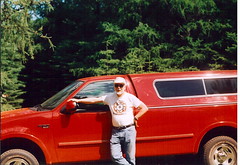
Mel and his pickup truck 2000I do wish my truck had better gas mileage.  Because trucks and SUVs were viewed as tools for many workers Congress exempted them from the fuel economy mandates.  Don’t ask me the reasoning behind the exemption.  Maybe Congress thought the increased cost of achieving the better fuel economy would not offset the reduced fuel costs, or it thought the vehicles would not be powerful enough.

I haven’t followed all the safety standards but one I really appreciated not being in my pre-air bag SUV: automatic seat belts.  I prefer to fasten my seat belt myself, thank you; not be nearly strangled by a seat belt with a mind of its own.

Boy, do they cost a small fortune!  The price for the used SUV was the most that I had ever paid for a vehicle up to that time.  I have less than one year to go on the payments for the pickup, and those payments exceed my tiny pension check from Unisys (my own fault it is tiny).

I disagree strongly about SUVs and pickup trucks blocking the view of drivers behind them.  It is the following drivers’ own fault; they are driving too close.  Remember that sign on semis: If you can’t see my mirrors, I can’t see you.  And there is some fool in a tiny car one car length behind that sign.  The same goes for following an SUV or a pickup truck.  I’ve had people so close behind me that not only can’t I see them in my side mirrors but I can barely see their car roof over my tail gate.

So, if I don’t like the fuel economy and I don’t like the cost, why did I buy these larger vehicles?  Simply, they are tools for me.  I use them to carry things.  I have carried a half-ton in my half-ton pickup many times.

Since we sold the eight-year-old 1952 DeSoto my father-in-law had given us, the largest vehicle we had owned was a Volvo 245 station wagon.  We had gone on vacations with two kids in a Fiat 850 (smaller than a VW Beetle) and Ford Falcons.  We later owned a Fiat 124 sport coupe, two Escorts, a Dodge Colt, and three Volvos (not all at the same time).

But this all changed when we bought property in the Superior National Forest.  Our first contact with the property nearly broke my teeth.  The Oldsmobile a friend was maneuvering down the driveway came to an abrupt halt when the steering assembly hung up on a big rock.  Between that rock and the probability that we would have to drive an unplowed drive and road, we decided we needed a four-wheel, high clearance vehicle.  Our choice was a used Jeep Cherokee Sport.  “Sport” meant among other things that it had a skid plate on the bottom.  And we did clear that rock and we did get into an unplowed drive.

We kept the Jeep for four years and 90,000 miles but its maintenance costs were getting out of line.  We also were often filling it to capacity for our trips to our cabin.  And I didn’t like all that stuff sitting right behind our heads.  We started looking at pickup trucks.

I thought a Ford F-150 would be great but my wife thought it was “overkill” in size.  When we found a dealer who give us a decent price for our Jeep, we took a Ranger for a test drive.  I couldn’t see the top of the speedometer and turned around before I even left the lot.  We wound up driving off as the proud owners of a 1997 F-150 XLT with more doodads than we ever dreamed of having.

The F-150 has been the most useful and reliable vehicle we have owned.  Four years and 60,000 miles later people think it is new.  I can count on one hand the number of unexpected repairs we have had and we were able to drive to the shop for all of those.  Yeah, I know most modern cars are just as reliable (aren’t we glad they don’t build them like they used to).  But most cars don’t carry as much.

I have carried 14-foot boards without worrying about dropping them on the road.  I have carried half-ton loads of an old wall to the dump and half-ton loads of blocks to rebuild the wall.  I have moved a good portion of our goods from our former house in Plymouth to our current house in Duluth.  I carry most of my tools from house to cabin and back, plus our food, clothing, books, and any needed building materials.  And I don’t worry about the load hitting me in the back of the head.

Last month I carried half-ton loads of cement for a sauna, the last 100 feet was over rocks.  Between the low-range of the four-wheel drive and the high clearance, I had no problem getting to where we would mix the cement.  I would not have been very happy carrying 80-pound bags that distance, even in a cart.

As a bonus, I have pulled vehicles out of ditches and mud, including another pickup truck.

However, the best thing about it is that I can get into it without folding myself in half and I can wear a hat without the bill bumping the top of the windshield (and I’m of average height).

Nevertheless, I drive my wife’s Dodge Stratus on errands around town or on long trips because of the better gas mileage.  My pickup truck is a godsend for sixty pieces of lumber, but it is definitely “overkill” for six bags of groceries.

P.S. August 19, 2007, my F-150 now has 112,000 miles, is a bit slower, and people still think it is new.  However, I just spent $800 to have hidden rusty areas on the doors and back panels repaired.  That cost beats making payments for a new vehicle.  I drive it much less now because I carry big loads less often.  We now drive my wife's 70,000 mile 2002 Prius whenever we don't take a bus.  In fact I drive my truck so little that I have to get the oil changed at three months well before I've driven it another 3,000 miles.

©2000, 2007 Melvyn D. Magree

Well, the truck is long gone.  I traded it in for a used 2008 Trailblazer.  I bought the Trailblazer at a Chevy dealer from the same salesman (Dean Melbostad, now retired) who sold my the F-150 at a Ford dealer which had since gone out of business.  I did see the buyer at the Post Office and he was pleased.

And now the Trailblazer is gone.  I traded it in for a leased Toyota RAV4.  The RAV4 has more gizmos than I ever dreamed of for the Trailblazer.  The only fault I find with it is that the dial speedometer is hard to read with the headlights on, a practice I have had since I lived in Sweden.  "Headlights on for safety."

Saturday, November 10, 2012

Driving lessons from a bus driver

When I was trained as a school bus driver long, long ago, a couple of rules I learned hold true for drivers of any type of vehicle.

The first rule is to always drive with your full headlights on.  I actually first learned this in Sweden where the police cars had their headlights wired to come on automatically on starting the car.  I've tried to remember this ever since.  I forget now and then, including at night with a bus in downtown Minneapolis!!!

Your headlights increase your visibility to other drivers, especially if you have a car whose color is close to the background.  With lights on, a light car on snow and a dark car on asphalt are much more visible.  If your car is more visible, you have less chance of a driver turning into your path.  This can also be important in parking garages where many cars almost become invisible without lights.  Even if you think you can see very well, always assume others might not see as well.

If your full headlights are on, then your taillights are also on.  This can protect you if you are coming from an on ramp that merges in a tunnel.  Few drivers will even notice you if your taillights are not on.  Have you noticed cars at night without taillights, but if you pass them you see they have headlights?  The drivers assumed the daytime running lights also turned on their taillights.

The second rule is that backing vehicles have right-of-way.  At the company I worked for, school buses were parked front in.  If a driver backs out with a 30+ foot bus on either side, there is no way that driver can see a bus coming down the lane.  So, the rule a backing bus has right-of-way.

It also is a good rule in a public parking lot or ramp.  With all the SUVs and pickup trucks, can a driver backing out a space have any way of seeing a car coming down the lane at 10+ miles per hour.  Yet there are many drivers who think they are the only driver around and will zip right behind a car already partially out.  And often these same drivers do not have their lights on in the parking ramp!

Monday, October 01, 2012

Short cuts can short change you: Part II

For Part I, click here.

After I returned from the fruitless search for the missing sheet of plywood, I ate supper, went to bed, and tossed and turned too much of the night, considering various options for the next day.

The next morning I plotted out the work for the day.  On one of my crawls underneath, I noticed that there were lots of staples sticking out.  These would have hindered moving plywood sections and so I began removing them.  I think it took me all morning to get them out; I don't remember if that was one-quarter of joists or all of them.

Finally, maybe it was after lunch, I measured out lengths of insulation and stuffed them between the joists, two layers of 3-1/2 inch denim "no-scratch".  I think I did one "sixteen inch by six feet" section at a time.  However, the insulation would not stay between the joists; it sagged and even dropped completely out.

I had set aside some of the old insulation supports, springy sixteen-inch wire rods.  These did the trick of holding the insulation up.  I also had a full package of them left from when I had first put insulation under the floor.  Fortunately, I didn't let my wife throw them out or give them to a rummage sale.

Sometime in the afternoon, I had insulation in place on one-quarter of the joists.

My memory may be wrong, but I think I considered that it a good stopping place.  The next step would be to cover what I had done with plywood.  That would be the next visit's work.  Now it was time to return my friend's trailer.

For some reason, I took the longer way around, thinking that a more direct road was still closed, even when I knew it had been opened.  I had gotten directions to my friend's house from Two Harbors from Map Quest or Google.  When I got into Two Harbors and cell phone coverage, I called him to let him know I was on my way (his Duluth number was long distance from our cabin).  It's a good thing I did.  He told me that I can't use Cant Rd. to get to his place.

When I did get there he noticed the tire iron wasn't on top of the loose spare tire.  Hoo boy!  At 65 mph it must have bounced out.  At least traffic was sparse and it didn't slam into someone's grille or worse.

On Friday I returned to our cabin and tried getting a 4x8 sheet of 1/4-inch plywood in place to screw it to the joists.  No way could I manage this by myself.

So I cooked up what I call Plan A-.  My trying to cover the insulation with whole sheets of plywood was Plan B; the original Plan A having been to put the insulation in from the top.  Plan A- was putting in pieces of plywood from the bottom and holding them up by some means.

Before I cut up my brand new sheets of plywood, I found some old, squirrel-chewed 1/4-inch plywood on our lumber left-overs pile.  The squirrels probably liked the glue.  There was enough good wood to make two about 70x14 panels.  I also found that my circular saw, unused for many years, had a plywood blade and still worked.

My original thought had been to screw runners to the side of the joists and then zigzag the plywood up and let it drop back down.  I measured a "pocket" carefully and tried to cut each piece carefully.  I cut one piece in and tried to fit it in.  I couldn't push up on one side and get the other side to go over the opposite runner.  That didn't work so well.  I took the runners off one side and then just held the piece up with one hand and used a cordless drill to put 1-1/2 screws every 18 inches or so.  That worked.

Except!  There were hangers over the support beams that prevented the piece from going completely to the outside edge.  I had to make notches in the piece.  Then, because I was using low supports to cut the plywood, my cuts weren't the straightest possible.  I had to trim wherever a piece was too wide.  And of course, the joists are not precision cut or placed lumber and are different distances apart - 14-1/2 inches one place and 14-1/4 another.  Some places a piece may fit snugly, and other places there are huge gaps that will have to be filled with caulk.

To shorten this long tale of fortitude, stubbornness, stupidity, and cleverness, the two pieces of scrap worked, and so I cut four more pieces out of the new sheets.  At five o'clock Saturday afternoon, I had one quarter of the insulation up and supported.  Now I began putting all my scattered tools away.  That took an hour.  Then another hour straightening up the cabin and packing up.  When I went to turn off the refrigerator I discovered I never turned it on.  Fortunately the cabin had been so cold when I arrived the day before that the food stayed cool enough.

At about seven I drove out the driveway and locked the cable.  I looked East down the road and saw a full moon almost over the center of the road.  Take a few pictures.  I should have done it with a tripod; the moon is bleary.  Off I go on the hour-long drive listening to the latest "To the Best of Our Knowledge" on my iPhone plugged into the radio.  It gets darker and darker.  I'm not used to this.  My eyes dart back and forth watching for deer.  Then I realize I don't have my high beams on.  Ah, that makes a difference.

Finally I arrive back in Duluth, but no way am I going to prepare supper for myself at this hour.  I stop at Bulldog Pizza for a pint and a big sandwich.  What a relief to sit down without a cabin floor hanging six inches from my face or without a steering wheel in my hands peering into the dark.

Still 3/4 of the insulation to go.  At least the next time I'll have my wife there to help in so many ways.