Showing posts with label Brimson. Show all posts

Sunday, November 26, 2017

I love(d) my pickup truck

I love my pickup truck
Melvyn D. Magree
Originally published in the
Northland Reader
now the
Reader Weekly
September 14, 2000

Several writers in various publications complain about the number of SUVs and pickup trucks; their major complaint is that these vehicles have much worse gas mileage than sedans.  Other complaints include that these vehicles do not meet the same safety standards, that they cost a small fortune, and that they block the view of drivers behind them.  As a former SUV owner and a current pickup truck owner I agree with most of these points.
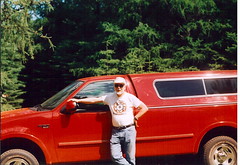
Mel and his pickup truck 2000I do wish my truck had better gas mileage.  Because trucks and SUVs were viewed as tools for many workers Congress exempted them from the fuel economy mandates.  Don’t ask me the reasoning behind the exemption.  Maybe Congress thought the increased cost of achieving the better fuel economy would not offset the reduced fuel costs, or it thought the vehicles would not be powerful enough.

I haven’t followed all the safety standards but one I really appreciated not being in my pre-air bag SUV: automatic seat belts.  I prefer to fasten my seat belt myself, thank you; not be nearly strangled by a seat belt with a mind of its own.

Boy, do they cost a small fortune!  The price for the used SUV was the most that I had ever paid for a vehicle up to that time.  I have less than one year to go on the payments for the pickup, and those payments exceed my tiny pension check from Unisys (my own fault it is tiny).

I disagree strongly about SUVs and pickup trucks blocking the view of drivers behind them.  It is the following drivers’ own fault; they are driving too close.  Remember that sign on semis: If you can’t see my mirrors, I can’t see you.  And there is some fool in a tiny car one car length behind that sign.  The same goes for following an SUV or a pickup truck.  I’ve had people so close behind me that not only can’t I see them in my side mirrors but I can barely see their car roof over my tail gate.

So, if I don’t like the fuel economy and I don’t like the cost, why did I buy these larger vehicles?  Simply, they are tools for me.  I use them to carry things.  I have carried a half-ton in my half-ton pickup many times.

Since we sold the eight-year-old 1952 DeSoto my father-in-law had given us, the largest vehicle we had owned was a Volvo 245 station wagon.  We had gone on vacations with two kids in a Fiat 850 (smaller than a VW Beetle) and Ford Falcons.  We later owned a Fiat 124 sport coupe, two Escorts, a Dodge Colt, and three Volvos (not all at the same time).

But this all changed when we bought property in the Superior National Forest.  Our first contact with the property nearly broke my teeth.  The Oldsmobile a friend was maneuvering down the driveway came to an abrupt halt when the steering assembly hung up on a big rock.  Between that rock and the probability that we would have to drive an unplowed drive and road, we decided we needed a four-wheel, high clearance vehicle.  Our choice was a used Jeep Cherokee Sport.  “Sport” meant among other things that it had a skid plate on the bottom.  And we did clear that rock and we did get into an unplowed drive.

We kept the Jeep for four years and 90,000 miles but its maintenance costs were getting out of line.  We also were often filling it to capacity for our trips to our cabin.  And I didn’t like all that stuff sitting right behind our heads.  We started looking at pickup trucks.

I thought a Ford F-150 would be great but my wife thought it was “overkill” in size.  When we found a dealer who give us a decent price for our Jeep, we took a Ranger for a test drive.  I couldn’t see the top of the speedometer and turned around before I even left the lot.  We wound up driving off as the proud owners of a 1997 F-150 XLT with more doodads than we ever dreamed of having.

The F-150 has been the most useful and reliable vehicle we have owned.  Four years and 60,000 miles later people think it is new.  I can count on one hand the number of unexpected repairs we have had and we were able to drive to the shop for all of those.  Yeah, I know most modern cars are just as reliable (aren’t we glad they don’t build them like they used to).  But most cars don’t carry as much.

I have carried 14-foot boards without worrying about dropping them on the road.  I have carried half-ton loads of an old wall to the dump and half-ton loads of blocks to rebuild the wall.  I have moved a good portion of our goods from our former house in Plymouth to our current house in Duluth.  I carry most of my tools from house to cabin and back, plus our food, clothing, books, and any needed building materials.  And I don’t worry about the load hitting me in the back of the head.

Last month I carried half-ton loads of cement for a sauna, the last 100 feet was over rocks.  Between the low-range of the four-wheel drive and the high clearance, I had no problem getting to where we would mix the cement.  I would not have been very happy carrying 80-pound bags that distance, even in a cart.

As a bonus, I have pulled vehicles out of ditches and mud, including another pickup truck.

However, the best thing about it is that I can get into it without folding myself in half and I can wear a hat without the bill bumping the top of the windshield (and I’m of average height).

Nevertheless, I drive my wife’s Dodge Stratus on errands around town or on long trips because of the better gas mileage.  My pickup truck is a godsend for sixty pieces of lumber, but it is definitely “overkill” for six bags of groceries.

P.S. August 19, 2007, my F-150 now has 112,000 miles, is a bit slower, and people still think it is new.  However, I just spent $800 to have hidden rusty areas on the doors and back panels repaired.  That cost beats making payments for a new vehicle.  I drive it much less now because I carry big loads less often.  We now drive my wife's 70,000 mile 2002 Prius whenever we don't take a bus.  In fact I drive my truck so little that I have to get the oil changed at three months well before I've driven it another 3,000 miles.

©2000, 2007 Melvyn D. Magree

Well, the truck is long gone.  I traded it in for a used 2008 Trailblazer.  I bought the Trailblazer at a Chevy dealer from the same salesman (Dean Melbostad, now retired) who sold my the F-150 at a Ford dealer which had since gone out of business.  I did see the buyer at the Post Office and he was pleased.

And now the Trailblazer is gone.  I traded it in for a leased Toyota RAV4.  The RAV4 has more gizmos than I ever dreamed of for the Trailblazer.  The only fault I find with it is that the dial speedometer is hard to read with the headlights on, a practice I have had since I lived in Sweden.  "Headlights on for safety."

Tuesday, November 21, 2017

A comedy of frustration

Almost two weeks ago we drove to our cabin to get more firewood and change the blade on our chipper.  The latter was to set it up for winter storage.

After I hit a deer in March, I’ve been leery of driving alone.  I try to go only when my “eagle-eye” wife can also watch for deer.  She is pretty good at seeing deer dozens of feet from the road and even calls attention to deer busy eating dozens of feet from the road.

But, probably close to where I hit the deer in March, another deer was in front of the car.  I slammed on the brakes, hit the deer, and then it was standing well off the road wondering what happened.  I got out and checked the front end but found nothing even scratched.

We continued on to our cabin and discovered a snowplow mound of snow across our drive.  OK, I’ll get out the shovel in back and clear it off.

Except there was no shovel in the back.  We hadn’t put it in before we left.

OK, I’ll get the snowblower.  It had started with only a couple of pulls a few  weeks ago.  I uncovered it, pushed the primer a few times, and pulled the starter cord.  One times, two times, three times… Nothing!

I pushed it back to the cabin in order to plug it in.  Even though there was not much snow, it still was an effort to get the wheels to turn.

i unburied the cord from under the splitter and plugged it into the outside outlet and into the snowblower.  The power-on light on the cord didn’t come on.  With a bit of wiggling, I got it to come on.  I plugged it into the snow blower and pushed the ignition button.  Nothing!  Not even a few turnovers.

So, I grabbed a snow shovel and went back to the road.  My wife had used a little shovel that belongs in her car to clear a goodly amount of the snow.  I used the bigger shovel to get more out of the way.

Finally we were able to drive into our parking space and unload the car.

We ate our lunch and then I went back out to put the snowblower back by the parking space.  As I started to heave it along, I noticed that the electric cord was not attached to the spark plug!

I put the cord back on the spark plug, and I think I had the snowblower going in three pulls.

The good news was that I was able to work on getting the chipper blade off.  I had already spent three weekends trying to loosen the nuts holding it in place.  I used two different kinds of penetrating oil.  Now I came armed with acetone and a ten-inch breaker bar.  The hardware store recommended acetone to loosen the blue Loctite, supply the level that could be loosened with hand tools.

I decided to try the breaker bar first.  It is long-handled socket wrench.

Would you believe that the nuts loosened with only three or so pushes?

I took the nuts and bolts off the flywheel and the chipper knife, the latter well-nicked.  And I managed not to drop the knife to the bottom of the housing as I pulled it out.  That would be lots finagling to get it past the flywheel.

I didn’t put the sharp knife on.  Our time was running short.  I sort of stuffed all the tools and parts into the shed and covered the chipper up.  I did take off the battery and the solar charging panel to take home to a warm basement.

Putting the chipper back together will have to wait until spring.  ’Tis a pity!  We have a huge pile of balsam boughs to chip.

Sunday, June 25, 2017

It’s around here someplace

This was a saying in my wife’s family about lost objects, and we still use it.

In April I went to our cabin by myself.  I unlocked the cable across the drive and hung the lock from my pants pocket.  I forgot all about it until I was ready to leave.  I couldn’t find it.

I looked every where I had been.  In the the car, in the cabin, in the grass on all the paths I had been on.  Nada!  So, I used a lock from one of the sheds.

Each time I’ve visited since then I’ve taken another look.

I had resigned my self to buying another lock, but just hadn’t been to my favorite hardware store.  When I did, I would have to send a new key to the guy that plows our drive.

I was mowing the grass near the road yesterday and a neighbor stopped to chat.  After several minutes my wife came to investigate why she didn’t hear the trimmer.  As she came near the cable post she exclaimed “Mel!”  I wondered if she had fallen.

No, she had found the missing lock.  It was partially buried where I had run over it after it had fallen off my pocket.  Several passes over it with the car had buried even more.  She was attracted to it because the hasp did not look like any natural object.

The lock was full  of soil and sand.  We had to soak it and swish it in water several times.  By the time we were ready to leave, we could open and close the lock without a problem.

Sometimes he who hesitates finds stuff, around here someplace.

Wednesday, November 23, 2016

“Tame” wild life

Have you noticed how some wild animals are not afraid of people, especially if the people appear to have food and they don't move?  Of course, we know that we are food for mosquitoes and flies, but some birds and rodents can be almost oblivious of people.

Many of us have seen mice and squirrels come right up to picnic tables with people sitting at the table.  As soon as anybody moves, the animal scurries away, but not far.  Gulls are a screeching nuisance around many popular areas from Canal Park to Thompson Hill; they are always on the look out for something dropped or even thrown to them.  Occasionally a gull may be so bold as to grab food right out of a person's hand.  I saw this happen around the food stands in a park in Sweden.  One second a person was holding a hot dog, the next second the person had only a bun!

Just recently I was only a large object in the way of a busy ground squirrel.  I was installing a pump on a well when I heard rustling in the grass by a clump of chokecherries.  I was on one side of a garden cart and the noise was on the other side.  Pretty soon, I noticed a ground squirrel scurrying around.  It went under the cart and then out my side to my feet.  It sniffed at my boots and climbed up to check my laces.  No food there!  It then checked between my sole and the upper of my boot.  No food there!  Then it looked up at my jeans.  Nah!  Not worth climbing.

The ground squirrel then went out on the scarred ground around the newly dug well and investigated various clumps.  When I moved it raced back to the safety of the grass.

Later in the day when I came out to pump some water, the ground squirrel was in the middle of the clearing.  It dove into a hole by one of the clumps left by the back hoe.  In a few minutes, it came back out and started exploring the barren ground.  It worked its way over to the chokecherries and climbed up one of them.  From its perch at about my eye level and about three arm-lengths away it studied me.

I don't remember if it tired of watching me or if I moved, but it climbed back down.  Quite soon after that, it ventured onto the wood chips around the well and started digging not four feet from me.  It would make two or three scratches in the chips and then look up.  Two or three scratches more
and look up again.  Very quickly it was down to the dirt and continued this pattern, back legs straddled, looking just like Disney's Chip 'n' Dale.  Every so often it would stop, turn around, and with its nose, push the chips and dirt further from the hole.  Deeper and deeper it went.  When it was
about a half-body length in, it met the tunnel it had been seeking and it disappeared.  I pushed some chips over the hole.

The next time I came back the chips were out of the hole as well as more dirt.  As I didn't want anybody to trip on the hole, I put a rock on it.  This may seem that I am mean to the ground squirrel, but I'm sure that if it was in the hole it had many other exits.  If it wasn't in the hole it will use other exits as well as dig as many new exits as it wants.

However, having met this little neighbor I decided not to cut down the chokecherry clump.  It will be interesting to watch the ground squirrel as the seasons progress.  Does it have a big cache of seeds buried and won't come out once the snow is deep?  Will it need to come out to get some additional food and leave tracks in and out of all its exits?  Or will it come to some handy perch to investigate and be amused by these large creatures who make so much noise as they move about?

This may have been published as “Gopher Story” in the Northland Reader, November 1999.  The Northland Reader was renamed Reader Weekly a few years later.

Sunday, November 06, 2016

Hunting with the wrong license

My wife left our cabin early today to visit a friend.  Before she had gone ten miles a buck jumped out in front of her in a well-shaded place.  Her car hit it in the hindquarters.  Once she came to a stop she looked for the deer for some time but never found it.

Did it survive?  If not, will a hunter find it before the wolves or carrion eaters such as crows and eagles?

The damage to her car seems minimal, only a cracked headlight, one we just had replaced.

I told her to call our insurance company as soon as possible.  Also when the adjuster comes to make sure he checks for frame damage.  When I hit a bear in 2014, the adjuster only looked at body damage.  A few years later a mechanic found significant mechanical damage.

Thursday, January 07, 2016

If...

Some have said that “if” is the biggest word in the English language.  It certainly does have a lot of import on our thinking, be it blame, regret, or thankfulness.  Our lives are certainly filled with choice points of our own doing or the actions of others.  “If my teacher hadn’t suggested,,,, then I might not have…”  “If I hadn’t asked for a raise, would I have ever gotten one.”, and on and on.

I have so many “if’s” in my life that got me to this moment of typing on a laptop that I could probably fill this issue of the Reader.  And you would have fallen asleep by the fourth page.

One of my early if’s is if my parents hadn’t divorced, would my mother have moved us in with her aunt and uncle?  That determined where I started school.  If my great aunt and uncle hadn’t bought a house on the other side of the city, would I have have gone to a second elementary school.  At that school I met many others who would become life-long friends.

I did lose those contacts when my mother decided to rent an apartment on the other side of town.  By the time I started high school, she remarried and we moved back to the other side of town.

That house was in a school attendance area different than the area many of my old friends were in.  I made the choice of asking for an exemption to go to that smaller school to be with my friends again.

One of the math teachers at the smaller school punctuated his remarks with “When you go to Case…” meaning Case Institute of Technology.  Five of us started as freshmen there a year or two later.

But would I have been able to afford the $750/year tuition?  The assistant principal suggested that I apply to the Huntington Fund for a scholarship.  I did and was granted a full scholarship.

With my job at Kroger’s, suggested to me by one of the friends I met in the second elementary school and with whom I still correspond, I was able to afford books and bus fare across the city to Case.

Shortly after we moved back across the city, I attended a Methodist Church within a half-hour’s walk and was active in the Methodist Youth Fellowship (MYF).  This continued into my Case years.

I don’t know the exact cause, but I started losing interest in my engineering studies.  I ran for president of the area MYF council and won.  Also on the council was the daughter of a doctor.  After I flunked out of Case, I started dating her.

We both went to Ohio Wesleyan the following fall, she as a freshman and me as a junior.  Despite my flunking out of Case, the Huntington Fund kept funding me.  They had long dropped their maximum scholarship to $500, and I had to take out student loans to supplement it and my own part-time job earnings to make the $1,100 annual tuition.

I got good enough grades in mathematics that Case took me back in the graduate program with a full fellowship in the computer center which included a $75/week salary!  I also married that sweetheart from two paragraphs back.

I don’t think you want to put up with two thousand words of all the twists and turns of the next fifty plus years, but I have many, many “If I hadn’t done this, would this interesting thing have happened.”  I’ll try to collapse those into the few paragraphs remaining of my space.

We chose to move to Minnesota and my employment with Univac because we liked canoeing.  After five years I became restless and managed a transfer to Europe.  We started in Switzerland for a few weeks and then lived in Italy for the next two years.

I became unhappy with the management in Rome and transferred to Sweden.  We liked Sweden so much that we stayed four years.  But then my wife decided our kids should go to junior high in the United States.  Another “if” I must stick in is that my wife met an American women on the subway who had a cabin in Brimson.  She extended an open invitation to visit them.

I gave a wishy-washy description of my interests to my previous bosses at Univac in Roseville, and so we didn’t move back to Minnesota.  Instead I wound up in “exile” in Blue Bell, Pennsylvania.  I was “rescued” when Univac needed people to work on a new computer in Roseville.  That computer was cancelled and I was put on another project, on which I didn’t shine.

Meanwhile, the microcomputer revolution started and I jumped into it.  I blew that too and wound up as a bus driver.  But my wife was doing quite well in her work.  What we didn’t do well on was co-ordinating when we would take our annual BWCA visit.  With the background of a whole bunches of “if’s” we finally visited our friends in Brimson and did so annually.

Yikes, what if I could have 2,000 words!

Our son went to Japan and when we visited him we missed an annual visit to Brimson.  We went in fall instead and found property for sale.  We bought it, and a few years later had built our own cabin.

This time my wife engineered the transfer and we moved from the Twin Cities to Duluth to be nearer our cabin.  But she found more and more things to do in Duluth and has less time to spend in Brimson.  And we’re both getting older and mowing lots of paths and cutting firewood seems to take longer and longer.

We have lots of memories of all those if’s and we know lots more if’s are coming.

“Two roads diverged in a wood, and I—
I took the one less traveled by,
And that has made all the difference.”
- Robert Frost

Also published in the Reader Weekly of Duluth, 2016-01-07 at http://duluthreader.com/articles/2016/01/06/6522_if.

Saturday, November 14, 2015

More wireless cost available

I checked Verizon today and found a list of data plans and prices.
http://www.verizonwireless.com/landingpages/verizon-plan/

It doesn’t provide the detailed information that AT&T provides at http://www.att.com/att/planner/, but it does provide an overview.

With unlimited text and talk, Verizon offers a choice of “ice cream cone” sizes from 1GB at $30/month to 18GB at $100.  The fine print reads "Plan cost per month plus $20/month/smartphone purchased on device payment. Taxes/fees apply.”

For more details, you have to call.

Too bad Verizon isn’t available in Brimson, Minnesota.

I wish I could claim credit for more wireless info being available, but I assume thousands of people have been complaining.  Good corporations listen to their customers and prospective customers.  I wouldn’t be surprised to soon find a website that provides all the info you need to make an informed decision.

Saturday, June 27, 2015

Biting off more than my chipper can chew

A few years ago a logger friend suggested clear cutting some of the aspen on our Brimson property.  I was hoping he would take some of the balsam, but he said there is no market for it. About two years ago, he and his partner cruised the property to assess how much they would cut.  I thought they would be working that winter.  They never did because “It was too damn cold!”

Last fall some people expressed interest in buying the property.  My wife was eager to sell and I went along reluctantly.  I called my logger friend to tell him not to cut because of the possible sale.  Well, the buyers couldn’t get a loan unless there was a working well.  Our dug well hadn’t produced much water in probably ten years.  We sure didn’t feel like spending the money to have a drilled well.  End of sale.

I called my logger friend back and said he could start when ready.

I assumed he would be cutting in an area of about two football fields, and so I said I would pick up the slash.  I would use it for chips or firewood.

We walked the area in which they were cutting and discovered a clump of five large birch trees, each probably at least fifteen inches in diameter at the base.  One was already rotted, and my wife and I cut that down and salvaged the bark for fire starter.  We thought we would cut the other four down after the loggers were through.  But they offered to cut them down for us, and they even dragged them to the landing area (the place where they put cut logs on a truck to take the chip-board company).

Meanwhile, they kept working across the property until they had cut double what I thought they would.  And then they cut three times what I thought they would.  Then the spring road restrictions went into force and they stopped.  They want to come back next year to take even more!

Before I go on, let me say a few words about clear cutting.  Aspen (popple or poplar) is a weed! It is a large plant whose root system extends over several acres and keeps putting up shoots wherever conditions are right.  When we bought the property, an area had been clear-cut a few years before.  In fact, we have an aerial photo that was taken after the clear cut – “desolation” for acres and acres.  When we bought the property, that area was covered with thousands of trees one to two inches in diameter and eight to ten feet tall.  A few years later, I was taking out trees for firewood that had fallen over; they were three to five inches in diameter or larger.

Also, a DNR forester who did a stewardship plan for us, said, “If you want moose, clear cut!” We did see a few moose tracks about that time, but we haven’t seen any for years.  It may be wishful thinking, but I think I saw a single moose track on one of our trails a week or two ago.

And, many of the smaller trees that were not knocked over by the heavy machinery are six to eight feet tall and greening nicely.  Oh, about ten years ago, the Forest Service put out a contract for clear cutting on the property that runs behind ours.  The only way we know it was clear-cut is that there are no really big trees.

One of our disappointments in our first few years owning the property was all of the dying or dead birch.  They were so far gone that only their bark was useful, and we haven’t even collected all of that yet.  Birch is a tree that grows out of old stumps, and we now have hundreds of newer birch trees.  I made up a rule of thumb that if I couldn’t put my thumbs together and reach my forefingers around the birch, it was a candidate for firewood.

Those trees are safe for awhile.  I finally got the four big birches cut into rounds for splitting and am awaiting the loan of a splitter.  We may have three to four years worth for our cabin. our sauna, and our fireplace in Duluth.

Meanwhile, I am working through a jumbled pile of “slash” that must have been thirty feet long, ten feet wide, and six feet high.  The majority of it is four to fifteen inches in diameter and from four to sixteen feet long.  These were either too small or two crooked to take to the chip mill.  I think I have the pile down to about a sixth of what it was.  And the pile of rounds of aspen is probably three times the size of the stacked birch.

Meanwhile the pile of stuff too small for firewood keeps growing.  For a change of pace I do put that through my chipper and pave the paths with the result.

The problem with all this wood cutting and splitting is that I don’t have time or energy to keep all the paths mowed or cleared of brush.  I haven’t even taken the time to go around “The Path”, a triangle that is about three-quarter of a mile in length.  And there are two other loops that I have neglected over the years.

My wife insists, and I agree, that the loggers should clean up the slash of next year’s cutting, and even clean up what I haven’t removed of this year’s slash.  After all, as that same DNR forester said, “Don’t make it a sweat farm!”

Thursday, April 23, 2015

It is around here someplace!

Whenever one of us can’t find something, we say, “It is around here someplace!”

This has not always been effective in retrieving a lost object.

The earliest loss I remember is my wedding ring, the winter of our first year of marriage.  When I noticed it missing after a trip to the super market, I was fairly certain we would never find it again.  My guess was that it had slipped off when I took a glove off to get my car keys.  The snow bank was at least three feet high.

The next memorable loss was in a watery hay stack: the Mississippi River.  We were part of a flotilla of the Minnesota Canoe Association.  Probably for the vanity of not having a white stripe on my wrist, I had set my high-school-graduation watch on the gunwale of the canoe.  One of the kids asked for Kool-Aid and as I reached for the jug, he or she moved.  Kerplash!  No way would I be able to determine exactly where that watch was.

Books are something that seem to disappear easily.  I remember leaving a copy of “Abbé de Tours” on an airplane.  I lent “Dieu rit en Alsace” (“God laughs in Alsace”) and the borrower denies having it.  I have a vivid memory of John McWhorter’s “Power of Babel” being on my wife’s night stand.  Even buying another copy didn’t make it turn up.

A “good” place to lose something is the Essentia Fitness Center.  I’ve left behind in the locker room an iPod, keys, earbuds, and other stuff.  In almost every case, somebody had turned the item in at the reception desk.  Sadly, others have not always been so fortunate.

This winter I lost my cabin keys in Brimson.  We looked in every building and in the car, but could not find them.  Fortunately we could make copies with my wife’s set.  Then the snow started melting and there was a “golden” carabiner next to the sauna door.  Although I am paranoid about making sure that the carabiner is securely hooked onto a belt loop, I wasn’t paranoid enough that one time.

A few days before my wife returned our granddaughter to Japan, she lost her cellphone.  She and I asked several times at every place she had been if anybody had turned it in.  I called her cell phone and all I got was my recorded voice.  I went to the provider’s web site and checked for unauthorized usage.  There was none but I suspended usage anyway.  After awhile I removed the suspension, but I kept checking for unauthorized usage.

We kept looking over and over in some of the same places, especially the kitchen counter where she often left her phone.  “It’s around here someplace.”

Halfway through my wife’s trip, I was about a day away from ordering a new phone from my provider or getting one on eBay.

As I do every few days, I was going to get some more groceries at the Whole Food Co-op.  It is important to mention the place because I had to determine how many and which of our bags to take.  Because we have so many floppy bags that are difficult to pack, I’m often tempted to use the Co-ops paper bags.  However, we do have two bags with rigid sides.  I selected on of these and then selected what smaller bags and jars I would need for the bulk items I intended to buy.

When I got to the co-op and was at the bin for my first purchase, I reached into the bag for a smaller bag.  There were no smaller bags!  Nothing!  Nada!  Ingenting!  How did I miss putting them in?  As if wishful thinking would put them in the bag, I peered into it intently.  I then noticed a red piece of cloth sticking out from the flap that forms a double bottom.

What is this?  A closer look and I was holding the embroidered zipper pouch that my wife keeps her phone in.  Unzip!  There was her phone!  Mirabile!  It didn’t even have enough power to show the low-power red line.  But, you guessed it, it was around here someplace.

Several hours later I had it fully charged, functional, and with all her data.

I emailed her that either she would never take it out of the house with it off or I would buy a Tile to attach to it. If she has it on and we have our computers set properly, we can use Find My iPhone to locate it within a few feet.

I am also guilty of not remembering carefully where I have put something.  We have a charger for AA batteries that I was sure had been on the kitchen counter.  In fact, I remember clearly that it had been plugged into an outlet above the counter.  As with the cell phone, I kept looking on the counter and in drawers, but I could never find it.

This past Saturday I looked in drawers at our cabin for kerchiefs to keep the sun off my neck.  I found a couple in the next to the bottom drawer, but I was sure there were more.  I opened the bottom drawer and there was… the battery charger.

OK, now where were the batteries that I brought from Duluth to be charged.  Nowhere to be found.

When I got back to Duluth and put my laptop on my desk, there were the batteries: “around here someplace!”

Last time Mel looked, his head was still on his shoulders.

Also published in the Reader Weekly of Duluth, 2015-04-23 at http://duluthreader.com/articles/2015/04/22/5161_it_is_around_here_someplace

Thursday, April 09, 2015

Wild about wild animals

The people of the world seem to be going wild with various ideologies that are harmful to others, and I need a break from writing about these foibles.  So, why not write about wild animals I’ve encountered?

My first close encounter with a wild animal that I remember was on a Boy Scout camping trip.  I don’t remember if I was a junior or an adult leader at the time.  I was sharing a tent with one of the scouts when we heard scurry along a bottom edge of our tent.  I got out a flashlight and we saw a mouse running around.

Without thinking, I grabbed the mouse and stuck it in my shirt pocket; the shirt was on a hanger on a rope at the top of the tent.  Then I started worrying that the mouse might gnaw a hole in my shirt, but I did nothing.

In the morning, I found my shirt pocket intact, but with the mouse dead inside.  I don’t think I injured it when I captured it; I think it died of fright.  I felt sad, but I felt it was a territorial dispute.

A much later animal intrusion ended more happily.  A bat went down the chimney at our cabin and rustled all night trying to get out.  Lucky bat, it was not cool or cold weather when we would have had a fire below.  I managed to get it out with chimney cleaning rods and duct tape.  I gave the rods a couple of taps on the roof and the bat went gliding off.

I’ve encountered bears many times, and my first Reader submission was a compilation of bear stories.  Black bears are more likely to turn and run when encountering humans, but don’t count on it.  My latest encounter was a bear in our cabin yard.  I stepped outside to take its picture, but I made the mistake of clicking my tongue to catch its attention.  I got its attention, but it chose to run the other way from that eight-foot tall animal standing to the top step.

We’ve seen moose tracks around our cabin, but these have all but disappeared as the trees have grown bigger.  A DNR forester told us that if we want moose we should clear cut.  The moose like to munch on young aspen.  Maybe we’ll have more moose as our recent clear cut fills in.

The most moose I’ve seen was on the Kawishiwi River in the Boundary Waters Canoe Area.  My son and I must have seen fourteen moose in one day.  We were at least three canoe lengths from one grazing the water plants.  I wonder if I’ll ever find those pictures in my jumbled archives.

Among the most skittish animals are woodpeckers.  Even if they are twenty feet up in a tree, they often will fly away.  I did manage once to get some pictures of a pileated woodpecker a lot closer than that.  Within a block of our house one was battering away, and I took several pictures almost level with it.

I did sneak up on a sapsucker drumming on the aluminum vent stack of our outhouse.  I guess it was so lovelorn that it didn’t notice me sneaking up on it to within eight feet.

Probably the least shy animals are wild turkeys.  Or is it most dumb?  A few years ago I saw one strutting around on the shoulder of Hwy. 44.  I stopped and took several pictures of it.  It would walk toward me and then back off.  I almost thought it was a domestic turkey.

But this past weekend I missed a flock of turkeys.  I saw a single turkey on the opposite side of the road.  I decided not to stop.  Then I looked to my right and saw about a dozen turkeys on my side.  Thank goodness they were on the shoulder and not on the pavement.  I slowed down but didn’t stop.  I was too tired from cutting up firewood.

One animal that I had to stop for was a huge snapping turtle.  Its shell must have been two feet or more front to back.  I stopped and took several pictures as it made its slow way across the road.  I doubt that anybody would have hit it; the damage to their car would have been considerable.

I do wish that I had stopped for another turtle crossing the road.  I was staying with my sister-in-law in a small town while I attended a conference several miles away.  As I drove to the conference I saw a turtle crossing the road.  I thought of stopping and carrying it across but didn’t.  When I came back in the evening, there was a broken shell only a quarter way across the road.

Another amphibian that fared better was a green toad that got caught in our rain gauge.  I tried shaking it out, but its sticky feet held tight.  I laid the gauge down on the ground, but it still didn’t leave its “shelter”.  I stomped or banged the ground behind it, and it darted out so fast that I almost couldn’t see it.

Deer are both curious and skittish.  I have taken pictures of them as little as thirty feet away looking right at me.  Other times I only have to wave a hand while I’m in the cabin and they will bolt.

I rarely see wolves, but we hear them or see their kills.  We came across a deer carcass on one of our trails. The next time we passed the spot, the carcass was almost gone except for an organ and some hair.

I did get a great “video” of a wolf howl.  You can listen to it on YouTube; look for “Wolves Howling in Brimson”.

You can also find some of my animal photos at https://www.flickr.com/photos/28887068@N00.

Some year Mel will be organized and find all of his notes and pictures.

This version has a few corrections from the original article at http://duluthreader.com/articles/2015/04/08/5095_wild_about_wild_animals.

Sunday, March 22, 2015

I found “around here someplace”.

Whenever my wife or I can’t find something that we know should be in plain sight she often says “It will turn up” or “It’s around here someplace”.

A few weeks ago while we were at our cabin, my carabiner of keys attached to a belt loop was no longer on my belt loop.  Fortunately, I was at our cabin with my wife who also had a set of keys.  I searched all the obvious places, including aiming a flashlight down the outhouse.  At the time we had about eight inches of snow on the ground, and so the keys could have dropped anywhere.

So we had a new set of keys made and I bought another carabiner to hold them.

Yesterday, I was heating up the sauna to wash up later.  As I walked out the door, I scanned the area for my missing keys.  Lo and behold, there in the snow was a metallic orange device; it was my missing carabiner and keys.  The snow had melted enough to unhide them.

So, now I know “around here someplace” is just outside our sauna:)

Thursday, December 11, 2014

Would wood that could become the lost cord?

I had planned to write this third column about wood last week, but the latest blasphemies of ISIS led me to compare them to the blasphemies of other established religions.

I did have what I thought was a better title for this article, but, as too often happens, I didn’t write it down.  Like the lost chord, it disappeared.

Other than climbing two trees, one of my earliest memories of wood is from eighth grade.  The Cleveland Public Schools required boys to take wood shop, metal shop, and printing.  I remember a bit of each of these classes, but it is only from wood shop that I have a tangible, functional memory.  I built a two-shelf bookcase from walnut.  Other than occasional waxing and once re-gluing its joints, we still have it holding books in our dining room.  How many kids can afford to buy walnut today?

At one time, my Dad had forty acres outside Cleveland that was mostly woods.  He thought he would sell some of his black walnut, hoping to make a tidy profit.  He cut down a few on the side of a ravine, but he couldn’t get anyone to haul them up.  i never did follow up with my half-siblings on what happened to the logs.

I also remember my dad sitting in a kitchen chair at a gasoline-powered splitter.  He went through quite a pile of wood in short order.  I think he may have been in his late sixties then.  But a few years later he went to gas heat.  It was part of his deal with a company building a gas transmission line through his property.  When I split wood by hand in my mid-seventies, I think of his “ease” at the task.

But trees are not always so benign.  A year doesn’t seem to pass without at least one front-page picture of parked cars severely damaged by fallen trees.

When I was  in junior high, a tornado struck parts of Cleveland.  One of the areas was where I had had a paper route.  I don’t know what damage it caused, but decades later, some of those streets didn’t have any of trees that I had passed under on my route.

A few years ago our daughter and her husband had taken their SUV to a dealer for some service.  When the dealer had completed the service, they parked it outside, right under a tree.  A branch broke on the tree and did some serious damage to the roof of their SUV.

Every once in awhile when we go to our cabin in Brimson, we have to cut apart trees that have fallen across our drive or one of our paths.  We have been fortunate that any trees down across the road to and from our cabin have been cut up by somebody else before we got to them.

In Brimson, it is a question of cutting up downed trees vs. cutting down trees.  We have so many downed trees that we really don’t need to cut any live trees for firewood.  We have so many downed trees that we will never get to many of them.  In fact, there are probably enough downed trees within ten feet of our paths, that I will not to have to cut much brush to get to them.

We spent part of the last two weekends cutting up a pair of trees that have been down for three years.  Most of the wood was nice and dry, but when I split some of it, it was filled with caterpillar tunnels or was rotted.  The tunneled wood we certainly won’t bring back to Duluth; the rotted we piled in the fire ring.

Our efforts rewarded us with enough wood to keep us toasty through the night for at least four weekends at the cabin.

But the far better wood for heating is birch, but we would have to wait a couple of years for it to dry out.  As I mentioned in an earlier column, birch is a “weed”.  It just pops up without any help from us.  One birch that I cut years ago had another growing right next to it.  The stump of the previous birch has rotted and the current one is large enough for firewood.  Many of the birch trees are big enough that splitting them in half would make good firewood.  The problems are getting enough burnable wood for now, making sure that we have a clear space for them to fall, and being at our cabin with enough time to cut them down and split them.

Remember how we were disappointed about all the dying birch when we bought the property over twenty years ago?  Well, the remains of many of those dead birches are still useful.  We have many tubes of birch bark still around.  Take a sharp knife, cut in a few inches, tear off, and clean up.  A handful of birch bark is the best fire starter of all.  One of the locals who did some work for us said birch bark was just like fuel oil.  If we don’t have a lot of snow in the next few weeks, maybe we can harvest enough old birch bark to last us through the winter.

Mel thinks three articles on trees is enough for now.  He promises not to write about trees for the rest of the year.

Monday, December 01, 2014

What a difference a day makes

Originally published in
Reader Weekly
March 15, 2001
Often when I do something different, I have unexpected problems which might not have happened if I had done the usual.

One weekday in August was unusual in many ways and I had my share of problems.  I planned to go to our cabin in Brimson, Minnesota on Thursday morning instead of Friday afternoon or Saturday morning.  Kathleen Anderson, a Brimson jill-of-all-trades, was to come over at one o’clock to help me do the base for our sauna.

The first problem was at breakfast; I spilled orange juice.  Now I had to wash the table cloth.  Then I forgot to pack some things.  Then the garage door would only open partially.

I eventually got to Brimson at noon and gobbled lunch.  I scurried around to have all the tools and material in place before Kathleen came.

Kathleen came at the appointed time.  In about three hours we had the base level and square.

The rest of the day was a blur of work and reading.  I started getting ready for bed about nine, actually got into bed before ten, and zonked out quickly.

Sometime after eleven I woke up to scratching and peeping sounds.  It was in the stove pipe.  Something was stuck just above the damper, probably a bird.

I really didn’t want to take the stove pipe apart.  I would have soot everywhere, and the bird would probably fly all over the room before I finally got it out of the cabin.

I laid awake wondering what to do in the morning.  Do I build a fire to incinerate the critter?  Do I take the stove pipe apart?  What can I put down the chimney to snag the bird?  Aha!  Duct tape on the end of a set of rods!

I finally fell into a fitful sleep, sometimes waking to more scratching and peeping.

At six the alarm went off.  I had lots to do for the day.  Slowly, bit by bit, I washed my face and put on my contact lenses, folded the bed into a couch, read the newspaper online, ate breakfast, and other odds and ends.

Finally a bit after eight I am ready to rescue the bird.  I assemble the chimney brush rods and set them on the roof.  I put the ladder against the roof.  I get my hard hat with ear protectors and a screen face plate.  I don’t want to be pecked or scratched.  I get my work gloves and tool belt.  Into the tool belt I put a flashlight, scissors, and a roll of duct tape.

Up the ladder I go!  Take storm cap off chimney.  Peer down chimney.  It’s just a black hole.  Shine flashlight down hole.  The soot just eats the light.  Maybe I should put new batteries in the flashlight.  Wait a minute!  I have a work light.

Down the ladder.  Get work light and 100 foot extension cord on a reel.  Plug cord into outlet on side of cabin.  Plug light into cord to check.  After some jiggling I have a good connection.

Up the ladder with the light and the cord reel.  Get the work light in place.  It doesn’t come on!  Jiggle the connection.  It works.  Look down the chimney again.  The light doesn’t come on.  Repeat previous steps.  Finally the light is on pointing down the chimney.  The soot eats the light.  Maybe the light from the work light is too diffuse.  I’ll try new batteries in the flashlight.

Down the ladder.  Cut open new package of batteries.  Replace batteries.  Check flashlight.  Great, it’s quite a bit brighter.

Up the ladder.  Shine flashlight down chimney.  Flashlight doesn’t work!  Unscrew cap and reseat cap.  Now it works.  Shine down chimney.  It looks like there is a spot of light down there.  But I can’t really see anything ten feet down a matte black tube.

OK, I’ll try to get the bird out blind.  Cut piece of duct tape.  Good sign, it doesn’t fold on itself.  Wrap tape around end of rod, twist tape so sticky side is out when I make a loose loop.  Twist and wrap other end around rod.

Stick rod down chimney.  Slowly, slowly, gently, gently.  I don’t want to crush the bird.  I feel the bird at about ten feet.  The rod feels just a bit heavier.  Pull up and out.  What is this dark blob I see?  Just soot covered duct tape!  Put another loop of tape on end of rod.

Stick rod down chimney.  Slowly, slowly, gently, gently.  I feel the bird.  I pull up.  The rod doesn’t feel heavier.  Try again.  The rod is going down further!  It’s going past the damper!  It won’t come back up!  The tape is catching the damper!

Oh great!  Am I going to have take the stove pipe apart after all?  Keep trying.  Again.  Again.  On the fourth try the tape comes through the damper, I hope.  Feel around again for the bird.  Ah!  I think I have it.  Up gently, gently, slowly, slowly.  Don’t bang the rod and bird against the side of the chimney.

The end of the rod is in sight.  I see a gray lump.  It looks furry.  I see one webbed wing.  I see a big pink hole opening and closing as the bat gasps for air or screeches threats.

I set the rod down and the bat falls off or extricates itself from the sticky duct tape.

The bat lies on the roof on its belly with its wings and legs splayed out.  Oh!  I should take a picture of the bat.  As I turn around to start down the ladder to get my camera, I see the bat gliding into the nearby trees.

I laugh and sigh at my accomplishment.  I can’t believe that I succeeded in my wishful plan.  From the roof I look out over our little domain of outbuildings surrounded by acres and acres of trees.  I feel the rush of yesterday fade away to serenity.

©2001, 2007 Melvyn D. Magree

Friday, November 28, 2014

I give thanks for trees

I give thanks most recently for the two aspen that fell down a couple of years ago right next to a path.  One had been stuck at a forty-five degree angle in another tree, but I managed to cut it last year so the remainder was lying parallel to the ground.  This past weekend my wife and I went to cut them up into fireplace lengths.

These were nine inches and greater in diameter.  It would be much quicker to cut them up with a chain saw than with a draw saw or a bow saw.  With reason, my wife doesn’t want me to use a chain saw without adult supervision.

First step is to put on chaps.  The chaps are meant to snarl up a chain saw if it comes in contact with my legs.  Next step is to put on a hard hat with ear muffs and a face guard.  Next step is to fill the chain saw with bar oil and 50:1 gas/oil mix.  Final step is to get it started before heading to the woods.

My chain saw is labelled Easy2Start and it sort of is.  One trick is not to yank on the starter rope but pull it slowly.  Even then it can take a number of pulls in colder weather before it really starts.  Oh yes, there are a couple of important steps before trying to start a chain saw.  One, make sure the chain guard is on.  Two, make sure the chain brake is set.

Finally, the engine keeps running!  I give the trigger a few pulls to keep it running and then turn the engine off.  What?  Turn it off?  Well, I started it by a tool shed and I will be cutting several hundred feet away.  No point in carrying a running saw either in my hands or in a toboggan.

We also put in a timberjack, lopping shears, and draw saws.  Oh, yeah, don’t forget a water bottle.  We don’t carry extra gas or oil because we’ll probably run out of energy before the chain saw runs out of gas.

Actually, it was time for a coffee break before we even filled a toboggan with one layer of rounds.  A round is a short length of a log, for our purposes around fourteen inches long.  But, oh, those rounds!  They were, dry, free of bark and decay, and just the right diameter to put in our fireplace.

After coffee, the timberjack came into play.  One tree had snapped about two feet above the ground, but not completely.  I cut it at the break, and the tree was now laying on the ground.  Not good for a chain saw.  To get the tree above ground to cut without cutting rocks or bending my back too far, I used the timberjack to raise the tree several inches of the ground.  You can see a picture of a timberjack at www.drpower.com under the woodcutting category.

The chain saw ran out of gas just about the time I ran out of gas.  Time for lunch!

We filled up the longer toboggan with two layers of rounds and a few in the smaller toboggan with all the tools.  You can guess who got to pull the longer toboggan.  Even lightly-loaded toboggans have a mind of their own.  When the path turns, they want to go straight.  If the snow is a lot higher than the beaten path, a toboggan can tip as you try to get it back in the path.  Fortunately, the snow was only about three inches higher than the path and no mishaps occurred.

After lunch it was time to split our harvest.  Once upon a time, I split wood with a five-pound splitting maul.  But my aim became worse and worse.  First hit, smack in the middle.  Second hit, one inch too far to the left.  Third hit, one inch too far to the right.  Maybe after ten hits I would have a round split in two.

I did buy a hydraulic manual splitter some years ago.  If the rounds are long enough and cold enough, it works quite well with one hand.  There are only two problems.  One is getting it in and out of the wood shed.  I can still manage to lift it without dropping it on my feet.  The second is to remember to close the oil valve after opening it to let the rammer return.  Many have been the times I’ve wondered why the rammer isn’t splitting the wood.  Then, blink goes the proverbial light bulb and with a few twists of my wrist, the splitter works again.

After a short chocolate break,  I had all the rounds split in halves or quarters, and my wife had it stacked in the wood shed or boxed to take back to Duluth.  Probably to those who depend on wood heat daily, we just played around.  My guess is that we cut and split almost half a fireplace cord.  A fireplace cord is eight-feet long, four-feet high stack of sixteen inch pieces.  That could heat our cabin for possibly three week-ends.

Then it was back to Duluth, light a fire in the fireplace, drink wine, and read newspapers on our iPads.  But we had no undraped window to look out at living trees.

You can find more of Mel’s whimsy at magree.blogspot.com.

This was published in the Reader Weekly of Duluth, 2014-11-27 at http://duluthreader.com/articles/2014/11/27/4415_i_give_thanks_for_trees.

Thursday, November 20, 2014

I like trees, dead or alive

For as long as I can remember, I have been near trees or wood products.  If trees were not on the block I lived, there were some just a minute or two away.  Probably every building I lived in was wood framed, and each had wood door and window frames.  And of course I’ve had access to books, magazines, and newspapers everywhere.

When we lived in Plymouth outside Minneapolis, we planted a small variety of trees in addition to those left on the lot when our house was built.  Over the twenty-two years we lived there, we cut some of them down and planted new ones.  We cut trees down because they became diseased or otherwise threatened to fall down.  We cut trees down because we wanted to plant something else there.

Two of the saddest removals were of a very large box elder and a clump of small box elders. 

We had the large box elder taken down because it threatened to drop large limbs on our roof.  Besides our visual loss, it might have been the loss of a home to a three-legged squirrel whom we saw raise several families.

I forgot why I cut down the smaller clump.  When I cut down the first, a pair of crows were trying to land where the tree had been.  “Where’s our nest?  It used to be here.”

When we bought our property in Brimson, we also bought thousands of trees; mostly aspen and balsam fir and way too much alder.  We also have a section of black spruce swamp, a small stand of red pine planted by a former neighbor, and tamarack.  The first year we saw many large dead or dying birch; we thought that was the end of birch.

A few years before we bought the property, local loggers had clear-cut a large swath of aspen on the Federal land behind us and a section of the property.  The aspen coming up were about ten-feet tall and an inch or two in diameter.

The DNR forester who gave us a stewardship plan told us that if we want moose, we should clear-cut.  Moose like to browse on young aspen.  We did see some moose tracks the first few years but haven’t seen anymore for a long time.  Much of the aspen is five inches or more in diameter.  Moose may still be in the area; a neighbor is a shed hunter and a few years ago found three interlocked horns.

Did you know that aspen is one of the largest organisms in the world?  Aspen grows from an interlocking root system.  I didn't find a reference to the largest in Minnesota, but Pando in Utah is considered the largest.  It covers over 100 acres, weighs over thirteen million pounds, has over 40,000 stems, and is considered to be over 80,000 years old.  If a single stem (trunk) dies, another will replace it from the root system.

Clear-cutting aspen is like giving it a bad cold.  If you treat the cold, it will take seven “days” to heal; otherwise it will take a “week”.

Most of our firewood is aspen, but we don’t even have to cut it down.  Enough aspen three-inch in diameter and larger breaks from wind that we only need to cut it up before it rots.  Even then, I can’t keep up with clearing it.

Our preferred firewood is birch, but we have to wait a few years for cut birch to dry out.  My rule of “thumbs” is that if I can’t touch my thumbs together as I wrap my hands around the trunk then it is a firewood candidate.  Ah, yes!  I didn’t tell you that birch is another “weed”.  Some is growing surrounded by other trees, but most is growing along the edge of paths.  Some is also growing from old stumps.  And some I have transplanted from the utility right-of-way before the periodic brush cutting.

Another welcome “volunteer” is red maple.  We planted some sugar maple in our cabin yard and elsewhere.  Some sugar maple did well; some never grew over a foot.  However, in the same area we planted sugar maple, red maple has come up without any help from us.  We also have a stand of red maple along the back line that is doing well.  It would do even better if I cut all the alder that is growing among the maples.

Alder, ah! There is a “noxious” weed if there ever was one.  Alder grows in clumps that go every which way.  Some will go just above the ground for six feet or more and then shoot right across a path at eye level.  We cut down what we can, but we don’t work hard enough to keep paths open.  We did find a tip that household bleach can kill the stump.  We have only tried it on a few stumps.  All I can say is that the stumps went from orange to white.

At our Duluth house we went from six or more trees to one, and that one is a replacement for one that was getting damaged by heavy snows.  Most of the trees we took down were where we wanted to build a new garage or in the way of power or telephone lines.  The best tree to take out was an American elm right next to the house.  Squirrels used it to get to a vent.  No elm, no squirrels in the wall.

Mel would have rather written this looking at hundreds of trees than a garage and other houses.

This was published in the Reader Weekly, 2014-11-20 at http://duluthreader.com/articles/2014/11/20/4403_i_like_trees_dead_or_alive.

Wednesday, July 16, 2014

Summer Idyll or Sweat Farm

Here I sit in the screen “house” about noon at our cabin after hauling some chips and cut brush. The sky is blue, the trees are green, the wind is blowing through the trees, and birds are chirping. Do I even want to move?

The weather forecast was for 30% chance of thunderstorms, but I am going by my own weather “advisory”.  If bad weather is predicted, there is often a bigger chance that the weather will be just fine.  This is one of those “just fine” days.

We are here on a too infrequent four-day weekend.  Even though it is the weekend of the Fourth of July, there are surprisingly few neighbors around.  The only thing we heard from neighbors who often shoot off fireworks was some late evening hooting.  Maybe they were watching a soccer match on TV.  Somebody was shooting yesterday in the woods, hopefully not on our land.  The only person who I think might have had access to that area is already gone.

“Don’t make it a sweat farm” was from Bruce Berggren, a DNR forester, who gave us a stewardship plan in the early Nineties.  I don’t remember if we had more than a dome tent, a picnic table, and a tarp then.  We weren’t doing more than cutting brush to expand our “living area” and to make room for planting trees.

Now we have a “yard” that is three times as big as our yard in Duluth and three loops of trails with some side paths.  But, because we found much to occupy ourselves in Duluth, two of the loops and the side paths have grown over.  On the other hand, the “yard” seems to be getting bigger.

Our first major “expansion” was to put cots in our dome tent.  Oh!  We had so much more room. We could put our packs and coolers under the cots.

Our first building was an 8x8 shed that I built probably within our second year here.  We moved our cots into it.  Oh! We had so much room.  We could even dress standing up. We could even put a propane heater in it and stay overnight in the winter.  With each stay, it seemed more and more space was taken up with tools.

A couple years later, I built a cabin with some assistance from others.  We decided that a nominal 12x16 should be sufficient for our needs until we built a house here.   When I first put in a cot, Oh! We had so much room.  Over the years, we have added more and more.  Before the second winter we had a wood stove.  We added a foldout couch and a card table.  We used an Ikea counter for our “kitchen” counter.  I had used it for my darkroom when we lived in Sweden.  I cut a hole in it for a sink which drains into a bucket on the floor.  We added a microwave and a mini-refrigerator.  I forgot to mention that we had electricity and telephone before I put the wallboard up.  We stuck a portable toilet in one corner.

At some point, I built an outhouse.  We can even use it in the winter in “comfort” with a small heater screwed onto a 20-lb propane tank.  Last year I installed a solar shed light.

The same year we moved to Duluth we had a well dug.  It’s only twenty feet deep, but the water was so nice to have.  Then came the drought years and we were back to hauling water.

We built an 8x12 sauna with the help of some friends.  A battery and a solar panel provide lighting.

Other buildings include a ramshackle woodshed built out of scrap lumber and a metal shed where we store our power equipment.  I wish I hadn’t been stingy on the cost.  I’m constantly bumping my head on the low ceiling.

A recent plus is that we have better internet service.  From 25Kbps (that’s right, K not M) with a landline to sometimes 10Mbps with cellular.  As this is off my cellphone contract with Consumer Cellular, my guess is that I’m paying about a third for phone and internet at the cabin than I was for the landline.

One big project I would like to do is get rid of all the “Toimi sand”.  Toimi is the neighboring township and the sand grains are from fist-size to boulders to climb onto.  This area is also called Kivi Country, kivi being Finnish for stone.  I would really like to get rid of many of them because those that stick up only an inch or two are lawnmower busters.  Even bigger ones make it hard to pull a cart over.

Two years ago I really hurt one shoulder using a ten-pound hammer on a 4x3x2 boulder to no avail other than chips flying all over.  I wonder if a small electric jackhammer would work.  Probably I couldn’t take the strain.

Well, I better wrap this up.  It looks like 30% chance of thunderstorms getting closer.  There are more clouds, some even dark, in the sky and the wind is getting stronger.  I hope I can cut the grass on at least one short path.  Oh well, if the rain comes, I still have many books to read and last week’s Reader Weekly.

Mel did get more than one path cut, edited this, and sent it.  The rain still hadn’t come.

This was also published in the 2014-07-10 issue of the Reader Weekly at http://duluthreader.com/articles/2014/07/10/3701_summer_idyll_or_sweat_farm.

Thursday, June 26, 2014

Bear with me as I am mad and sad

I went to our cabin last Thursday intending to stay through Sunday, trying to catch up on all kinds of undone tasks, including lots of un-mowed trails.  Although thunderstorms were predicted, I followed my old habits of weather prediction interpretation.  If good weather is predicted for the day, then the weather will be good.  If bad weather is predicted, then the weather may not be as bad as predicted.

My assumptions proved warranted.  I had gray weather but very little rain.  The grass was too wet to mow mostly because of dew, but I did set to on many other tasks.

No, I don’t make our cabin a sweat farm as a DNR forester warned us years ago.  My preferred rhythm is an hour of some wood cutting, brush clearing, or whatever and then an hour of reading, playing SuDoKu, or browsing the web.

My wife didn’t join me partly because she wasn’t so optimistic about the weather and partly because she had a long list of activities she wanted to do in Duluth.  Also we did have a guest but we often let the guest take care of himself.

Well, it was a good thing my wife stayed behind.  The guest managed to clog the toilet and left for his planned activity.  My wife tried the hot water treatment, the plunger treatment, and the snake treatment.  Nothing worked to unblock the toilet.

When she called me to report this, I decided I should come back to Duluth to help her.  One hour later I was home.

I tried the snake and could not get it in as far as I knew it should go.  Then I pushed the snake while my wife turned the handle.  Success!  We cleared it!

My feeling that I had to come back to Duluth was my first “mad” of the day.

I headed back to Brimson.  I declined making coffee at home and opted to get some at Bixby’s.  I had to wait a bit, chatted with the barista, and was on my way.

As had been true most of the last part of the week, Duluth was foggy, but from Glenwood and north it was clear.  I turned off Jean Duluth Road and proceeded east on Hwy 44.  I passed the marsh and drove among the trees where it was darker.

Then a black shape came from the right.  It was a black bear that walked right into my car which slammed into its head.  I stopped as quickly as I could.  Looking behind me, I saw the bear lying of the side of the road, its head over the solid white line.

I called 911 with a non-emergency call.  I reported the incident and was transferred to the state highway patrol.  The state dispatcher said the DNR would be notified.

Several people stopped to ask if I was OK.  I said I was fine and that authorities had been be notified.  Some said the bear was still alive and that I should stay away from it.  One man said he could get his gun and shoot the bear.

Finally I inspected the damage.  There was a small triangular break in the front bumper and a piece of trim was hanging down to the road on one side.  Later I found that the wheel well plastic was loose and the right side of the bumper was loose.

I walked back to the bear, probably about two hundred pounds and three to four years old.  It was breathing with great quick heaves.

I walked back to my car and picked up lots of pieces of auto debris.  These can’t all be mine!  Many were in shapes I didn’t recognize.  There must have been previous crashes here.

A sheriff’s deputy pulled up by the bear and I walked back.  He checked my auto license on his computer and asked for other details.  He gave me a case number for insurance purposes.

I walked back to my car and got out some tools to get the hanging trim off.  While I was doing this, I heard “crack”.  The deputy shot the bear.

This was both a mad and sad event.  I was mad that it had even occurred and I was sad for the bear.

Finally, I called my insurance company while all the details were fresh in my memory.

As I drove off, I got mad again.  The sun was out and I had missed some good working and loafing time at the cabin.

Sunday the prediction for Brimson was more thunderstorms.  Fortunately, that didn’t deter my wife from joining me.  The weather was a mix of clear and cloudy with only a brief bit of pitter-patter when I was reading in the screen tent.  I got lots of grass mowed and she picked rhubarb for next week’s Rhubarb Festival.

On the way back I noticed how dark the area of the incident was compared to the marsh area to the west.

I also had another mad.  Three drivers behind me didn’t want to go the speed limit and were bunched up behind me, the first car being three or four car-lengths behind me.  If this same group had been behind me when I had stopped for the bear, I would have had rear-end damage as well as front-end damage.

Mel's first Reader article was "Bear Stories", published in the September 30, 1999 Northland Reader..

The current article was also published in the Reader Weekly, June 26, 2014 at http://duluthreader.com/articles/2014/06/26/3622_bear_with_me_as_i_am_mad_and_sad.

Wednesday, May 28, 2014

My camera is bare of bear!

I was sitting in our cabin this afternoon when a dark moving shape caught my eye.

It was a small black bear, probably a two or three-year-old.  It sniffed at our fire pit and stuck its snout in the pail of water we keep nearby..

I grabbed my camera and stepped outside.  I made the mistake of making a clucking sound to attract its attention.  I did get its attention and when it saw that eight-foot tall strange critter, it galloped off before I could even frame the picture.

“Eight-foot tall critter”?  A five-foot-nine guy standing on a two-and-a-half foot stoop can look very imposing to an animal who might never have seen a human being.

Monday, May 26, 2014

Was Elmer Fudd in the woods?

Yesterday we heard several gun shots south of our cabin property.  At least, we hope it was south of our property.  We walk along the southern boundary and would not appreciate a hunter on federal land thinking we were game.

I thought that maybe the shooter was hunting rabbits.  Actually hares.  The snowshoe hares (with summer brown coats and some still with white paws) are all over.  They were almost gone for several years and have rebounded so much that we see at least one in our yard every time we walk outside.

When I heard several gunshots, I thought of Elmer Fudd:  “Kill de wabbit!  Kill de wabbit!”

It must have been Elmer Fudd.  He thinks it’s open season on rabbits all the time.  Fudd should pick a different state.  The best I can determine from dnr.state.mn.us is that rabbit and hare season is November to February.  The only exception is that an owner or a tenant can kill nuisance rabbits at any time.  Must be Elmer Fudd.  He considers rabbits nuisances wherever he finds them.

Saturday, May 10, 2014

We have water in our cabin well!

Our 20ft deep pitcher pump well has been dry for at least five years.  This winter we had over six feet of snow, with a max accumulation of over three feet.  Now most of it is gone and we have puddles in low spots on our trails.  We haven’t had so much water in these low spots for years.

So, I gave the well a try.  Well, first, I had to replace the flapper because I had taken the old, dry one out.  But first I had to find the 9/16th socket wrench that I had gotten out of my tool box.  I looked all around the floor of our SUV and the ground around.  Finally, I found it in front of some other boxes. 

Then I had to get some primer water.  For this I used a jug of fresh water we brought from Duluth.  Then I had to find containers for the water.  One was a muddy pail and the other was a “5-gal” joint compound pail that I had used for mixing Quikrete.  The condition of these containers didn’t really matter because we weren’t going to use the water for drinking or washing.

I got the pump put back together and pushed and pulled the handle.  It met resistance rather quickly.  Hurray!  Progress!  Then ploosh!  Out came a nice stream of clear water.  I filled my containers and took them to where my wife was burning old wood in the fire pit.  If nothing more, it sure beat using our fresh water or finding one of the few remaining snow piles.

I don’t know if I’ll bother testing this water or dumping some bleach down to kill whatever.  I think we’ll just use it for the sauna, hand washing, and fire dousing.

Only two questions remain.  Will we have water in the well through to next spring?  How many years will it be before it goes dry again?

For now, I won’t think too hard on these questions.  We’ll just enjoy the extra convenience.