Showing posts with label speedometer. Show all posts

Sunday, November 26, 2017

I love(d) my pickup truck

I love my pickup truck
Melvyn D. Magree
Originally published in the
Northland Reader
now the
Reader Weekly
September 14, 2000

Several writers in various publications complain about the number of SUVs and pickup trucks; their major complaint is that these vehicles have much worse gas mileage than sedans.  Other complaints include that these vehicles do not meet the same safety standards, that they cost a small fortune, and that they block the view of drivers behind them.  As a former SUV owner and a current pickup truck owner I agree with most of these points.
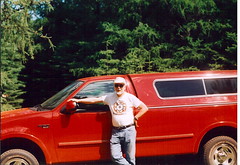
Mel and his pickup truck 2000I do wish my truck had better gas mileage.  Because trucks and SUVs were viewed as tools for many workers Congress exempted them from the fuel economy mandates.  Don’t ask me the reasoning behind the exemption.  Maybe Congress thought the increased cost of achieving the better fuel economy would not offset the reduced fuel costs, or it thought the vehicles would not be powerful enough.

I haven’t followed all the safety standards but one I really appreciated not being in my pre-air bag SUV: automatic seat belts.  I prefer to fasten my seat belt myself, thank you; not be nearly strangled by a seat belt with a mind of its own.

Boy, do they cost a small fortune!  The price for the used SUV was the most that I had ever paid for a vehicle up to that time.  I have less than one year to go on the payments for the pickup, and those payments exceed my tiny pension check from Unisys (my own fault it is tiny).

I disagree strongly about SUVs and pickup trucks blocking the view of drivers behind them.  It is the following drivers’ own fault; they are driving too close.  Remember that sign on semis: If you can’t see my mirrors, I can’t see you.  And there is some fool in a tiny car one car length behind that sign.  The same goes for following an SUV or a pickup truck.  I’ve had people so close behind me that not only can’t I see them in my side mirrors but I can barely see their car roof over my tail gate.

So, if I don’t like the fuel economy and I don’t like the cost, why did I buy these larger vehicles?  Simply, they are tools for me.  I use them to carry things.  I have carried a half-ton in my half-ton pickup many times.

Since we sold the eight-year-old 1952 DeSoto my father-in-law had given us, the largest vehicle we had owned was a Volvo 245 station wagon.  We had gone on vacations with two kids in a Fiat 850 (smaller than a VW Beetle) and Ford Falcons.  We later owned a Fiat 124 sport coupe, two Escorts, a Dodge Colt, and three Volvos (not all at the same time).

But this all changed when we bought property in the Superior National Forest.  Our first contact with the property nearly broke my teeth.  The Oldsmobile a friend was maneuvering down the driveway came to an abrupt halt when the steering assembly hung up on a big rock.  Between that rock and the probability that we would have to drive an unplowed drive and road, we decided we needed a four-wheel, high clearance vehicle.  Our choice was a used Jeep Cherokee Sport.  “Sport” meant among other things that it had a skid plate on the bottom.  And we did clear that rock and we did get into an unplowed drive.

We kept the Jeep for four years and 90,000 miles but its maintenance costs were getting out of line.  We also were often filling it to capacity for our trips to our cabin.  And I didn’t like all that stuff sitting right behind our heads.  We started looking at pickup trucks.

I thought a Ford F-150 would be great but my wife thought it was “overkill” in size.  When we found a dealer who give us a decent price for our Jeep, we took a Ranger for a test drive.  I couldn’t see the top of the speedometer and turned around before I even left the lot.  We wound up driving off as the proud owners of a 1997 F-150 XLT with more doodads than we ever dreamed of having.

The F-150 has been the most useful and reliable vehicle we have owned.  Four years and 60,000 miles later people think it is new.  I can count on one hand the number of unexpected repairs we have had and we were able to drive to the shop for all of those.  Yeah, I know most modern cars are just as reliable (aren’t we glad they don’t build them like they used to).  But most cars don’t carry as much.

I have carried 14-foot boards without worrying about dropping them on the road.  I have carried half-ton loads of an old wall to the dump and half-ton loads of blocks to rebuild the wall.  I have moved a good portion of our goods from our former house in Plymouth to our current house in Duluth.  I carry most of my tools from house to cabin and back, plus our food, clothing, books, and any needed building materials.  And I don’t worry about the load hitting me in the back of the head.

Last month I carried half-ton loads of cement for a sauna, the last 100 feet was over rocks.  Between the low-range of the four-wheel drive and the high clearance, I had no problem getting to where we would mix the cement.  I would not have been very happy carrying 80-pound bags that distance, even in a cart.

As a bonus, I have pulled vehicles out of ditches and mud, including another pickup truck.

However, the best thing about it is that I can get into it without folding myself in half and I can wear a hat without the bill bumping the top of the windshield (and I’m of average height).

Nevertheless, I drive my wife’s Dodge Stratus on errands around town or on long trips because of the better gas mileage.  My pickup truck is a godsend for sixty pieces of lumber, but it is definitely “overkill” for six bags of groceries.

P.S. August 19, 2007, my F-150 now has 112,000 miles, is a bit slower, and people still think it is new.  However, I just spent $800 to have hidden rusty areas on the doors and back panels repaired.  That cost beats making payments for a new vehicle.  I drive it much less now because I carry big loads less often.  We now drive my wife's 70,000 mile 2002 Prius whenever we don't take a bus.  In fact I drive my truck so little that I have to get the oil changed at three months well before I've driven it another 3,000 miles.

©2000, 2007 Melvyn D. Magree

Well, the truck is long gone.  I traded it in for a used 2008 Trailblazer.  I bought the Trailblazer at a Chevy dealer from the same salesman (Dean Melbostad, now retired) who sold my the F-150 at a Ford dealer which had since gone out of business.  I did see the buyer at the Post Office and he was pleased.

And now the Trailblazer is gone.  I traded it in for a leased Toyota RAV4.  The RAV4 has more gizmos than I ever dreamed of for the Trailblazer.  The only fault I find with it is that the dial speedometer is hard to read with the headlights on, a practice I have had since I lived in Sweden.  "Headlights on for safety."

Sunday, October 20, 2013

Efficiency is not dependent on organizational form

I emailed the following to the Reader Weekly 2013-10-10.  They published it on 2013-10-17 as "People make mistakes!  All the time.  Everyday."  It is also available at http://duluthreader.com/articles/2013/10/17/2270_party_of_one-1.

Some people are using the glitches in the Affordable Care Act exchanges as proof that government is inefficient.  Duh, how often have you updated software on your devices with version x.0 and then within a week or two received a notice of the release of version x.0.1?

Government is run by people.  Corporations are run by people.  People make mistakes!  All the time.  Everyday.  In every way.  Government screws up.  Corporations screw up.

For examples of corporate screw-ups and non-response to customer complaints, take a look at the customer “support” message boards.  All the support comes from other customers who spent hours trying to figure out how a product really worked.  If they are lucky, other users mark their responses as helpful and they get “points”, whatever those are worth.

I’ve seen some issues go on for two or more years.

Let me give you a short summary of some customer service issues I’ve had this year.

I think it was late spring when we had several days of windy, rainy weather.  Our DSL service was erratic.  It would be slow then normal then nothing at all.  The DSL light on our modem would go out.  I called CenturyLink and spoke with a tech in Idaho.  She said that our service had been throttled back from the nominal 7Mbps to 3Mbps.  She did some resetting and things were better.

The bad weather continued and our DSL service became erratic again.  I made a call and sent some emails, but this time I was told that it was my modem and that I should buy a new modem.  I checked online for the current CenturyLink modem, and guess what!  One customer had left a message that he bought that new modem and was having the exact same problems as we were!  Two months before my search!

I didn’t buy a modem and a few weeks later our modem was doing just fine.  Our service now runs about 6Mbps.  Could it be that CenturyLink had some line problems that customer support was not told about?

I bought a solar light for the outhouse at our cabin.  It worked fine and then it would not turn on until it had been off for about an hour.  I sent email to the customer support and received back a request for my address, phone number, date of purchase, and a scanned copy of the receipt.  I said “Phooey” and figured out that I had drained the batteries by leaving the light on.  Replacing the batteries improved the performance.  It looks like the first line of customer support is only screeners who have no access to problems and solutions.  Now this dumb customer left the light on again and it wouldn’t turn on again.

We replaced our cabin landline with a wireless home phone base.  The answering machine now gave a time an hour later than the time of call.  Consumer Cellular replied it was my answering machine.  With a bit of web searching, I found out that the wireless home phone base is passing the wrong information and that a firmware upgrade fixes the problem.  The upgrade is available only from the original manufacturer and only can be installed with Windows software.  When I relayed this information back to Consumer Cellular, they replied they could not help me and implied it wasn’t even their responsibility!  This from a company that is rated highly in customer service.

The keyboard and keypad on my laptop would not respond.  I tried the various reset tricks from Apple support boards but none worked for long.  I took my laptop back to Best Buy where I bought it, but everything worked fine for the Geek Squad.  It worked fine for a while at home and then… “Dead” again.  I figured out that it was Microsoft Outlook that I always have on that was the problem.  The techs had closed all my apps before their tests.  I reorganized Outlook's database and the keyboard has been working fine since.  If only I could make the fingers hitting the keys work as well!

But we should also look on the bright side.  Corporations have done a great job of making our cars more reliable and comfortable.  If we take some reasonable precautions they start every time and get us where we want to go safely.  We have all kinds of extras that weren’t on my first car, a 1940 Chevy.  Turn signals, windshield washers, side view mirrors, power steering, power brakes, anti-skid, ABS, air-conditioning, and accurate speedometers.

Ah! Accurate speedometers!  I had a 1969 Fiat that said I was going 70mph when I was actually going 63.  I had a Ford Escort that said I was going 55mph when I was actually going 47 mph!  The Ford dealer blamed it on the tires and wouldn’t do anything about it.  I found it was a wide-spread problem; when I compensated for the error I passed many Ford Escorts driving well under the speed limit.

If the dealer was right about the problem, the tires would have to be about 15 percent smaller than “standard” to have that speed disparity.  For a tire that was about two feet in diameter, that would work out to over an inch of tread wear.  The grooves on a auto tire are not even that deep!  What was it that Adam Smith said?  “Those who live by profit deceive and oppress the public.”

In the favor of those who live by profit, our latest cars do much better on speedometer accuracy – 30 mph on the speedometer at 30 mph and 71 mph at 70 mph! Oh, and we have one domestic car and one foreign car.

Sunday, November 18, 2012

A couple bumper stickers I'd like to see

You've probably seen the bumper sticker "Start seeing motorcycles".  When I see these, I wonder if the drivers of these cars are seeing pedestrians.  Some are, some aren't.  Regardless, I'd like to see the bumper sticker:
Start seeing pedestrians!
Just last week, the light for traffic going in my direction and the pedestrian light went on at the same time.  A driver in a pickup truck who wanted to turn right looked to his left and proceeded to turn right without ever looking my way.  I hollered, "Watch for pedestrians" and he stopped momentarily and then proceeded.  I hope my message got to him.

I have a good idea of the accuracy of our vehicles and speedometers.  I do my best to drive at the speed limit, but others don't.  On freeways many go whizzing by at five or ten miles over the limit.  On city streets with 30 mph I've had a backup behind me.  So, the bumper sticker I'd like to see is
What part of speed limit don't you understand?

Thursday, March 04, 2010

I'm glad they don't build them like they used to

People often complain about the quality of cars, even before Toyota's fiasco. However, few stop to think how much more reliable and long-lasting cars are. One of the many features that is more reliable is the speedometer. We have had several cars in the last two decades that have had much more accurate speedometers than previous cars.

In the late 70s when the 55mph limit was opposed, many people gamed the system because a few court cases ruled that a driver could not be ticketed for going less than 10mph over the limit. I regularly drove my Fiat 124 Sport Coupe between southeastern Pennsylania and New York City at 70mph. Oops! That's 15mph over the limit. Not really, my actual speed was 63mph. I went right by at least one patrol car parked under a bridge while my CB crackled with a warning that there was a smokey under that bridge. It was also fun to watch those who had previously passed me slow down to less than I had been going.

When we bought our first Ford Escort I couldn't understand why so many people were passing me when I was going 55mph. I took a few measurements and discovered that I was actually going 47mph!! The dealer wouldn't do anything about it, making some noise about tire wear, blah, blah. Tire wear on a new car?? Once I began driving a true 55mph, I passed a lot of Escorts driving much slower than I was. I guess the Escorts were wearing their tires out within a few miles of the dealers.

The 1997 Ford F-150 I bought later had a much more accurate speedometer. I think it was correct within one mph at highway speeds. It did fairly well at lower speeds; I went past many a radar sign registering 30mph just like my speedometer.

Our 2002 Prius is just about as accurate.

On a recent trip we timed our Chevy Trailblazer at 70mph on a six-mile stretch of I-35W. If our speed was exactly 70mph we would have covered the six miles in 308.57 seconds. We covered the distance in 308.9 seconds, and so our speed was 69.926mph.

Of course, our measurements weren't that close because of reaction time, plus it is difficult to set cruise control right on the line on the speedometer. I think I had it slightly under, but I couldn't be positive without reading glasses.

Even that is damn good. If one were to allow a one percent error, the range of time would be slightly outside 306 to 312 seconds. That is a whole lot better than the 17 percent error of the Ford Escort or the 10 percent error of the Fiat 124.