Imagine this! You go into a store to purchase something. When it comes time to pay you whip out, not your credit card but your cell phone. The merchant gives you a number, you call PayPal, enter the amount of the purchase and the number the merchant gave you. A moment later the merchant receives a notice on his or her computer that the payment has been made. The merchant wraps your purchase and thanks you for your business.
Far-fetched? No, it is technologically feasible and has been implemented in many parts of the world, see "Mobile Payments". The above scenario is a four-step process. The purchaser calls his or her financial institution. That company approves the sale and calls the merchant's financial institution transferring the money. That company sends a message to the merchant's computer. The merchant sees the message and completes the sale.
Apple has this down to a three-step process for iTunes and PayPal has it down to a seven-step process. I would guess that Apple trusts most of its iTunes users and eliminates the approval process. See "From Credit Card to PayPal: 3 Ways to Move Money", Wired, February 2010. See also the main article, "The Future of Money: It's Flexible, Frictionless and (Almost) Free".
To think that Congress passed an enormous bill to rein in the reign of the credit card companies. It could have passed a one-page bill to authorize Federal agencies, including the IRS to accept payments through PayPal.
True capitalists should welcome this creative destruction, which really is the basis for innovation, not behemoth near monopolies. For more on creative destruction, see Wikipedia: http://en.wikipedia.org/wiki/Creative_destruction
Monday, February 22, 2010
Saturday, February 20, 2010
Please pay your bill on receipt
Or if you prefer, you can pay for this column as soon as you read it and receive a five-percent discount.
This little entry was triggered by a wonderful spoof of the health care system by Nicholas Kristof, "I Cost More, but I'm a Specialist", New York Times, 2010-02-20. He writes that "We Americans have the greatest news care system in the world…" His bill for our reading his column is $1,681.63.
He also has a link to another spoof, "If Air Travel Worked Like Health Care", Jonathan Rauch, National Journal, 2009-09-26.
Since I'm only 1/100th as good as Nicholas Kristof, my bill for your reading this column is $16.82. I'm sorry but we do not accept credit cards nor do we bill your news insurance provider.
This little entry was triggered by a wonderful spoof of the health care system by Nicholas Kristof, "I Cost More, but I'm a Specialist", New York Times, 2010-02-20. He writes that "We Americans have the greatest news care system in the world…" His bill for our reading his column is $1,681.63.
He also has a link to another spoof, "If Air Travel Worked Like Health Care", Jonathan Rauch, National Journal, 2009-09-26.
Since I'm only 1/100th as good as Nicholas Kristof, my bill for your reading this column is $16.82. I'm sorry but we do not accept credit cards nor do we bill your news insurance provider.


Friday, February 19, 2010
Report spoof email as often as you can
It seems that every day I get some spam that intimates that it is from a major corporation and that my account has been compromised. I report almost every one of these to the spoofed corporation (if I've found an email address for such) as well as to the Federal Trade Commission (spam@uce.gov) and the Anti-Phishing Working Group (reportphishing@antiphishing.org).
Sometimes it is hard to find an email address for a spoofed company. Somewhere on a home page or a help page you might find a link to spam, spoof, phishing, fraud, or security.
You might think that it is a bit of work to report spoofing, but consider it like calling the police when you see suspicious activity around a neighbor's house. Consider also this statement that I received from PayPal after reporting a phishing message:
Every email counts. When you forward suspicious-looking emails to
spoof@paypal.com, you help keep yourself and others safe from identity
theft.
See also my blog entry Phishing against which bank this week?
Sometimes it is hard to find an email address for a spoofed company. Somewhere on a home page or a help page you might find a link to spam, spoof, phishing, fraud, or security.
You might think that it is a bit of work to report spoofing, but consider it like calling the police when you see suspicious activity around a neighbor's house. Consider also this statement that I received from PayPal after reporting a phishing message:
Every email counts. When you forward suspicious-looking emails to
spoof@paypal.com, you help keep yourself and others safe from identity
theft.
See also my blog entry Phishing against which bank this week?
Thursday, February 18, 2010
One of those days
We skied a lot today at Bridger Bowl. Not as much as many other people, but far more than we would have done at Spirit Mountain in Duluth. The sore thighs I was developing in the afternoon are no longer bothersome, but getting motivated to do anything is "bothersome".
I should answer my brother's email, I should practice singing, I should write some more meaningful blog entries, I should… Maybe I should go to bed, but 8:00 just seems too early.
One of the minor interesting things is mentally adjusting clocks. I reset my watch to Mountain Standard Time, but I didn't reset our car clock. I reset my iPod to MST but not my computer. Then my iPod's alarm goes off an hour early in the morning. It's back on Central Standard Time!!!
Ah ha! I synchronized my iPod with my Mac and that changed the iPod time again. So now I've set the Mac to automatically adjust the time to its location.
I suppose I should reset my camera clock also, but will the exact time matter on the photos?
Tomorrow is our last big day of skiing. I hope I have enough energy for the half-hour drive back to Bozeman. And enough energy to write emails, to sing, and to write a meaningful blog or two.
I should answer my brother's email, I should practice singing, I should write some more meaningful blog entries, I should… Maybe I should go to bed, but 8:00 just seems too early.
One of the minor interesting things is mentally adjusting clocks. I reset my watch to Mountain Standard Time, but I didn't reset our car clock. I reset my iPod to MST but not my computer. Then my iPod's alarm goes off an hour early in the morning. It's back on Central Standard Time!!!
Ah ha! I synchronized my iPod with my Mac and that changed the iPod time again. So now I've set the Mac to automatically adjust the time to its location.
I suppose I should reset my camera clock also, but will the exact time matter on the photos?
Tomorrow is our last big day of skiing. I hope I have enough energy for the half-hour drive back to Bozeman. And enough energy to write emails, to sing, and to write a meaningful blog or two.
Tuesday, February 16, 2010
Avalanche!
We are now in Bozeman MT while skiing at Bridger Bowl as part of the annual Ski Hut trip.
This morning I had a lesson and my wife chose to stay in town. After the lesson I stopped at a mid=slope chalet for coffee and then went up for another run. I was so tired that I decided to ski back down to the base, have lunch, and then maybe go out again. This was about 11:30.
Some people in our group said that they had seen an avalanche from the lift and heard that people were in the area. Later Scott Neustel, owner of Ski Hut, came in looking distressed. He was on a nearby ridge when it happened and his group was told to stay put for a bit.
He had managed to take a picture of the avalanche and passed his camera around. Imagine the tree tops reaching to the bottom of an "e" in this text; the top of the avalanche cloud reached to the top of the "e". Some people said the snow was moving at 70-75 mph.
As of 4:43 MST, no one had been reported missing, but stories are circulating about close calls. The authorities are still checking by helicopter and snowmobile.
Anybody taking the lift to the high country is required to take a working transponder. But authorities never can be sure that somebody didn't take another route up.
When I drove back down, almost every turn out had people stopped and looking up at the mountains. I don't know what they could see other than a helicopter circling around.
This morning I had a lesson and my wife chose to stay in town. After the lesson I stopped at a mid=slope chalet for coffee and then went up for another run. I was so tired that I decided to ski back down to the base, have lunch, and then maybe go out again. This was about 11:30.
Some people in our group said that they had seen an avalanche from the lift and heard that people were in the area. Later Scott Neustel, owner of Ski Hut, came in looking distressed. He was on a nearby ridge when it happened and his group was told to stay put for a bit.
He had managed to take a picture of the avalanche and passed his camera around. Imagine the tree tops reaching to the bottom of an "e" in this text; the top of the avalanche cloud reached to the top of the "e". Some people said the snow was moving at 70-75 mph.
As of 4:43 MST, no one had been reported missing, but stories are circulating about close calls. The authorities are still checking by helicopter and snowmobile.
Anybody taking the lift to the high country is required to take a working transponder. But authorities never can be sure that somebody didn't take another route up.
When I drove back down, almost every turn out had people stopped and looking up at the mountains. I don't know what they could see other than a helicopter circling around.
Tuesday, February 09, 2010
The scourge of drunk drivers
Ralph Doty wrote an interesting column in last week's Budgeteer News. I've have often thought about writing something similar but haven't done the research. When we lived in Sweden from 1970 to 1974 I had heard that even a member of Parliament was sentenced to prison for driving drunk.
Ralph's column led me to do a search on
http://publikationswebbutik.vv.se/shopping/ShowItem____3944.aspx
and click on "Ladda när document". This will download "National cooperation against drink and drug driving in traffic according to the Skellefte model" into your computer. The Skellefteå model is a very comprehensive program to combat a very serious problem.
BTW, if you read Swedish, you can also find some documents that relate some really sad stories about the consequences of drunk driving.
Ralph's column led me to do a search on
Sweden "drunk driving" prisongiving over 60,000 references. An answer.com item led me to Vägverket's site (Swedish Highway Administration) and I did a further search to find a relevant document in English. If you want to read it, go to
http://publikationswebbutik.vv.se/shopping/ShowItem____3944.aspx
and click on "Ladda när document". This will download "National cooperation against drink and drug driving in traffic according to the Skellefte model" into your computer. The Skellefteå model is a very comprehensive program to combat a very serious problem.
BTW, if you read Swedish, you can also find some documents that relate some really sad stories about the consequences of drunk driving.
Monday, February 08, 2010
Don't throw out the sports section!!
When we get the Sunday Duluth News Tribune, we separate out the glossy ads, the classifieds, and the sports section and put them into the recycling pile. We've been doing it for years, pausing at the sports section only if there is a human interest story on its front page.
For some reason a week ago I paused and said I should check for the Outdoors section on the last page of the sports section. Goodness, gracious, there was an article about Wes Neustel, former owner of Ski Hut and organizer of the annual Ski Hut trip to Bozeman MT. We know Wes, like thousands of others, and look forward to this trip.
Yesterday, I paused again before tossing the sports section on the recycling pile. On the Outdoors page was an article about Tim Bradach finding locked moose horns near his property in Brimson. Gosh, his and some friends' property is right across the road from ours. And double gosh, on Saturday I was musing on how long it was since we saw any moose tracks on our trails. The moose hadn't disappeared; we just hadn't looked hard enough.
For some reason a week ago I paused and said I should check for the Outdoors section on the last page of the sports section. Goodness, gracious, there was an article about Wes Neustel, former owner of Ski Hut and organizer of the annual Ski Hut trip to Bozeman MT. We know Wes, like thousands of others, and look forward to this trip.
Yesterday, I paused again before tossing the sports section on the recycling pile. On the Outdoors page was an article about Tim Bradach finding locked moose horns near his property in Brimson. Gosh, his and some friends' property is right across the road from ours. And double gosh, on Saturday I was musing on how long it was since we saw any moose tracks on our trails. The moose hadn't disappeared; we just hadn't looked hard enough.
Sunday, February 07, 2010
I tried to cut my leg off
Well, not really, but I came close.
I was cutting stumps flush with the ground. I was working on the last for the day and in a rather awkward kneeling position. I knew that I should be careful and shifted my legs to be farther away from the chain saw.
Then I shifted again and the chain saw came out and caught in the knee of my jeans, ripping a small part. I looked closer and it also ripped the knee of my long johns. I thought I felt a small cut on my knee. I put the saw down and walked into the cabin to look at it.
I pulled down my pants and long johns, and sure enough there was a bloody streak across my knee.
My wife got out the first aid kit, swabbed the cut with an antiseptic wipe, put a gauze pad on the cut and fixed it with adhesive strips, and for good measure she wrapped it all with an elastic bandage.
My knee is not as good as new yet, but I am quite ambulatory. In fact, we went snowshoeing later. Not very far; we had to cut a lot of snow-laden brush bent over the path. Afterwards, the brush cutting made my shoulders hurt more than my knee did. Also the cut knee hurt less than the other knee which has been sore for over a year.
However, as I write this, my cut knee is reminding me that it is damaged. My next step is to take a shower, see how it looks, and have my wife redress it.
Interestingly, I'll be seeing a dermatology nurse practitioner on Tuesday for some other skin problems, some of which are on the cut leg. Will she be surprised!
I was cutting stumps flush with the ground. I was working on the last for the day and in a rather awkward kneeling position. I knew that I should be careful and shifted my legs to be farther away from the chain saw.
Then I shifted again and the chain saw came out and caught in the knee of my jeans, ripping a small part. I looked closer and it also ripped the knee of my long johns. I thought I felt a small cut on my knee. I put the saw down and walked into the cabin to look at it.
I pulled down my pants and long johns, and sure enough there was a bloody streak across my knee.
My wife got out the first aid kit, swabbed the cut with an antiseptic wipe, put a gauze pad on the cut and fixed it with adhesive strips, and for good measure she wrapped it all with an elastic bandage.
My knee is not as good as new yet, but I am quite ambulatory. In fact, we went snowshoeing later. Not very far; we had to cut a lot of snow-laden brush bent over the path. Afterwards, the brush cutting made my shoulders hurt more than my knee did. Also the cut knee hurt less than the other knee which has been sore for over a year.
However, as I write this, my cut knee is reminding me that it is damaged. My next step is to take a shower, see how it looks, and have my wife redress it.
Interestingly, I'll be seeing a dermatology nurse practitioner on Tuesday for some other skin problems, some of which are on the cut leg. Will she be surprised!
Thursday, February 04, 2010
Clever trailer hitch cover
As a pickup passed me the other day, it was hard not to notice the cover on the trailer hitch – a pig riding a motorcycle, a hog on a HOG!
For those not in the know, HOG is a nickname for Harley-Davidson motorcycles. For the origin of the nickname, click here. You'll find in the same article more than you ever thought you wanted to know about the history of Harley-Davidson.
For those not in the know, HOG is a nickname for Harley-Davidson motorcycles. For the origin of the nickname, click here. You'll find in the same article more than you ever thought you wanted to know about the history of Harley-Davidson.
Interesting connections and challenges
Stonyfield Farms, a yoghurt maker, had an offer for "Anticancer, A New Way of Life" by David Servan-Schreiber. I had seen references to the book before and had noted the author's name. When I saw the offer today, I wondered again if the author was related to Jean-Jacques Servan-Schreiber, the author of "Le Defi Americain" ("The American Challenge"). Sure enough, Wikipedia has David as Jean-Jacques' eldest son.
I should reread "Le Defi Americain". The elder Servan-Schrieber was worried about the U.S. swamping Europe economically and culturally. Ironically, his eldest son immigrated to the U.S. And even more ironically, the U.S. is becoming overwhelmed economically by China.
I should reread "Le Defi Americain". The elder Servan-Schrieber was worried about the U.S. swamping Europe economically and culturally. Ironically, his eldest son immigrated to the U.S. And even more ironically, the U.S. is becoming overwhelmed economically by China.
Friday, January 29, 2010
Rhyming with filibuster
Yesterday's Star Tribune had an op-ed article based on Yeats and the current political situation where there seems to be no center. The author asked what rhymes with filibuster.
How about philobluster? Love of bluster. To me, filibuster seems more bluster than substance.
Philobluster is not original with me. I did think of it independently today, but there are nine references on the web.
How about philobluster? Love of bluster. To me, filibuster seems more bluster than substance.
Philobluster is not original with me. I did think of it independently today, but there are nine references on the web.
Wednesday, January 27, 2010
Federal government has no corner on bureaucracy
In December I signed up for online bill pay for our cabin telephone. Last month I received an email that my online bill was ready, I went online and paid it. A few days later I received the paper bill in the mail. This situation was repeated this month
I emailed that phone company about it. The response was, "It takes 2 to 3 billing cycles before you stop receiving paper statements." Maybe I could paraphrase this as, "It takes 2,000 to 3,000 customer suggestions before a company stops wasteful practices."
See also "The Federal Government Has No Corner on Bureaucracy", Reader Weekly, 2008-01-03.
I emailed that phone company about it. The response was, "It takes 2 to 3 billing cycles before you stop receiving paper statements." Maybe I could paraphrase this as, "It takes 2,000 to 3,000 customer suggestions before a company stops wasteful practices."
See also "The Federal Government Has No Corner on Bureaucracy", Reader Weekly, 2008-01-03.
Tuesday, January 26, 2010
We're sorry, Wall Street???
For a marvelous piece of sarcasm, read, "Dear Wall Street, We're sorry" by David Weidner, MarketWatch, 2010-01-26, subtitled "How the Little Guy Ruined Wall Street".
Saturday, January 23, 2010
Quote of the day
Charles M. Blow wrote an interesting commentary in "Mobs Rule", New York Times, 2010-01-22. He wrote that "many see Barack Obama as a left-leaning version of George W. Bush: just another out-of-touch emperor." He concluded with Obama's "agenda will suffer now that the emperor has no cloture."
Thursday, January 21, 2010
Senate seat of the people of Massachusetts?
Scott Brown, the newly elected United States Senator for Massachusetts, called his new position "the people's seat", "G.O.P. Senate Victory Stuns Democrats", New York Times, 2010-01-20. I read somewhere that he called it not a Kennedy seat, not a Democrat seat, but "the seat of the people of Massachusetts".
But how can it be "the seat of the people of Massachusetts" when so much money and time pour into Massachusetts for both candidates? I would say that outsiders determined the vote almost as much as the people who actually voted.
Scott Brown and the Republicans should be careful about congratulating themselves about the election. The turnout was 55 percent of the 4.1 million registered voters. That means that Scott Brown came in second to none of the above: forty-five percent of the registered voters didn't think the election was that important, twenty-eight percent voted for Brown, and twenty-six percent voted for Martha Coakley, and less than one percent actually took the trouble to vote for neither of the two major-party candidates.
Given that many commentators think Brown's 52-47 percent win over Coakley was a strong rebuke of the Democrats, I think they really should look at the 45-28-26 percent "win" for "none of the above" should be looked at as a strong rebuke of the political system in general.
But how can it be "the seat of the people of Massachusetts" when so much money and time pour into Massachusetts for both candidates? I would say that outsiders determined the vote almost as much as the people who actually voted.
Scott Brown and the Republicans should be careful about congratulating themselves about the election. The turnout was 55 percent of the 4.1 million registered voters. That means that Scott Brown came in second to none of the above: forty-five percent of the registered voters didn't think the election was that important, twenty-eight percent voted for Brown, and twenty-six percent voted for Martha Coakley, and less than one percent actually took the trouble to vote for neither of the two major-party candidates.
Given that many commentators think Brown's 52-47 percent win over Coakley was a strong rebuke of the Democrats, I think they really should look at the 45-28-26 percent "win" for "none of the above" should be looked at as a strong rebuke of the political system in general.
Fighting back on the overturning of corporate campaign spending
The Supreme Court overturned precedent about granting "political speech" to corporations, unions, and other organizations, "Justices Overturn Key Campaign Limits", New York Times, 2010-01-21.
I find it very interesting that the "conservatives" who were appointed by presidents from a party that proclaims it is for individual liberty gives greater liberty to corporate interests.
We can't do much about various groups promoting or panning candidates, especially candidates for whom few of the members of the group can vote. But we can refuse to vote for candidates who accept contributions from groups or from people who have no right to vote for that candidate. And we can let them know why we won't vote for them.
Too often we as a people make voting an either/or proposition; we must vote for one of the major party candidates or we will be "throwing our vote away". It is way past time to stand up and be counted in a different way.
If any candidate for whom you might vote accepts contributions from those who can't vote for him or her, write and tell that candidate that you will vote for somebody else or leave that spot on the ballot blank. Maybe you will make no difference for an election cycle or two, but we have to start someplace. If you tell your friends and relatives what you did, if you write letters to the editor about what you did, maybe, just maybe the idea will catch on.
If you vote for the same old, same old, is it really democracy? Real democracy starts with individuals making their voices heard, not with sheep following the herd.
I find it very interesting that the "conservatives" who were appointed by presidents from a party that proclaims it is for individual liberty gives greater liberty to corporate interests.
We can't do much about various groups promoting or panning candidates, especially candidates for whom few of the members of the group can vote. But we can refuse to vote for candidates who accept contributions from groups or from people who have no right to vote for that candidate. And we can let them know why we won't vote for them.
Too often we as a people make voting an either/or proposition; we must vote for one of the major party candidates or we will be "throwing our vote away". It is way past time to stand up and be counted in a different way.
If any candidate for whom you might vote accepts contributions from those who can't vote for him or her, write and tell that candidate that you will vote for somebody else or leave that spot on the ballot blank. Maybe you will make no difference for an election cycle or two, but we have to start someplace. If you tell your friends and relatives what you did, if you write letters to the editor about what you did, maybe, just maybe the idea will catch on.
If you vote for the same old, same old, is it really democracy? Real democracy starts with individuals making their voices heard, not with sheep following the herd.
Tuesday, January 19, 2010
I wish I had written that about taxes
Myles Spicer had a good op-ed piece about taxes in today's Star Tribune, see http://www.startribune.com/opinion/commentary/81999627.html
He dispels many of the myths about high taxes including businesses moving because of taxes, the relative rate of U.S. taxes to other countries and of Minnesota taxes to other states, the efficiency of government, and the effect on economic growth.
Although he too doesn't like taxes, he appreciates the things that taxes provide.
He dispels many of the myths about high taxes including businesses moving because of taxes, the relative rate of U.S. taxes to other countries and of Minnesota taxes to other states, the efficiency of government, and the effect on economic growth.
Although he too doesn't like taxes, he appreciates the things that taxes provide.
He made my day!
Morgan Freeman is quoted in the January/February AARP Magazine as wanting to be like Clint Eastwood when Freeman grows up.
Sunday, January 17, 2010
Guess who is a capitalist?
Many in the calamitist side of "liberals" decry capitalism as if it were some evil force out to destroy the world.*
Is this so-called capitalism really capitalism or is it management hi-jacking a company? Upper management controls the company even though they have no or few shares in the company. They appoint other corporate managers to serve on their boards. Then they grant themselves and the board members shares in the company, or at a minimum give them a well-below market price for the shares.
Have you thought that your neighbors may be the real capitalists? What about the people that do lawn-mowing for a living? Nobody is going to cut grass with a pair of shears on their hands and knees. Nobody is going to cut grass with a scythe (I saw this being done in Budapest in 1974). Few are going to cut grass with a push mower. Anybody cutting grass as a job is going to have a power mower or two or three. Having a power mower requires capital.
Because few could make a living mowing grass within walking distance of their home, they will need a truck to haul their mower around. Having a truck requires capital.
Some jobs will require different kinds of mower. More capital for more mowers and more capital for a trailer to haul several mowers. Oh, yes, mowers need gasoline. Capital buys gasoline.
In northern climes snow covers grass part of the year. To keep cash flow going, our lawn-mowing capitalists have to also clear snow. The equipment to clear snow requires capital.
Capitalism permeates many trades: carpenters, plumbers, and electricians. These tradespeople generally don't work for large corporations, but themselves, their families, or small companies. They need capital for their tools and materials.
Capitalism is part of all small businesses - the coffee shops, the restaurants, the shoe repair shops, the web designers, the free lance programmers, the free lance photographers, the small farmers, …
If we didn't have individuals practicing capitalism, who would create innovative stuff? Would we have Steve Jobs and Steve Wozniak creating new computers in a garage? Would we have Bill Gates selling his BASIC? Selling software!!?? How uncooperative!! Would we have Earl Bakken creating Medtronic? We can't wait for government or for large corporations to do these things.
The next time somebody criticizes "Capitalism" ask them to explain what they mean. Ask them how an individual can start a business without capital. If an individual starts a business, is that a bad thing because that individual is a capitalist?
* For more on "calamitists" see Climate change and so-called bipartisanship.
Is this so-called capitalism really capitalism or is it management hi-jacking a company? Upper management controls the company even though they have no or few shares in the company. They appoint other corporate managers to serve on their boards. Then they grant themselves and the board members shares in the company, or at a minimum give them a well-below market price for the shares.
Have you thought that your neighbors may be the real capitalists? What about the people that do lawn-mowing for a living? Nobody is going to cut grass with a pair of shears on their hands and knees. Nobody is going to cut grass with a scythe (I saw this being done in Budapest in 1974). Few are going to cut grass with a push mower. Anybody cutting grass as a job is going to have a power mower or two or three. Having a power mower requires capital.
Because few could make a living mowing grass within walking distance of their home, they will need a truck to haul their mower around. Having a truck requires capital.
Some jobs will require different kinds of mower. More capital for more mowers and more capital for a trailer to haul several mowers. Oh, yes, mowers need gasoline. Capital buys gasoline.
In northern climes snow covers grass part of the year. To keep cash flow going, our lawn-mowing capitalists have to also clear snow. The equipment to clear snow requires capital.
Capitalism permeates many trades: carpenters, plumbers, and electricians. These tradespeople generally don't work for large corporations, but themselves, their families, or small companies. They need capital for their tools and materials.
Capitalism is part of all small businesses - the coffee shops, the restaurants, the shoe repair shops, the web designers, the free lance programmers, the free lance photographers, the small farmers, …
If we didn't have individuals practicing capitalism, who would create innovative stuff? Would we have Steve Jobs and Steve Wozniak creating new computers in a garage? Would we have Bill Gates selling his BASIC? Selling software!!?? How uncooperative!! Would we have Earl Bakken creating Medtronic? We can't wait for government or for large corporations to do these things.
The next time somebody criticizes "Capitalism" ask them to explain what they mean. Ask them how an individual can start a business without capital. If an individual starts a business, is that a bad thing because that individual is a capitalist?
* For more on "calamitists" see Climate change and so-called bipartisanship.
Wednesday, January 13, 2010
Haiti Disaster Relief: How to Contribute
The New York Times has assembled a list of agencies that are helping in the relief effort for Haiti. It is at http://thelede.blogs.nytimes.com/2010/01/13/haiti-disaster-relief-how-to-contribute/
It includes online and postal addresses.
It includes online and postal addresses.
Tuesday, January 12, 2010
Cutting health care costs, one economist's view
The "Naked Economist", Charles Wheelan, bared his soul and writings to the slings and arrows of his critics with "Here's how we can cut health care costs" published on Yahoo! Finance, 2010-01-11
The bureaucracy doesn't want the truth
Whether it's a government or a corporate bureaucracy, it sometimes doesn't want the truth, but the "right" answer.
I've put myself in this bind because of some passwords or secret question answers I've created. Rather than creating a "true" answer, I've created misleading answers. So if I'm asked a secret question, I can't give the true answer, I may only give the right answer, which I may have forgotten!!
For more on this, see "The True Answer and The Right Answer", Stanley Fish, New York Times, 2010-01-11.
I've put myself in this bind because of some passwords or secret question answers I've created. Rather than creating a "true" answer, I've created misleading answers. So if I'm asked a secret question, I can't give the true answer, I may only give the right answer, which I may have forgotten!!
For more on this, see "The True Answer and The Right Answer", Stanley Fish, New York Times, 2010-01-11.
They sang better than I would
Yesterday I led the first session of the University for Seniors study group "Singing for the Singing-Impaired". Well, none of the participants were singing-impaired and certainly none were shy.
Too boot, I still had a bad cough and could only get through the first two or three songs.
I used a computer-driven, MIDI-played, and video displayed words and notes, a cappella "call and response", and YouTube.
If you're still thinking about joining us, we sang "Happy Birthday", "I knew an old lady", "Do Re Mi" from "Sound of Music", "Dough, the stuff I need to buy beer", "Auld Lang Syne", "Yankee Doodle", "Aura Lee" and its reincarnation "Love Me Tender", "This Land is Your Land", "Clementine", "Pop Goes the Weasel", and "We Shall Overcome".
All that signed-up but two showed up. We'll see how many return next week. We still could use more lower voices.
For more about the study group, see "Are you timid about singing?"
Too boot, I still had a bad cough and could only get through the first two or three songs.
I used a computer-driven, MIDI-played, and video displayed words and notes, a cappella "call and response", and YouTube.
If you're still thinking about joining us, we sang "Happy Birthday", "I knew an old lady", "Do Re Mi" from "Sound of Music", "Dough, the stuff I need to buy beer", "Auld Lang Syne", "Yankee Doodle", "Aura Lee" and its reincarnation "Love Me Tender", "This Land is Your Land", "Clementine", "Pop Goes the Weasel", and "We Shall Overcome".
All that signed-up but two showed up. We'll see how many return next week. We still could use more lower voices.
For more about the study group, see "Are you timid about singing?"
Why do I go to the fitness center?
I go so I have energy to shovel snow.
Why do I stop shoveling snow? So I have energy to go to the fitness center.
Why do I stop shoveling snow? So I have energy to go to the fitness center.
Sunday, January 10, 2010
Are you timid about singing?
While I was sitting in church I thought that I should put an announcement about the study group I'll be leading, “Singing for the Singing-impaired”, in the University for Seniors announcements. Maybe because it was Poetry Sunday I started thinking in verse. Then it was announced that poems were welcome from those not on the program. I read mine, and surprise, I received applause as well as laughter.
For more information, call 218-726-7637 or email cschweig@d.umn.edu
When singing begins in the house,Singing for the Singing-Impaired, Mondays 1:00 p.m. Except January 18, University for Seniors, University of Minnesota, Duluth, KPlz 303. Basses especially welcome.
Do you want to hide like a mouse?
When songs ring out in a bar,
Do you try to be afar?
When voices raise in a house of worship,
Do you look for ways out the door to slip?
You need fear no more,
Singing is no chore!
Join Singing for the Singing-Impaired;
You will be very glad that you dared!
And if you voice is lower,
You will help our group flower.
For more information, call 218-726-7637 or email cschweig@d.umn.edu
Friday, January 08, 2010
A dietary conundrum
A saying is "Waste not, want not", but often the truth is "To waist is to want more".
Mindful relaxation
As we drove to our cabin today, we listened to a "To the best of our knowledge" podcast on the mind. One of the points was letting the right hemisphere take over and live in the present moment.
We realized as we drove through the frosted evergreens that we were living in the ride rather than anticipating our arrival at the cabin.
Once we got there, we did a number of chores to get a fire going, unloading the SUV, having some hot chocolate, and preparing for a sauna. Again, we were mostly living in the moment.
When we finally got in the sauna, we let our minds float and thought only of our breath. Of course, after a while we started feeling the sweat and the giddiness of not taking saunas enough.
Back in the cabin, it was eat and drink slowly and just savor being here.
Now I've ruined that feeling by writing this:) I was going to end this entry with the preceding sentence, but then my wife sighed, "You've made it into a task!"
We realized as we drove through the frosted evergreens that we were living in the ride rather than anticipating our arrival at the cabin.
Once we got there, we did a number of chores to get a fire going, unloading the SUV, having some hot chocolate, and preparing for a sauna. Again, we were mostly living in the moment.
When we finally got in the sauna, we let our minds float and thought only of our breath. Of course, after a while we started feeling the sweat and the giddiness of not taking saunas enough.
Back in the cabin, it was eat and drink slowly and just savor being here.
Now I've ruined that feeling by writing this:) I was going to end this entry with the preceding sentence, but then my wife sighed, "You've made it into a task!"
Teaching: putting in or drawing out?
"A teaching artist is an artist who actively engages learners in consciously developing the aesthetics of their own processes of learning."
- Arnold Aprill, Chicago Arts Participation in Education (CAPE)
Quoted in "The Music Teaching Artist's Bible: Becoming a Virtuoso Educator", Eric Booth, p. 16.
See the same section for other incisive quotes on what a teaching artist is.
When I read the above to my wife, she said that's what most teachers strive for. I replied that that's not what politicians want. She replied, "Unfortunately!"
One of the other quotes mentioned education as drawing out rather than putting in. It was this idea that led me to make the remark about politicians. "No child left behind" rewards schools for "putting in" and makes no provision for drawing out.
- Arnold Aprill, Chicago Arts Participation in Education (CAPE)
Quoted in "The Music Teaching Artist's Bible: Becoming a Virtuoso Educator", Eric Booth, p. 16.
See the same section for other incisive quotes on what a teaching artist is.
When I read the above to my wife, she said that's what most teachers strive for. I replied that that's not what politicians want. She replied, "Unfortunately!"
One of the other quotes mentioned education as drawing out rather than putting in. It was this idea that led me to make the remark about politicians. "No child left behind" rewards schools for "putting in" and makes no provision for drawing out.
Tuesday, January 05, 2010
Who wished us an unhappy new year?
For me, 2009 ended with a whimper! Me whimpering as a developing cold sufferer.
My cold made itself known after supper and by bedtime (yes, 10 on New Year's Eve) I was wondering if my coughing would keep both of us awake. I did manage to stay asleep until one and woke every hour or so after that.
There went our three-day weekend at our cabin. No way did I want to keep my wife awake with the shaking of the smaller bed every time I coughed. And there was no escape to another room to muffle the worst of my coughing.
2009 also ended with a whimper in that my wife's car wouldn't start. We did jump start it and she ran an errand or two. But then it died again. Jump starting a Prius is not much fun because the battery is buried under a bolted-down cover.
On Saturday when I was feeling better we did go shopping, including for a battery charger.
As you can see from "Stopped in our tracks" Sunday was better.
But Monday was downhill again. On the first of several errands, somebody noticed that the spare tire was hanging wrong. Oh, boy, back home right away. I read the manual about accessing the spare, but nothing seemed to work to raise it or lower it. I tried three times, coming in when my fingers got cold. The third time, I called the dealer for a service appointment for Tuesday, today. But by the time I called I was sick again with cold. It took to bedtime for me to feel half-way decent again.
Of course, I was sick with worry a good part of the night figuring out how I would get to dealer without the spare tire falling all the way down and doing who knows what damage.
Before the appointment I hooked a nylon tow cable to the wheel of the spare and wrapped and wrapped the tow cable around the trailer hitch. For extra security, I wrapped and hooked a bungee cord on top of the cable.
I drove normally to the dealer but I kept hearing a ping. When I pulled into the service area I saw my securing of the cable had worked fine. But the hook came out of the spare tire wheel and was dragging on the ground!! At least the spare tire wasn't scraping on the ground.
For $33.68 I was told that the tire had been stowed upside down. Having somebody else stow it correctly in a warm place was worth it.
Tomorrow we jump start my wife's car and she takes it to a dealer to have the battery checked.
Maybe then we can start a normal new year? Whatever normal is.
My cold made itself known after supper and by bedtime (yes, 10 on New Year's Eve) I was wondering if my coughing would keep both of us awake. I did manage to stay asleep until one and woke every hour or so after that.
There went our three-day weekend at our cabin. No way did I want to keep my wife awake with the shaking of the smaller bed every time I coughed. And there was no escape to another room to muffle the worst of my coughing.
2009 also ended with a whimper in that my wife's car wouldn't start. We did jump start it and she ran an errand or two. But then it died again. Jump starting a Prius is not much fun because the battery is buried under a bolted-down cover.
On Saturday when I was feeling better we did go shopping, including for a battery charger.
As you can see from "Stopped in our tracks" Sunday was better.
But Monday was downhill again. On the first of several errands, somebody noticed that the spare tire was hanging wrong. Oh, boy, back home right away. I read the manual about accessing the spare, but nothing seemed to work to raise it or lower it. I tried three times, coming in when my fingers got cold. The third time, I called the dealer for a service appointment for Tuesday, today. But by the time I called I was sick again with cold. It took to bedtime for me to feel half-way decent again.
Of course, I was sick with worry a good part of the night figuring out how I would get to dealer without the spare tire falling all the way down and doing who knows what damage.
Before the appointment I hooked a nylon tow cable to the wheel of the spare and wrapped and wrapped the tow cable around the trailer hitch. For extra security, I wrapped and hooked a bungee cord on top of the cable.
I drove normally to the dealer but I kept hearing a ping. When I pulled into the service area I saw my securing of the cable had worked fine. But the hook came out of the spare tire wheel and was dragging on the ground!! At least the spare tire wasn't scraping on the ground.
For $33.68 I was told that the tire had been stowed upside down. Having somebody else stow it correctly in a warm place was worth it.
Tomorrow we jump start my wife's car and she takes it to a dealer to have the battery checked.
Maybe then we can start a normal new year? Whatever normal is.
Sunday, January 03, 2010
Stopped in our tracks
Today we visited our cabin for the second time since the December snowstorm, but only today did we have time to go snowshoeing. We didn't get far before we were blocked by twenty feet of bent over alder.
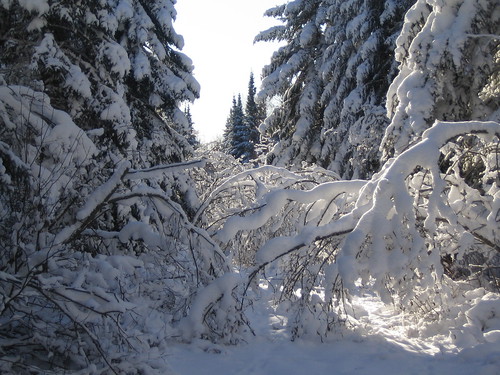
We did manage to get through by shaking the snow off the branches and zig-zagging our way through.
Next time I'll have to remember big nippers and a pruning saw.
What this photo doesn't show is how blue the sky was.
We did manage to get through by shaking the snow off the branches and zig-zagging our way through.
Next time I'll have to remember big nippers and a pruning saw.
What this photo doesn't show is how blue the sky was.
Did the "surge" in Iraq keep the tigers away too?
Sometime ago I wrote a blog or an article about how people connect actions to results without careful examinations of the relationship. Keeping the tigers away is a reference to a hippie sitting on a park bench snapping his fingers to keep the tigers away.
Reading "The War Within" by Bob Woodword I got a good sense of how the "surge" in Iraq was not a major factor in an improvement. The major factor was appointing General David Petraeus as commander in Iraq (pp. 335-337).
Petraeus assembled his own team to evaluate the situation. It included Colonel H.R. McMaster who led the Tall Afar campaign, the only apparent successful clear, hold, and rebuild campaign, and Derek Harvey of the Defense Intelligence Agency, one of the few people who had gone out and spoken, in Arabic, with many of the factions in Iraq. His team went out all over Iraq to assess the situation and find out what was really going on. Petraeus himself went out into the streets to see what had been happening; he was appalled at the "ghost towns" of once prosperous sections.
Now Petraeus is in charge of both Afghanistan and Iraq. Will he bring about lasting change in either?
Reading "The War Within" by Bob Woodword I got a good sense of how the "surge" in Iraq was not a major factor in an improvement. The major factor was appointing General David Petraeus as commander in Iraq (pp. 335-337).
Petraeus assembled his own team to evaluate the situation. It included Colonel H.R. McMaster who led the Tall Afar campaign, the only apparent successful clear, hold, and rebuild campaign, and Derek Harvey of the Defense Intelligence Agency, one of the few people who had gone out and spoken, in Arabic, with many of the factions in Iraq. His team went out all over Iraq to assess the situation and find out what was really going on. Petraeus himself went out into the streets to see what had been happening; he was appalled at the "ghost towns" of once prosperous sections.
Now Petraeus is in charge of both Afghanistan and Iraq. Will he bring about lasting change in either?
Wednesday, December 30, 2009
A prime example of the stupidity of war
You won't get through this with dry eyes: "A Mideast Bond, Stitched of Pain and Healing", Ethan Bronner, New York Times, 2009-12-30.
Contradictory parental advice
As I was walking gingerly on slippery, bumpy, ice-and-snow-covered sidewalks, carefully watching where I stepped, slouched over so that I saw the surface only a few feet in front of me, I thought of the parental advice, "Watch where you walk!"
But as I was slouched over, I also thought of the parental advice, "Stand up straight!"
Momma, make up your mind!
But as I was slouched over, I also thought of the parental advice, "Stand up straight!"
Momma, make up your mind!
A famous bartender
When it comes to beer, nobody can outdraw Wyatt Burp.
Oh, no! I thought I was so clever to come up with this, but I'm late to the party again. I searched for "Wyatt Burp" in quotes and had about 10,700 hits!!
Oh, no! I thought I was so clever to come up with this, but I'm late to the party again. I searched for "Wyatt Burp" in quotes and had about 10,700 hits!!
Monday, December 28, 2009
The title of this blog still holds
When I started this blog, I didn't think I would put much in regularly, and so I called it the Irregular Blog. Then I wrote more and more to the point that I felt compelled to write daily.
Meanwhile, as I grew older, my to-do list got longer and longer. But the blog seemed to come first, and I ignored or never got around to many items on the list.
We went to our daughter's lake place for Christmas; a place with no internet access except by smart phone. Plus the social and physical setting is such that it is difficult to go off by oneself to spend time writing.
There is more about the holiday and my to-do list, but let me just say that the snow storm in Duluth changed my to-do list drastically. I still have much snow to clear from in front of our garage and I have no idea when the city will clear the snow boulders from our sidewalk. I know it won't be me!
Let me see: I should sing next, answer some email, copy some documents, find some lost documents, investigate some software problems, work on income tax, make some reservations, … Nah! I think I'll just read some of the books I got for Christmas.
Meanwhile, as I grew older, my to-do list got longer and longer. But the blog seemed to come first, and I ignored or never got around to many items on the list.
We went to our daughter's lake place for Christmas; a place with no internet access except by smart phone. Plus the social and physical setting is such that it is difficult to go off by oneself to spend time writing.
There is more about the holiday and my to-do list, but let me just say that the snow storm in Duluth changed my to-do list drastically. I still have much snow to clear from in front of our garage and I have no idea when the city will clear the snow boulders from our sidewalk. I know it won't be me!
Let me see: I should sing next, answer some email, copy some documents, find some lost documents, investigate some software problems, work on income tax, make some reservations, … Nah! I think I'll just read some of the books I got for Christmas.
Tuesday, December 22, 2009
More on the changing economy
David Brooks wrote an interesting column on how we are changing from making stuff to creating ideas or protocols, ways of doing things. See "The Protocol Society", New York Times, 2009-12-22.
I checked on the local availability of the books Brooks recommended: "From Poverty to Prosperity" and "Smart World". Neither the Duluth Public Library nor the UMD Library has either book.
Are we changing fast enough? Are we too concerned about jobs for doing the same old things few want to pay for? Shouldn't we be more concerned about opportunities to bring forth new ideas? Is "No Child Left Behind" more about training kids to make stuff rather than to create ideas? Are our politicians more interested about protecting companies and industries that make stuff rather than encouraging companies and industries that make protocols?
Sometimes I think we have more of the prerequisites than any other country to move to a protocol society, and sometimes I think by we are going to let other countries get there first.
I checked on the local availability of the books Brooks recommended: "From Poverty to Prosperity" and "Smart World". Neither the Duluth Public Library nor the UMD Library has either book.
Are we changing fast enough? Are we too concerned about jobs for doing the same old things few want to pay for? Shouldn't we be more concerned about opportunities to bring forth new ideas? Is "No Child Left Behind" more about training kids to make stuff rather than to create ideas? Are our politicians more interested about protecting companies and industries that make stuff rather than encouraging companies and industries that make protocols?
Sometimes I think we have more of the prerequisites than any other country to move to a protocol society, and sometimes I think by we are going to let other countries get there first.
Monday, December 21, 2009
Benefits day is coming!
Yep, Tax Day is coming. That is the day in April when our income tax filing is due, as well as any money due. Then there is also "Tax Freedom Day", the day supposedly when the average person has earned enough money to pay all the taxes he or she owes for the year. See also
"The 'Tax Freedom Day' Trick", Dave Johnson, Huffington Post, 2009-01-13. After "Tax Freedom Day", the average person supposedly can enjoy the benefits of his or her work.
What the "Tax Freedom Day" people don't want you to think about is all the benefits you get from government. They want you to think only about the "frivolous" things that government does with your taxes. Of course, they don't mention the "frivolous" things large corporations do with the money you paid for their goods and services, or the money they could have given you in your pay.
We should also celebrate "Benefits Day", the last day of the year, a time when we can look back at all the benefits we have received from government, from corporations, and from individuals. When they all work together for the common good, we all have a better life.
"The 'Tax Freedom Day' Trick", Dave Johnson, Huffington Post, 2009-01-13. After "Tax Freedom Day", the average person supposedly can enjoy the benefits of his or her work.
What the "Tax Freedom Day" people don't want you to think about is all the benefits you get from government. They want you to think only about the "frivolous" things that government does with your taxes. Of course, they don't mention the "frivolous" things large corporations do with the money you paid for their goods and services, or the money they could have given you in your pay.
We should also celebrate "Benefits Day", the last day of the year, a time when we can look back at all the benefits we have received from government, from corporations, and from individuals. When they all work together for the common good, we all have a better life.
Spam or legit?
I received an eCard from Blue Mountain but no sender name in the subject. I think that Blue Mountain is a legitimate company, but when I looked at the source of the message, I didn't find any name that I recognized.
If it was your card, I'm sorry that I deleted it. If it was really a spam message, then I did the right thing.
If it was your card, I'm sorry that I deleted it. If it was really a spam message, then I did the right thing.
A little word play about chords
I am bored with the chore of finding a cord for my electronic keyboard to make a chord, which I'll probably lose anyway.
Wednesday, December 16, 2009
Whoa to a tale of woe!
This morning I received the following email:
I called her and left a message and then called her stepmother about it. Her stepmother called her and then called me back. Sure enough, her email account was hacked and she is closing the account.
I don't know if I was the first to warn her, but it leaves me feeling better that I know she knows about the problem.
What does bother me is that I could not find any way of reporting this to her email provider. You would think that they would be interested in tracking down crooks like this hacker.
It is with profound sense of sadness i wrote this email to you. I don't know how you will find this but you just have to forgive me for not telling you before leaving. I traveled down to United Kingdom Yesterday for a short vacation but unfortunately,i was mugged at a gun point on my way to the hotel i lodged all my money and all other vital documents including my credit card and my cell phone have been stolen by muggers.It was with the email address of a cousin. Very strange! One, we are not very close and she would have no reason to let me know her travels. Two, she has others who are closer relatives who would be able to find help. Three, she lives in California and wouldn’t go “down to United Kingdom”. Four, why would an American ask another American for money in pounds? Five, I can't believe that the police and embassy were of no help. Six, I do know that my cousin writes much better than this.
I've been to the embassy and the Police here but they're not helping issues at all,Things are difficult here and i don't know what to do at the moment that why i email to ask if you can lend me £1,500.00 so i can settle the hotel bill and get a returning ticket back home. Please do me this great help and i promise to refund the money as soon as i get back home.
I look forward to your positive response.
I called her and left a message and then called her stepmother about it. Her stepmother called her and then called me back. Sure enough, her email account was hacked and she is closing the account.
I don't know if I was the first to warn her, but it leaves me feeling better that I know she knows about the problem.
What does bother me is that I could not find any way of reporting this to her email provider. You would think that they would be interested in tracking down crooks like this hacker.
Tuesday, December 15, 2009
Climate change and so-called bipartisanship
How can there be bipartisanship on any issue when there are more than two sides? Actually, as Stewart Brand writes in "Four Sides to Every Story", New York Times, 2009-12-14 there is a continuum from alarmists who think there is no problem, to those who think caution should be applied to a possible problem, to those who think we should address a given problem, to alarmists who think the problem needs immediate, drastic action.
Brand divides the stances on climate change into the Denialists, the Skeptics, the Warners, and the Calamatists. The real scientists who are Skeptics are often quoted by the Denialists, much to the discomfort of the Skeptics.
This division could be applied to many issues, like health care. We have those who deny there is a problem and even exaggerate the effects of any propose solution and those who exaggerate any problem and deny that proposed solutions will do enough. Then there are all the people who recognize there is a problem, something should be done about the problem, disagree on the severity of the problem and about which solutions are most appropriate.
Unfortunately, the Denialists and the Calamatists too often control the public discourse and make the work of more reasoned minds more difficult. It is even worse when the Deniers and some Skeptics are locked into one political party and the Calamatists, the Warners, and some Skeptics are locked into another political party. With this arrangement how is any real bipartisanship possible?
We would be much better off if we had five political parties: Denialists, Skeptics, Warners, Calamatists, and Referees. The last party would examine the positions of the Skeptics and the Warners, and blend them into politics of the possible. Hopefully, the Denialists and the Calamatists would be marginalized to mere commentators.
Spelling changes from Deniers and Calamitists to Denialists and Calamatists made 2010-01-23.
Brand divides the stances on climate change into the Denialists, the Skeptics, the Warners, and the Calamatists. The real scientists who are Skeptics are often quoted by the Denialists, much to the discomfort of the Skeptics.
This division could be applied to many issues, like health care. We have those who deny there is a problem and even exaggerate the effects of any propose solution and those who exaggerate any problem and deny that proposed solutions will do enough. Then there are all the people who recognize there is a problem, something should be done about the problem, disagree on the severity of the problem and about which solutions are most appropriate.
Unfortunately, the Denialists and the Calamatists too often control the public discourse and make the work of more reasoned minds more difficult. It is even worse when the Deniers and some Skeptics are locked into one political party and the Calamatists, the Warners, and some Skeptics are locked into another political party. With this arrangement how is any real bipartisanship possible?
We would be much better off if we had five political parties: Denialists, Skeptics, Warners, Calamatists, and Referees. The last party would examine the positions of the Skeptics and the Warners, and blend them into politics of the possible. Hopefully, the Denialists and the Calamatists would be marginalized to mere commentators.
Spelling changes from Deniers and Calamitists to Denialists and Calamatists made 2010-01-23.
Monday, December 14, 2009
Is the Web imploding?
Recently have you more frequently received a message like
"Safari can’t open the page “http://www.duluthnewstribune.com/event/article/id/154651/group/Opinion/” because the server where this page is located isn’t responding."
Just a few minutes ago I was not able to access a newspaper server with two different browsers. I have been receiving such messages more and more frequently from a wide variety of sites. I know it is not my connection because I was able to receive email between two attempts.
Could it be my provider has not kept up with the number of subscribers it has? Could it be that many sites are not keeping up with the number of accesses they receive. Could it be we are seeing more denial of service attacks? A search of Google for "denial of service attacks 2009" get over 76,000,000 hits!!!!
I do know that a few minutes later I was able to access the News Tribune again.
"Safari can’t open the page “http://www.duluthnewstribune.com/event/article/id/154651/group/Opinion/” because the server where this page is located isn’t responding."
Just a few minutes ago I was not able to access a newspaper server with two different browsers. I have been receiving such messages more and more frequently from a wide variety of sites. I know it is not my connection because I was able to receive email between two attempts.
Could it be my provider has not kept up with the number of subscribers it has? Could it be that many sites are not keeping up with the number of accesses they receive. Could it be we are seeing more denial of service attacks? A search of Google for "denial of service attacks 2009" get over 76,000,000 hits!!!!
I do know that a few minutes later I was able to access the News Tribune again.
Sunday, December 13, 2009
How dumb can I get?
When I went to bed last night my nose was a bit stuffed. I looked for the nasal spray in my toilet kit and couldn't find it. I couldn't believe I had left the nasal spray on my dresser at home. I did have an inhaler and used it. Now I could go to sleep a bit more comfortably.
This morning when I was ready to put my contact lenses in I found the nasal spray. It was on the counter where the lens solution should have been. The lens solution was still in my toilet kit! At least the nasal spray is saline solution and doesn't have menthol and other stuff that would make my eyes burn.
I used the lens solution liberally before putting the lenses in. No problem so far.
I wear old felt boot liners as slippers in the cabin. One seemed to catch as if I a carpet square was up. I'd move my foot and it wouldn't catch again. But this kept happening. Finally I saw that there was a thread coming out of the liner. I pulled the thread up. It was stuck under a box. I moved it out from under the box. It was wrapped around a chair leg. I untangled it from the chair leg. I followed the thread. It was under another chair leg. I picked up the chair and the thread; finally I had found the end. I pulled off the slipper. The sole and upper were not joined from the big toe to the arch! The thread wouldn't break; I had to cut it with scissors. I hope my wife can fix the liner; they are cozy in the cabin.
This morning as the inside temperature dropped quite a bit, I started another fire. But why was it so smokey? Ah, yes, the air intake was partially closed and the damper was shut. Smart people pay attention to details.
Oh well, I took a walk this morning on a trail we haven't kept up for a few years and I remembered all of its twists and turns. I exaggerate a bit. It was the third time I've been on that trail this fall. A few weeks ago we walked it with some friends. Even though several landmark trees had fallen; deer and other animals had used the trail enough to give me a sense where the trail was.
Last week my wife and I walked it and placed yellow flagging tape at several places. Today when I walked it, I couldn't always see the next bit of tape. That was because I had walked forward to pick a place for the next bit. I could see where we had placed the last bit, but I didn't think we might not be able to see the next one from the previous.
I did spend a bit of time noting how the landmarks had changed. For example, I knew we had gone through a thicket of alder, went past a couple of large balsam, stepped over a fallen tree, and then bore left into a grassy area. Animals had changed the path to go above the alder, and the two balsam had been uprooted. Today I was able to identify that place by spending a bit of time looking around.
Am I an expert woodsman. Far from it. But when you do certain things over and over again, you can retain memories long afterwards. Now if I can only find the old trail that went east from where this trail turned west.
This morning when I was ready to put my contact lenses in I found the nasal spray. It was on the counter where the lens solution should have been. The lens solution was still in my toilet kit! At least the nasal spray is saline solution and doesn't have menthol and other stuff that would make my eyes burn.
I used the lens solution liberally before putting the lenses in. No problem so far.
I wear old felt boot liners as slippers in the cabin. One seemed to catch as if I a carpet square was up. I'd move my foot and it wouldn't catch again. But this kept happening. Finally I saw that there was a thread coming out of the liner. I pulled the thread up. It was stuck under a box. I moved it out from under the box. It was wrapped around a chair leg. I untangled it from the chair leg. I followed the thread. It was under another chair leg. I picked up the chair and the thread; finally I had found the end. I pulled off the slipper. The sole and upper were not joined from the big toe to the arch! The thread wouldn't break; I had to cut it with scissors. I hope my wife can fix the liner; they are cozy in the cabin.
This morning as the inside temperature dropped quite a bit, I started another fire. But why was it so smokey? Ah, yes, the air intake was partially closed and the damper was shut. Smart people pay attention to details.
Oh well, I took a walk this morning on a trail we haven't kept up for a few years and I remembered all of its twists and turns. I exaggerate a bit. It was the third time I've been on that trail this fall. A few weeks ago we walked it with some friends. Even though several landmark trees had fallen; deer and other animals had used the trail enough to give me a sense where the trail was.
Last week my wife and I walked it and placed yellow flagging tape at several places. Today when I walked it, I couldn't always see the next bit of tape. That was because I had walked forward to pick a place for the next bit. I could see where we had placed the last bit, but I didn't think we might not be able to see the next one from the previous.
I did spend a bit of time noting how the landmarks had changed. For example, I knew we had gone through a thicket of alder, went past a couple of large balsam, stepped over a fallen tree, and then bore left into a grassy area. Animals had changed the path to go above the alder, and the two balsam had been uprooted. Today I was able to identify that place by spending a bit of time looking around.
Am I an expert woodsman. Far from it. But when you do certain things over and over again, you can retain memories long afterwards. Now if I can only find the old trail that went east from where this trail turned west.
Friday, December 11, 2009
Vertical farming: down to earth or pie in the sky?
The Reader Weekly had an article in its 2009-12-03 issue on vertical farming; that is, farming in an agricultural skyscraper. Vertical farming will supposedly solve a lot of agricultural problems, including scarcity of land and cost of delivery to market.
The Reader Weekly article was taken from http://www.emagazine.com/earthtalk/archives.php. I thought I had accessed the original article but can't access it again. It may be in response to a question in the 2009-11-06(?) issue.
One constant reference is to The Vertical Farm Project. This seems to be nothing but design projects, no demonstration projects. I did find "Vertical Farm Built in Iqaluit". but the article is about a nearly completed project and was written in 2008-04-01. Unfortunately, note the date! The story goes on to tout the wonders if the story were true.
I have a hunch that many people took this story for gospel. Hm, something more akin to the "The Age of Unreason". We believe uncritically what we want to believe.
I've lost my way in all the twists and turns of my search for more info on vertical farming. Supposedly there was a vertical farm demonstration project at Cornell University, but a search of the Cornell web site gives nothing on vertical farming.
If the benefits were so great, one would think there would be hundreds of demonstration products by now.
The Reader Weekly article was taken from http://www.emagazine.com/earthtalk/archives.php. I thought I had accessed the original article but can't access it again. It may be in response to a question in the 2009-11-06(?) issue.
One constant reference is to The Vertical Farm Project. This seems to be nothing but design projects, no demonstration projects. I did find "Vertical Farm Built in Iqaluit". but the article is about a nearly completed project and was written in 2008-04-01. Unfortunately, note the date! The story goes on to tout the wonders if the story were true.
I have a hunch that many people took this story for gospel. Hm, something more akin to the "The Age of Unreason". We believe uncritically what we want to believe.
I've lost my way in all the twists and turns of my search for more info on vertical farming. Supposedly there was a vertical farm demonstration project at Cornell University, but a search of the Cornell web site gives nothing on vertical farming.
If the benefits were so great, one would think there would be hundreds of demonstration products by now.
The Age of Unreason
Sarah Palin quit as governor to become a celebrity. Sarah Palin is a Republican. Therefore all Republicans want to become celebrities.
Bad reasoning? Yes, but it is exactly the type of reasoning Sarah Palin uses in her recent article, which I saw in yesterday's Star Tribune. The original article is "Copenhagen's political science", Sarah Palin, Washington Post, 2009-12-09.
She maintains that some scientists in England supposedly falsified data. These scientists are proponents of the idea of global warming. Therefore all scientists who are proponents of the idea of global warming have falsified data.
If you have time, follow the links from the Washington Post. You might be able to find the posted emails, judge for yourself if they all are real, and determine how much they "disprove" global warming, if at all.
For a more balanced view, see "Whose war on science?", Michael Gerson, Washington Post, 2009-12-11.
You also can find many interesting comments by following almost any link.
Before you judge "conservatives" too harshly, consider that many "liberals" take facts out of context to make a point. Sixty some million people do not have health insurance. Sixty some million people are in imminent danger of a health crisis. Sixty some million people will suffer greatly because they don't have health insurance. Yes, there are many people who will suffer because they don't have health insurance, but let's find other justifications for health care being available to all who need it.
Bad reasoning? Yes, but it is exactly the type of reasoning Sarah Palin uses in her recent article, which I saw in yesterday's Star Tribune. The original article is "Copenhagen's political science", Sarah Palin, Washington Post, 2009-12-09.
She maintains that some scientists in England supposedly falsified data. These scientists are proponents of the idea of global warming. Therefore all scientists who are proponents of the idea of global warming have falsified data.
If you have time, follow the links from the Washington Post. You might be able to find the posted emails, judge for yourself if they all are real, and determine how much they "disprove" global warming, if at all.
For a more balanced view, see "Whose war on science?", Michael Gerson, Washington Post, 2009-12-11.
You also can find many interesting comments by following almost any link.
Before you judge "conservatives" too harshly, consider that many "liberals" take facts out of context to make a point. Sixty some million people do not have health insurance. Sixty some million people are in imminent danger of a health crisis. Sixty some million people will suffer greatly because they don't have health insurance. Yes, there are many people who will suffer because they don't have health insurance, but let's find other justifications for health care being available to all who need it.
Tuesday, December 08, 2009
Racing to the top to reward the top
Bank of America is rushing to repay its government bailout funds, not because it has more money, but it doesn't want a government cap on CEO pay ("Bailout Refund Is All About Pay, Pay, Pay", Andrew Ross Sorkin, New York Times, 2009-12-08).
BofA and other large corporations want to pay their executives "competitively" to attract "top talent". My question is what has happened to "rising through the ranks"? Wouldn't people inside the company know more about running the company than an outsider? And if someone inside the company who was a real contributor, feeling shunted aside in favor of an outsider, quit to go elsewhere for a top job. This person would be contributing to the company's competitors and speeding the upward spiral of executive compensation.
Of course, if the board hires an outsider at a "competitive" salary, then they will have to pay themselves a competitive salary. I often think a board should work only for the long-term benefit of the personal investment they made in shares.
I think this behavior belies the myth of capitalism and free enterprise. Many corporations are run for the benefit of the top executives with employees, small shareholders, customers, and communities coming in a distant second.
See also my columns "Talk about Boards with Conflicts of Interest!", Reader Weekly, 2000-04-27 and. "Sauce for the goose is sauce for the gander", Reader Weekly, 2006-04-27.
But for the real clincher, see "Why Changing the CEO May Not Change the Company", Jason Zweig, Wall Street Journal, 2009-12-01. Hm! this sounds like a liberal opinion coming from the Wall Street Journal:) Note that the link may be temporary.
BofA and other large corporations want to pay their executives "competitively" to attract "top talent". My question is what has happened to "rising through the ranks"? Wouldn't people inside the company know more about running the company than an outsider? And if someone inside the company who was a real contributor, feeling shunted aside in favor of an outsider, quit to go elsewhere for a top job. This person would be contributing to the company's competitors and speeding the upward spiral of executive compensation.
Of course, if the board hires an outsider at a "competitive" salary, then they will have to pay themselves a competitive salary. I often think a board should work only for the long-term benefit of the personal investment they made in shares.
I think this behavior belies the myth of capitalism and free enterprise. Many corporations are run for the benefit of the top executives with employees, small shareholders, customers, and communities coming in a distant second.
See also my columns "Talk about Boards with Conflicts of Interest!", Reader Weekly, 2000-04-27 and. "Sauce for the goose is sauce for the gander", Reader Weekly, 2006-04-27.
But for the real clincher, see "Why Changing the CEO May Not Change the Company", Jason Zweig, Wall Street Journal, 2009-12-01. Hm! this sounds like a liberal opinion coming from the Wall Street Journal:) Note that the link may be temporary.
Smoking is not a private act
I went to the car wash today with a nice-smelling car; I left with a stinky car!
The prep guy is a heavy smoker and in this very cold weather he keeps the overhead doors closed. Just opening my window to give him the sales slip let so much smoke residue into my car from the air and from his clothes that by the time I got home the car still smelled of stale smoke.
See also "Smokers are a dying breed".
The prep guy is a heavy smoker and in this very cold weather he keeps the overhead doors closed. Just opening my window to give him the sales slip let so much smoke residue into my car from the air and from his clothes that by the time I got home the car still smelled of stale smoke.
See also "Smokers are a dying breed".
Monday, December 07, 2009
I'm not transitioning, prioritizing, or strategizing with neologisms
As you know, I'm not the world's best writer and I don't always write clearly. But I have been jolted by grandiose words that could be replaced with simpler words or more elegant phrases.
When I have time, I report phishing emails to the appropriate authorities. Today's phishing email purported to over four million dollars in accrued interest for me at Abbey Bank in London.
I tracked down Abbey Bank's web site and found the page on reporting spam. It said that one should send details to phishing@abbey.com and then followed it with
When I have time, I report phishing emails to the appropriate authorities. Today's phishing email purported to over four million dollars in accrued interest for me at Abbey Bank in London.
I tracked down Abbey Bank's web site and found the page on reporting spam. It said that one should send details to phishing@abbey.com and then followed it with
The emails are then made available to our colleagues who liaise with the various law enforcement agencies and ISP's.Argh! Can't their colleagues work or co-operate with law enforcement and ISPs?
Sunday, December 06, 2009
Reality in dreams, dreams in reality
Last night I had a dream about wrapping presents. One of the presents was food and we had to hide it from the dog. I suddenly woke up with the thought that we had no dog. We haven't for about nineteen years.
I went back to sleep, probably had some other dreams, and then one in which a salesman was trying to get me to sign for a car. I was reluctant and woke up with the realization we didn't need a car; we had recently bought a car.
I find it interesting how often we have dreams that we think are the real world.
But then in the real world we have dreams about what we will do. Some will come true; some won't.
I long had a dream of visiting Europe again and visiting friends I have living there. Now I've given that up because I don't want to fly again. The last trip to Japan was too much sitting still for too long. And all the security hassle at either end makes the sitting still even more burdensome.
I have all kinds of dreams about what we will do with our Brimson property. We long ago gave up on building a house there. Now it's a lot to fix the floor insulation of the cabin; something I keep putting off every year as we have more squirrels with silicosis. I have a dream of opening up all the trails I once had cut. Will I spend enough time there? Even with the new chipper, it takes about four hours to sixty feet, what with the gathering of the brush and branches to stuff into the chipper. Four hours is about all the time I spend on this activity each two-day stint; there are other tasks to be done, including walking and loafing. I probably had at least two miles of trails.
I have all kinds of small dreams of becoming a better singer. I can't do that if I keep writing these blogs:)
So which is reality? The dreams when I'm sleeping or the dreams when I'm awake?
I went back to sleep, probably had some other dreams, and then one in which a salesman was trying to get me to sign for a car. I was reluctant and woke up with the realization we didn't need a car; we had recently bought a car.
I find it interesting how often we have dreams that we think are the real world.
But then in the real world we have dreams about what we will do. Some will come true; some won't.
I long had a dream of visiting Europe again and visiting friends I have living there. Now I've given that up because I don't want to fly again. The last trip to Japan was too much sitting still for too long. And all the security hassle at either end makes the sitting still even more burdensome.
I have all kinds of dreams about what we will do with our Brimson property. We long ago gave up on building a house there. Now it's a lot to fix the floor insulation of the cabin; something I keep putting off every year as we have more squirrels with silicosis. I have a dream of opening up all the trails I once had cut. Will I spend enough time there? Even with the new chipper, it takes about four hours to sixty feet, what with the gathering of the brush and branches to stuff into the chipper. Four hours is about all the time I spend on this activity each two-day stint; there are other tasks to be done, including walking and loafing. I probably had at least two miles of trails.
I have all kinds of small dreams of becoming a better singer. I can't do that if I keep writing these blogs:)
So which is reality? The dreams when I'm sleeping or the dreams when I'm awake?
Saturday, December 05, 2009
Healthy choices equal healthy life, always?
In the last two months several letters in the Star Tribune and the Duluth News Tribune have stated that if people would make healthy choices they would lead healthy lives and we wouldn't need a health care system for all. If this were only so.
A doctor once told me the secret to a long life was to not smoke, drink in moderation, exercise regularly, and pick healthy grandparents.
Granted there are many people who don't follow the first three rules. We see them all the time. These people do make up a large portion of those who need medical care. But should those of us who didn't pick healthy grandparents and didn't pick something else important to our health be left to our fate as described by some of these letter writers.
I have a heart murmur that has raised false alarms a few times. Should my ability to obtain health insurance determine if I get care to be sure the problem was not more serious?
I just read an entry on a Caring Bridges site of a person that almost died at the age of four. Did he have a choice then of a healthy life style?
There is a lot to the "wisdom" of "picking healthy grandparents". Many conditions are genetic and may be detected at a time early enough to prevent more serious consequences. Should this detection be based on the ability to pay or obtain health insurance?
The "something else important to our health" is to pick a good environment to live in. The problem is that we may not know our environment is unhealthy until it is too late.
A school in California had an abnormal number of students and teachers getting cancer, some of who died. See "Is Dirty Electricity Making You Sick?" Prevention Magazine, December 2009. Maybe there is another cause besides excessive radiation, but did those who became ill have any way of knowing they would be in an unhealthy environment.
Minamata Bay in Japan had excessive mercury that poisoned many, including giving children severe birth defects. Did the residents know that their bay was a dumping ground for industry? Did they have sufficient knowledge to relate the health problems to the pollution? Did they have the resources to stop the pollution or to move away?
Over two hundred people contracted pneumonia while attending an American Legion Convention in Philadelphia in 1976; thirty-four of them died. We lived in the area at the time and remember how baffled authorities were. It wasn't until January of the next year that it was determined that the bacteria came from the cooling tower of the hotel. According to Wikipedia there have other outbreaks of Legionnaire's Disease in Europe with fatalities; all traced to problems with the air conditioning. Does this mean that we should all stay away from air-conditioned buildings to stay healthy?
Even if we stay outside or only in our own homes, we don't know what harmful substances may be in our environment. Doctrinaire "free enterprisers" think any control on industrial pollution is bad for business. But sick and dying customers are bad for business. Sometimes we don't know if a product we use in our home is harmful until too late.
I guess the only way to have a guaranteed healthy life is to live in a cocoon. Oh, wait a minute! What is the cocoon made of? What are the nutrients being given to us from the outside?
I guess that leaves the only way to stay healthy is to never be born.
A doctor once told me the secret to a long life was to not smoke, drink in moderation, exercise regularly, and pick healthy grandparents.
Granted there are many people who don't follow the first three rules. We see them all the time. These people do make up a large portion of those who need medical care. But should those of us who didn't pick healthy grandparents and didn't pick something else important to our health be left to our fate as described by some of these letter writers.
I have a heart murmur that has raised false alarms a few times. Should my ability to obtain health insurance determine if I get care to be sure the problem was not more serious?
I just read an entry on a Caring Bridges site of a person that almost died at the age of four. Did he have a choice then of a healthy life style?
There is a lot to the "wisdom" of "picking healthy grandparents". Many conditions are genetic and may be detected at a time early enough to prevent more serious consequences. Should this detection be based on the ability to pay or obtain health insurance?
The "something else important to our health" is to pick a good environment to live in. The problem is that we may not know our environment is unhealthy until it is too late.
A school in California had an abnormal number of students and teachers getting cancer, some of who died. See "Is Dirty Electricity Making You Sick?" Prevention Magazine, December 2009. Maybe there is another cause besides excessive radiation, but did those who became ill have any way of knowing they would be in an unhealthy environment.
Minamata Bay in Japan had excessive mercury that poisoned many, including giving children severe birth defects. Did the residents know that their bay was a dumping ground for industry? Did they have sufficient knowledge to relate the health problems to the pollution? Did they have the resources to stop the pollution or to move away?
Over two hundred people contracted pneumonia while attending an American Legion Convention in Philadelphia in 1976; thirty-four of them died. We lived in the area at the time and remember how baffled authorities were. It wasn't until January of the next year that it was determined that the bacteria came from the cooling tower of the hotel. According to Wikipedia there have other outbreaks of Legionnaire's Disease in Europe with fatalities; all traced to problems with the air conditioning. Does this mean that we should all stay away from air-conditioned buildings to stay healthy?
Even if we stay outside or only in our own homes, we don't know what harmful substances may be in our environment. Doctrinaire "free enterprisers" think any control on industrial pollution is bad for business. But sick and dying customers are bad for business. Sometimes we don't know if a product we use in our home is harmful until too late.
I guess the only way to have a guaranteed healthy life is to live in a cocoon. Oh, wait a minute! What is the cocoon made of? What are the nutrients being given to us from the outside?
I guess that leaves the only way to stay healthy is to never be born.
Friday, December 04, 2009
Bureaucracy and email
I had a contact at the Duluth News Tribune to report problems with the DNT and Star Tribune boxes at the corner. Problems like running out very early, missing sections, wrong price settings, and on and on.
Things had been going smoothly until last week. Supposedly the Saturday Star Tribune has the funnies included; they weren't last week. One day this week there was no Variety section in the Star Tribune even though it was mentioned on the front page.
On that day I emailed my contact at the New Tribune, which prints and delivers the Star Tribune in the Duluth area. A day later I got an email from postmaster@forumcomm.com titled "Delivery Status Notification (Failure)" with a copy of the message I sent to my contact.
I assume my contact has either quit or been laid off. In either case, that's too bad because she was a friendly person to work with. However, instead of just bouncing email to her, shouldn't the company forward email to whoever is doing some of what she did? Or, give some notice of an alternate email address?
This just doesn't happen in large corporations like Forum Communications. It happens in small companies, too. I sent email to a salesman that I had bought a computer from; I never received a reply. The next time I went into the store I was told he had left. Shouldn't somebody have received his email? But employees who are still at this company don't always answer their email. I've bought other computers from same company and my current favorite salesman doesn't always answer his email. Maybe I should just go to the Apple Store in Roseville next time instead of buying local.
See also "Bureaucracy can exist in any economic model".
Things had been going smoothly until last week. Supposedly the Saturday Star Tribune has the funnies included; they weren't last week. One day this week there was no Variety section in the Star Tribune even though it was mentioned on the front page.
On that day I emailed my contact at the New Tribune, which prints and delivers the Star Tribune in the Duluth area. A day later I got an email from postmaster@forumcomm.com titled "Delivery Status Notification (Failure)" with a copy of the message I sent to my contact.
I assume my contact has either quit or been laid off. In either case, that's too bad because she was a friendly person to work with. However, instead of just bouncing email to her, shouldn't the company forward email to whoever is doing some of what she did? Or, give some notice of an alternate email address?
This just doesn't happen in large corporations like Forum Communications. It happens in small companies, too. I sent email to a salesman that I had bought a computer from; I never received a reply. The next time I went into the store I was told he had left. Shouldn't somebody have received his email? But employees who are still at this company don't always answer their email. I've bought other computers from same company and my current favorite salesman doesn't always answer his email. Maybe I should just go to the Apple Store in Roseville next time instead of buying local.
See also "Bureaucracy can exist in any economic model".
Thursday, December 03, 2009
Inclusiveness is exclusive
Sometime in the fall, I started reading "The Gospel of Inclusion" in UU World, the quarterly magazine of the Unitarian Universalist Association. I started gnashing my teeth part way through and couldn't continue.
It was about a black Pentecostal bishop who became Universalist in his thought, was ostracized in the megachurch he was active in, and brought some of his followers to a large Unitarian church in Tulsa OK. That's OK, but some of the underlying thoughts in the article bothered me.
One was the statement that the only problem with the Unitarian church was that it "was really, really white." Is that a problem? There are churches that are really, really black, and there are churches that are really, really mixed. In fact, the megachurch the bishop came from had four white ministers.
The other was that the new congregants transformed much of the Unitarian church to be more active in the services, saying "Amens" and "Preach it, brother". That's OK if that's what most of the existing congregation wants.
However, what about the people who want a quiet, contemplative service? What about the people who don't want somebody clapping or shouting in their ear? They are being excluded in the name of inclusiveness.
I lay awake much of the night after I read this article thinking about what I would write. I told myself to get up and make some notes. But I didn't want to disturb my wife. In the light of the next day those thoughts just didn't come back to me. But the thought of writing a blog about those thoughts has been hanging over my head since.
I have this feeling that much of the inclusiveness of UUs is more a guilt feeling than a true inclusiveness. All groups by their nature are exclusive. They are made of people with some common interests. If you share those interests you are generally welcome; if you want the group to have other interests, please go elsewhere. For example, would a social bridge club really be interested in having poker players who bet?
Unfortunately, our society has a false division for many things on black and white. On the other hand, for a variety of reasons, cultural interests tend to follow this division. But, color divisions aren't the only divisions. Would these "inclusive" churches welcome practicing Catholics who wanted to bring the mass and cross into their churches. If so, it would be quite a turnabout for churches that have taken crosses out of their sanctuaries and taken "God" out of the hymnals. They were excluding the ideas and words they didn't agree with. "Joy to the world, the word has come…" The "word has come"??? That's not the way I learned that carol.
My own feeling is that inclusiveness is a guilt trip. Some people feel guilty about being white and that having more contact with black people will do their consciences good. I resent this! Not because I think the races should be separate, but because I don't share in their guilt. My contacts with others have been made by circumstance and they are not exclusively white.
The inclusive people don't know the neighborhoods I've lived in, the friends and acquaintances I've had, who I've shared meals with, who my subordinates and my superiors have been, who I've done favors for and who has done favors for me, who I've proven wrong and who has proven me wrong.
So, please, be inclusive in accepting people who share the beliefs of your organization, but don't exclude them on things that are irrelevant to those beliefs.
It was about a black Pentecostal bishop who became Universalist in his thought, was ostracized in the megachurch he was active in, and brought some of his followers to a large Unitarian church in Tulsa OK. That's OK, but some of the underlying thoughts in the article bothered me.
One was the statement that the only problem with the Unitarian church was that it "was really, really white." Is that a problem? There are churches that are really, really black, and there are churches that are really, really mixed. In fact, the megachurch the bishop came from had four white ministers.
The other was that the new congregants transformed much of the Unitarian church to be more active in the services, saying "Amens" and "Preach it, brother". That's OK if that's what most of the existing congregation wants.
However, what about the people who want a quiet, contemplative service? What about the people who don't want somebody clapping or shouting in their ear? They are being excluded in the name of inclusiveness.
I lay awake much of the night after I read this article thinking about what I would write. I told myself to get up and make some notes. But I didn't want to disturb my wife. In the light of the next day those thoughts just didn't come back to me. But the thought of writing a blog about those thoughts has been hanging over my head since.
I have this feeling that much of the inclusiveness of UUs is more a guilt feeling than a true inclusiveness. All groups by their nature are exclusive. They are made of people with some common interests. If you share those interests you are generally welcome; if you want the group to have other interests, please go elsewhere. For example, would a social bridge club really be interested in having poker players who bet?
Unfortunately, our society has a false division for many things on black and white. On the other hand, for a variety of reasons, cultural interests tend to follow this division. But, color divisions aren't the only divisions. Would these "inclusive" churches welcome practicing Catholics who wanted to bring the mass and cross into their churches. If so, it would be quite a turnabout for churches that have taken crosses out of their sanctuaries and taken "God" out of the hymnals. They were excluding the ideas and words they didn't agree with. "Joy to the world, the word has come…" The "word has come"??? That's not the way I learned that carol.
My own feeling is that inclusiveness is a guilt trip. Some people feel guilty about being white and that having more contact with black people will do their consciences good. I resent this! Not because I think the races should be separate, but because I don't share in their guilt. My contacts with others have been made by circumstance and they are not exclusively white.
The inclusive people don't know the neighborhoods I've lived in, the friends and acquaintances I've had, who I've shared meals with, who my subordinates and my superiors have been, who I've done favors for and who has done favors for me, who I've proven wrong and who has proven me wrong.
So, please, be inclusive in accepting people who share the beliefs of your organization, but don't exclude them on things that are irrelevant to those beliefs.
Tuesday, December 01, 2009
Coffee, tea, and you
After dinner tonight, my wife asked if I wanted coffee in the dining room or wanted it upstairs at my computer. I responded that I would rather have it in the dining room with her. After all, we may have only forty years more together.
Actually, she would have had her coffee at her computer, but having coffee face to face is better than having it back to back.
Actually, she would have had her coffee at her computer, but having coffee face to face is better than having it back to back.
Bureaucracy can exist in any economic model
Many people complain about government bureaucracy as if it went away everything would be so much better. Unfortunately, bureaucracies occur in organizations of all types and sizes. They occur in government, in non-profits, and in profits.
We should also note that some employees have flexibility in almost any type of organization. I had a water inspector accept on my word that our usage dropped because I replaced a washer, not that something had happened to our meter.
The incident that triggered this blog entry was an automated call from a non-profit medical center reminding me of an appointment in two days. Some hours earlier that department had called me to move the appointment to next week. Left hand, please meet the right hand!
A couple of weeks ago I had sent an online problem report to a well-known computer manufacturer. I received a boiler plate response about checking that I had the latest version of the operating system and the latest version of the software with the problem. That information was automatically included in my report.
Today I discovered there was a work around to my problem, but it was not obvious. There were several non-intuitive steps involved. I sent a report to the agent who had initially responded to my problem report, including the suggestion that what I wanted should be a menu item. She thanked me for the report and suggested that I send the manufacturer a feedback suggestion. Duh! Couldn't she and shouldn't she do that herself? Shouldn't somebody in the call center be looking at the reports and extracting trends?
See also my "The Federal Government has no corner on bureaucracy", Reader Weekly, 2008-01-03.
We should also note that some employees have flexibility in almost any type of organization. I had a water inspector accept on my word that our usage dropped because I replaced a washer, not that something had happened to our meter.
The incident that triggered this blog entry was an automated call from a non-profit medical center reminding me of an appointment in two days. Some hours earlier that department had called me to move the appointment to next week. Left hand, please meet the right hand!
A couple of weeks ago I had sent an online problem report to a well-known computer manufacturer. I received a boiler plate response about checking that I had the latest version of the operating system and the latest version of the software with the problem. That information was automatically included in my report.
Today I discovered there was a work around to my problem, but it was not obvious. There were several non-intuitive steps involved. I sent a report to the agent who had initially responded to my problem report, including the suggestion that what I wanted should be a menu item. She thanked me for the report and suggested that I send the manufacturer a feedback suggestion. Duh! Couldn't she and shouldn't she do that herself? Shouldn't somebody in the call center be looking at the reports and extracting trends?
See also my "The Federal Government has no corner on bureaucracy", Reader Weekly, 2008-01-03.
Monday, November 30, 2009
An apology to my loyal readers
I'm sorry that the 8-13 people who regularly check this blog haven't found much here lately.
The cause is threefold.
The older I get, the longer my to-do list gets. Sometimes it's what-I-please; sometimes it's haftas. I do know my desk is overflowing with unfiled papers.
We've been spending a lots of time on outside activities, including trying to get more time in at the fitness center. And we've been spending three to four days a week at the cabin. After a day of moving stuff to the chipper and stuffing the chipper; I just want to read a book. Of course, the s-l-o-w internet speed doesn't help.
The muse has left me because I've ignored her. The text file in which I draft each month's blogs is filled with snippets of ideas waiting to be developed. I look at a snippet, write a sentence or two, and get stuck!
I make no promises, but I will try harder to keep this blog interesting to you.
Meanwhile, I promise that this sunset picture is not indicative of a sunset of this blog.

I took this Friday afternoon on our way back from the cabin. It is from Hwy 44 south of the cut through the moraine south of the tracks. As an indication of this not being a sunset of this blog, we went back to our cabin on Sunday and came back today.
As they say on Radio Nations Unies, "Merci pour vôtre fidelité."
As they say on Radio Nations Unies, "Merci pour vôtre fidelité." I'm sorry I can't promise, "Au demain, même heure, même fréquence."

The cause is threefold.
The older I get, the longer my to-do list gets. Sometimes it's what-I-please; sometimes it's haftas. I do know my desk is overflowing with unfiled papers.
We've been spending a lots of time on outside activities, including trying to get more time in at the fitness center. And we've been spending three to four days a week at the cabin. After a day of moving stuff to the chipper and stuffing the chipper; I just want to read a book. Of course, the s-l-o-w internet speed doesn't help.
The muse has left me because I've ignored her. The text file in which I draft each month's blogs is filled with snippets of ideas waiting to be developed. I look at a snippet, write a sentence or two, and get stuck!
I make no promises, but I will try harder to keep this blog interesting to you.
Meanwhile, I promise that this sunset picture is not indicative of a sunset of this blog.

I took this Friday afternoon on our way back from the cabin. It is from Hwy 44 south of the cut through the moraine south of the tracks. As an indication of this not being a sunset of this blog, we went back to our cabin on Sunday and came back today.
As they say on Radio Nations Unies, "Merci pour vôtre fidelité."
As they say on Radio Nations Unies, "Merci pour vôtre fidelité." I'm sorry I can't promise, "Au demain, même heure, même fréquence."
Wednesday, November 25, 2009
Real values from a real conservative
I enjoy reading David Brooks columns in the New York Times because he often makes sense out of all the conflicting ideas. He is conservative in the non-ideological sense; he doesn't take automatic positions because those are the currently popular "conservative" "values". He looks at ideas from several perspectives; he weighs the good and bad of proposals both now and on a longer time scale.
A good example is his column "The Values Question", New York Times, 2009-11-24.
The values in question are caring for the vulnerable in our society. If we care for the vulnerable, then we may not have resources to invest in other things we as a society want. On the other hand, do we want to live in a society that does not care for the vulnerable?
To me, this is real conservatism, even compassionate conservatism.
His apostasies from "true conservatism" include that to pay for the costs of some of these programs "the Democrats have admirably agreed to raise taxes."
A good example is his column "The Values Question", New York Times, 2009-11-24.
The values in question are caring for the vulnerable in our society. If we care for the vulnerable, then we may not have resources to invest in other things we as a society want. On the other hand, do we want to live in a society that does not care for the vulnerable?
To me, this is real conservatism, even compassionate conservatism.
His apostasies from "true conservatism" include that to pay for the costs of some of these programs "the Democrats have admirably agreed to raise taxes."
A computer screen is not a piece of paper
Many companies and organizations are making their documents available online. This can save many costs, including postage, paper, and printing. Unfortunately, they provide to their computer readers exactly the same format as they would in print. In fact, they often use the PDF files that go to the printer. Sorry, but my computer screen is not 11 inches high. And it is very difficult to read two columns meant to be on an 8.5x11 page.
I just found it impossible to read one document concerning Medicare supplemental insurance. The tables for comparison were spread across facing pages, that is a 17x11 document. The PDF file had the facing pages one under the other. I gave up trying to read it; we asked for the printed booklet.
Please, all of you information providers, please redesign your printed documents to be easily readable on computer screens. Have the information flow on seven to eight-inch high pages. Have all the information that belongs in a block on the same page, not at the end of one and the top of the next. Hire some good designers who understand these things.
If you do, you may find you have even less demand for the paper copies of your documents.
I just found it impossible to read one document concerning Medicare supplemental insurance. The tables for comparison were spread across facing pages, that is a 17x11 document. The PDF file had the facing pages one under the other. I gave up trying to read it; we asked for the printed booklet.
Please, all of you information providers, please redesign your printed documents to be easily readable on computer screens. Have the information flow on seven to eight-inch high pages. Have all the information that belongs in a block on the same page, not at the end of one and the top of the next. Hire some good designers who understand these things.
If you do, you may find you have even less demand for the paper copies of your documents.
Saturday, November 21, 2009
How many people have you forgotten?
A few weeks ago an executive of an alumni association of a school I attended left a message when he was in town. He later sent me email about getting together and thought we had an affinity because we received degrees close together in the same subject. I responded that I was not interested.
He responded that was OK and asked if I had contact with any of my classmates. I replied that I had only sporadic contact with a couple of people who were in the same high school as I was and started at that college together.
That got me thinking about all the people we've known throughout our lives whom we've lost contact with and have even forgotten. Sometimes if we drop an old acquaintance a line they may or may not respond.
I sent an email several years ago to a classmate who had gone on to be president of the college in which we started together, congratulating him on something of other. He never responded. I sent an email to a classmate at another school who I often hung out with at the student union. He was a professor at another school. He never responded.
Of course, there are a few who have responded but the follow-up is sporadic. I worked with people in various groups for several years. I can't remember the names of some in the group. Of those whom I remember, the correspondence is often a few emails about someone who died and then it lapses.
I think some people make an almost mystical attachment to old acquaintance, especially from high school or college. But it is not shared by others. Often I think the staff of classmates.com puts more enthusiasm into people getting involved than many members of any given class. I know members of my high school class rarely post anything on the message board. I know that I've posted a couple of news items and have had no follow up messages.
One of the most poignant was my memory of a dance. When my date for that dance came to the registration table at a high school reunion, I said, "Ah, my favorite date!" She looked at me and said, "Who are you?" When I gave my name, she said, "Oh!" and walked away.
I think you can get a good sense of how few people share an attachment to their past by looking at donations by percentage of graduating classes in alumni magazines. I've rarely seen it over forty percent. Or if you are interested in family history, how many relatives are even willing to respond to requests for the names of other relatives?
The choir I am in will soon be singing a song with the words, "The past is behind…" I think this is the attitude of many people. They are focused on either the here and now or the future.
He responded that was OK and asked if I had contact with any of my classmates. I replied that I had only sporadic contact with a couple of people who were in the same high school as I was and started at that college together.
That got me thinking about all the people we've known throughout our lives whom we've lost contact with and have even forgotten. Sometimes if we drop an old acquaintance a line they may or may not respond.
I sent an email several years ago to a classmate who had gone on to be president of the college in which we started together, congratulating him on something of other. He never responded. I sent an email to a classmate at another school who I often hung out with at the student union. He was a professor at another school. He never responded.
Of course, there are a few who have responded but the follow-up is sporadic. I worked with people in various groups for several years. I can't remember the names of some in the group. Of those whom I remember, the correspondence is often a few emails about someone who died and then it lapses.
I think some people make an almost mystical attachment to old acquaintance, especially from high school or college. But it is not shared by others. Often I think the staff of classmates.com puts more enthusiasm into people getting involved than many members of any given class. I know members of my high school class rarely post anything on the message board. I know that I've posted a couple of news items and have had no follow up messages.
One of the most poignant was my memory of a dance. When my date for that dance came to the registration table at a high school reunion, I said, "Ah, my favorite date!" She looked at me and said, "Who are you?" When I gave my name, she said, "Oh!" and walked away.
I think you can get a good sense of how few people share an attachment to their past by looking at donations by percentage of graduating classes in alumni magazines. I've rarely seen it over forty percent. Or if you are interested in family history, how many relatives are even willing to respond to requests for the names of other relatives?
The choir I am in will soon be singing a song with the words, "The past is behind…" I think this is the attitude of many people. They are focused on either the here and now or the future.
Friday, November 20, 2009
Congress and the Chamber of Commerce gave the Chinese my lunch!
Somewhere Thomas Friedman wrote about other countries are going to be eating our lunch because we are standing pat on education or technology. Here is one way it is happening.
Congress and the U.S. Chamber of Commerce have been dragging their feet on global warming and clean energy. The Chamber has claimed that doing something and investing in green energy will cost jobs.
Guess what? The foot dragging is costing jobs. China is already outstripping the U.S. in lower and lower cost of producing solar cells, wind turbines, and so on. Not just because of lower labor costs, but because of scale and improving products and techniques. Already several U.S. green energy companies have moved production to China, and the largest Chinese solar company has a large contract with the U.S. government.
See "The new arms race", Robert Kennedy Jr., Huffington Post, 2009-11-19, "The New Sputnik", Thomas Friedman, New York Times, 2009-09-27, and "Who has the right priorities?", a blog of mine in February.
I think China is putting up a big smoke screen, pardon the pun, about being a developing country that needs the dirty energy to catch up to the developed countries. The Chamber has fallen right into the Chinese trap. The Chinese are going to develop right past us while we hobble ourselves with old technology.
Thanks, Congress and the Chamber, for giving away our lunch.
Congress and the U.S. Chamber of Commerce have been dragging their feet on global warming and clean energy. The Chamber has claimed that doing something and investing in green energy will cost jobs.
Guess what? The foot dragging is costing jobs. China is already outstripping the U.S. in lower and lower cost of producing solar cells, wind turbines, and so on. Not just because of lower labor costs, but because of scale and improving products and techniques. Already several U.S. green energy companies have moved production to China, and the largest Chinese solar company has a large contract with the U.S. government.
See "The new arms race", Robert Kennedy Jr., Huffington Post, 2009-11-19, "The New Sputnik", Thomas Friedman, New York Times, 2009-09-27, and "Who has the right priorities?", a blog of mine in February.
I think China is putting up a big smoke screen, pardon the pun, about being a developing country that needs the dirty energy to catch up to the developed countries. The Chamber has fallen right into the Chinese trap. The Chinese are going to develop right past us while we hobble ourselves with old technology.
Thanks, Congress and the Chamber, for giving away our lunch.
Tuesday, November 17, 2009
Well, our well is not well!
In 1999 we had a well dug at our cabin in Brimson. It was a really rainy fall and the digging was delayed a bit. But when the well was dug did we have water! It even passed the lab test. We only had to lug enough water to prime the pitcher pump.
We had plenty of water for the sauna, for dishes, for drinking, and for putting out campfires.
Then the water started tasting bad. We dumped liquid bleach down it, pumped and pumped to dilute the bleach, and tested the water with something from Menard's. We were fine again.
Then the water was bad again. Repeat.
Then we had some very dry years. No water. Then we had some wet years. We only used the water for washing but not drinking.
Then we had some dry years again. Finally last year we could get some water again. But it was greenish or grayish. Lots of sediment. We only used it for putting out campfires. Same thing this year. I dumped some bleach down, but then I couldn't get any water out at all.
I checked the flapper leather and decided it was shot. In fact, it broke when I took it out. Today I bought and installed a new flapper leather. Still no water. I dug around in a shed and found a new cup for the plunger. It was a tight fit but eventually the pumping got easier. The primer water didn't disappear as fast, but still no water came up.
OK, let's stick a tape down. At 23 feet, 8 inches from the top of the pipe the tape hit bottom. As I reel the tape it feels damp, but that's only condensation because the ground is colder than the air. Up comes the tape: 6 feet, just moist; 4 feet, just moist; 2 feet, just moist; 1 foot, it's wet!! But we need more than three feet of water in the well to pull up any.
Drat! I guess we can only hope for a snowy winter with a slow melt.
I have a suspicion that the pressure of the well reservoir opened up the vein on the downstream side, and so the well drains faster than it did when it was first dug.
I guess we should have spent more money and had a drilled well. But the only driller we knew about at that time charged $60/foot, minimum 100 ft.
Oh, well, between my allergies and the slow internet connection there, we don't go up more than two days at a time. We can bring all the water we need in the SUV.
We had plenty of water for the sauna, for dishes, for drinking, and for putting out campfires.
Then the water started tasting bad. We dumped liquid bleach down it, pumped and pumped to dilute the bleach, and tested the water with something from Menard's. We were fine again.
Then the water was bad again. Repeat.
Then we had some very dry years. No water. Then we had some wet years. We only used the water for washing but not drinking.
Then we had some dry years again. Finally last year we could get some water again. But it was greenish or grayish. Lots of sediment. We only used it for putting out campfires. Same thing this year. I dumped some bleach down, but then I couldn't get any water out at all.
I checked the flapper leather and decided it was shot. In fact, it broke when I took it out. Today I bought and installed a new flapper leather. Still no water. I dug around in a shed and found a new cup for the plunger. It was a tight fit but eventually the pumping got easier. The primer water didn't disappear as fast, but still no water came up.
OK, let's stick a tape down. At 23 feet, 8 inches from the top of the pipe the tape hit bottom. As I reel the tape it feels damp, but that's only condensation because the ground is colder than the air. Up comes the tape: 6 feet, just moist; 4 feet, just moist; 2 feet, just moist; 1 foot, it's wet!! But we need more than three feet of water in the well to pull up any.
Drat! I guess we can only hope for a snowy winter with a slow melt.
I have a suspicion that the pressure of the well reservoir opened up the vein on the downstream side, and so the well drains faster than it did when it was first dug.
I guess we should have spent more money and had a drilled well. But the only driller we knew about at that time charged $60/foot, minimum 100 ft.
Oh, well, between my allergies and the slow internet connection there, we don't go up more than two days at a time. We can bring all the water we need in the SUV.
Monday, November 16, 2009
Dentistry and the economy
Today I got a new crown in my mouth, learned something about modern dentistry, and had a reinforcement of an idea on the economy.
I went to Lake Dental in Duluth today to have a bad tooth replaced. Instead of putting dental putty over the area, holding it until it set, sending the impression out to a lab, and having me come back another day, the dentist made the crown while I waited.
He wheeled a cart smaller than an airline beverage cart next to the chair, waved a "magic" wand over my teeth to take a three-dimensional picture of my teeth, manipulated the image as I looked, highlighted and improved the bad tooth, and clicked somewhere to start the making of the crown.

While the automatic process was going on, he prepared the site of the bad tooth for the crown.
He later brought out the crown, put it in temporarily to check fit, took it out to buff it, and put it back in. He ground off any sharp edges I described and made the bite better.
When he held up a mirror for me to see the result, I could see almost no difference. The real teeth are a bit more translucent at the edge.
The total time was less than two hours.
What does this have to do with the economy?
My father, a high-school dropout, became a dental prosthetic technician, probably with on-the-job training. He later started his own company out of his basement, Crown Postal Lab. He received impressions in the mail, made the crowns, and mailed them back to the dentists who ordered them. This means the orders took a minimum of four days, especially since my dad had to go into town to mail the packages. He did excellent work; I have a pile of letters of appreciation from dentists when he retired.
Now a computerized machine can do the job in less than two hours.
How many other jobs have become outmoded because of better techniques or machines. Does anybody earn a living ditch digging? No, contractors want people trained to operate back hoes. Even mental jobs have changed drastically. When I started programming, a mathematics degree was not even required. The level of skills now wanted even exceed what was expected when I gave up on programming.
The basic problem of the economy is not so much that it is "bad" or "slow" but that it is changing faster than people can adapt. There are too many people who can do the jobs that are no longer needed and too few people to do the jobs that are needed. It was not helped by the brain drain towards the financial industry to create "products" out of thin air. Now too much money has gone to rescue these "wizards" and not enough is available to train people for the goods and services needed for a solid economy.
I went to Lake Dental in Duluth today to have a bad tooth replaced. Instead of putting dental putty over the area, holding it until it set, sending the impression out to a lab, and having me come back another day, the dentist made the crown while I waited.
He wheeled a cart smaller than an airline beverage cart next to the chair, waved a "magic" wand over my teeth to take a three-dimensional picture of my teeth, manipulated the image as I looked, highlighted and improved the bad tooth, and clicked somewhere to start the making of the crown.

While the automatic process was going on, he prepared the site of the bad tooth for the crown.
He later brought out the crown, put it in temporarily to check fit, took it out to buff it, and put it back in. He ground off any sharp edges I described and made the bite better.
When he held up a mirror for me to see the result, I could see almost no difference. The real teeth are a bit more translucent at the edge.
The total time was less than two hours.
What does this have to do with the economy?
My father, a high-school dropout, became a dental prosthetic technician, probably with on-the-job training. He later started his own company out of his basement, Crown Postal Lab. He received impressions in the mail, made the crowns, and mailed them back to the dentists who ordered them. This means the orders took a minimum of four days, especially since my dad had to go into town to mail the packages. He did excellent work; I have a pile of letters of appreciation from dentists when he retired.
Now a computerized machine can do the job in less than two hours.
How many other jobs have become outmoded because of better techniques or machines. Does anybody earn a living ditch digging? No, contractors want people trained to operate back hoes. Even mental jobs have changed drastically. When I started programming, a mathematics degree was not even required. The level of skills now wanted even exceed what was expected when I gave up on programming.
The basic problem of the economy is not so much that it is "bad" or "slow" but that it is changing faster than people can adapt. There are too many people who can do the jobs that are no longer needed and too few people to do the jobs that are needed. It was not helped by the brain drain towards the financial industry to create "products" out of thin air. Now too much money has gone to rescue these "wizards" and not enough is available to train people for the goods and services needed for a solid economy.
Saturday, November 14, 2009
More about being a psychiatrist than a Muslim?
I don't normally read Gary Kohls' column in the Weekly Reader, but the headline for his column this week caught my attention - "The Fort Hood Murders/Suicide and the Taboo Question", Reader Weekly, 2009-11-12.
Kohls proposition is that modern psychiatrists rather than talk with their patients in depth prescribe too many psychotropic drugs. These drugs can often lead to delusional, self-destructive behavior. Worse yet, some psychiatrists use these drugs themselves. Dr. Nidal Malik Hasan's behavior prior to and on the day of the killings reflects many of the symptoms of psychotropic drug use. Kohls claims that many of the shootings over the past decade have been related to psychotropic medications.
Kohls cites "Drug-Induced Dementia: A Perfect Crime" by Dr. Grace E. Jackson and "The Fort Hood Shooter: A Different Psychiatric Perspective" by Dr. Peter Breggin, Huffington Post, 2009-11-08.
Kohls doesn't write it but Dr. Breggin does, "… Major Nidal Malik Hasan was driven by religious ideology."
Which came first, the ideology or the drug-induced delusions? Was the delusional behavior overlooked because of "political correctness" in the Army?
BTW, I've noticed "political correctness" in news reports, "the alleged shooter". For crying out loud, if two cops are shooting at a guy running loose with a gun, how can he be an "alleged shooter"?
Dr. Breggin writes that too many Army psychiatrists are nothing but pill-pushers who are letting soldiers into combat by suppressing their symptoms and creating greater problems for them in the field.
Then Dr. Breggin reduces his own credibility by touting his book on "How to Live Like Our Heroic Founders". Not that some of them didn't live exemplary lives some of the time, but…
Whatever the biases and credentials of those commenting on the Fort Hood case, it should get more attention than some media coverage and a military or civil trial. Organizations and professions need to look long and hard at their practices.
This case should get more attention than some media coverage and a military or civil trial. Organizations and professions need to look long and hard at their practices.
Kohls proposition is that modern psychiatrists rather than talk with their patients in depth prescribe too many psychotropic drugs. These drugs can often lead to delusional, self-destructive behavior. Worse yet, some psychiatrists use these drugs themselves. Dr. Nidal Malik Hasan's behavior prior to and on the day of the killings reflects many of the symptoms of psychotropic drug use. Kohls claims that many of the shootings over the past decade have been related to psychotropic medications.
Kohls cites "Drug-Induced Dementia: A Perfect Crime" by Dr. Grace E. Jackson and "The Fort Hood Shooter: A Different Psychiatric Perspective" by Dr. Peter Breggin, Huffington Post, 2009-11-08.
Kohls doesn't write it but Dr. Breggin does, "… Major Nidal Malik Hasan was driven by religious ideology."
Which came first, the ideology or the drug-induced delusions? Was the delusional behavior overlooked because of "political correctness" in the Army?
BTW, I've noticed "political correctness" in news reports, "the alleged shooter". For crying out loud, if two cops are shooting at a guy running loose with a gun, how can he be an "alleged shooter"?
Dr. Breggin writes that too many Army psychiatrists are nothing but pill-pushers who are letting soldiers into combat by suppressing their symptoms and creating greater problems for them in the field.
Then Dr. Breggin reduces his own credibility by touting his book on "How to Live Like Our Heroic Founders". Not that some of them didn't live exemplary lives some of the time, but…
Whatever the biases and credentials of those commenting on the Fort Hood case, it should get more attention than some media coverage and a military or civil trial. Organizations and professions need to look long and hard at their practices.
This case should get more attention than some media coverage and a military or civil trial. Organizations and professions need to look long and hard at their practices.
Friday, November 13, 2009
If you consider your course just, will your means be wise?
"When you once describe a venture as a holy war you surrender all capacity to judge honest alternatives." - Jamail Tabari, Arab archaeologist, character in "The Source" by James Michener. This was published in 1965.
Tabari was describing the blunder of the Crusaders assuming that Arabs were part of the "enemy". The Arabs wanted to form an alliance with the Crusaders against the Turks. The Crusaders saw the Arab clothes and slaughtered the "enemy", even those who were Christian.
I also thought of "When will they ever learn" as the title of this blog entry.
Bush invades Afghanistan without many Pashto-speaking troops and Iraq without many Arabic-speaking troops. Did he really understand what people on the ground really wanted? He thought of himself as a liberator; they thought of him as an invader.
Jihadists wage war against those wherever who don't agree with them. Are they any different than the Crusaders massacring Arab Christians? Or George Bush invading countries he doesn't understand.
Where are the Crusaders? Where are the Mamalukes? Where will the Jihadists be in one hundred years? Where will the United States be in one hundred years? I don't think either will achieve its supposed goals by then. And each will be replaced by other antagonists on their own "holy wars".
When will they ever learn?
Tabari was describing the blunder of the Crusaders assuming that Arabs were part of the "enemy". The Arabs wanted to form an alliance with the Crusaders against the Turks. The Crusaders saw the Arab clothes and slaughtered the "enemy", even those who were Christian.
I also thought of "When will they ever learn" as the title of this blog entry.
Bush invades Afghanistan without many Pashto-speaking troops and Iraq without many Arabic-speaking troops. Did he really understand what people on the ground really wanted? He thought of himself as a liberator; they thought of him as an invader.
Jihadists wage war against those wherever who don't agree with them. Are they any different than the Crusaders massacring Arab Christians? Or George Bush invading countries he doesn't understand.
Where are the Crusaders? Where are the Mamalukes? Where will the Jihadists be in one hundred years? Where will the United States be in one hundred years? I don't think either will achieve its supposed goals by then. And each will be replaced by other antagonists on their own "holy wars".
When will they ever learn?
Thursday, November 12, 2009
An Amazing View of Earth
We are all familiar with the picture of the blue planet, a full daylight view of Earth as seen from space. Another amazing picture is a less than "quarter-earth" as seen by Rosetta, the comet hunter launched by the European Space Agency.
For an image, see either "Comet Hunter's Last Look at Earth is Haunting" at Wired.com or the European Space Agency's posted copy.
For an image, see either "Comet Hunter's Last Look at Earth is Haunting" at Wired.com or the European Space Agency's posted copy.

Tuesday, November 10, 2009
Art imitating life or life imitating art?
Last week, Zoe of the comic strip Baby Blues asked for and got a pair of pink cowboy boots. She was so delighted with them that she even tried wearing them in the bathtub.
I had never even heard of pink cowboy boots until today. At UMD I saw a student wearing them.
Did Zoe get them because they had become popular, or did the student get them because Zoe got them?
My wife informed me that pink clothing had become popular in support of the fight against breast cancer. When I typed "breast cancer" and "pink ribbon" into Safari's Google panel, it suggested "breast cancer pink ribbon merchandise". Following through on that search, Google found over 512,000 items!
My wife said that some of these merchants contribute some of their proceeds to breast cancer causes.
What's that saying about Venus and Mars?
I had never even heard of pink cowboy boots until today. At UMD I saw a student wearing them.
Did Zoe get them because they had become popular, or did the student get them because Zoe got them?
My wife informed me that pink clothing had become popular in support of the fight against breast cancer. When I typed "breast cancer" and "pink ribbon" into Safari's Google panel, it suggested "breast cancer pink ribbon merchandise". Following through on that search, Google found over 512,000 items!
My wife said that some of these merchants contribute some of their proceeds to breast cancer causes.
What's that saying about Venus and Mars?
Fall of the Berlin Wall
Besides all the press coverage about the 20th anniversary of the fall of the Berlin Wall, I had another indication about a week ago. I was getting at least one hit a day on my Reader Weekly article, "Berlin Wall", first published just after the tenth anniversary of the fall.
Monday, November 09, 2009
Spending can be saving
Many want to cut government spending, sometimes even if would save money. The AARP Bulletin has a couple of good articles that highlight this problem.
See "Criminals Bilk Medicare of billions each year" online, "Busting Medicare Fraud" in print, November 2009.
Four years ago Congress turned down a request for $300 million to track down Medicare fraud. An inspector general said every dollar spent doing so would return $17. Hmm, so not spending $300 million cost $4.8 billion (300 x (17-1)). Million wise, billion foolish?
If crooks bilk Medicare, it's bad, but we don't want to spend the money to catch them. If businesses bilk Medicare, it's OK because these businesses contribute to our campaigns.
Medicare is being invoiced for wheel chairs on average four times the cost paid by suppliers. "Congress blocked attempts to impose competitive bidding." Hmm, competition is good for schools but not medical suppliers. See "The Case of the Expensive Wheelchair". Gosh, I thought it was bad that my daughter was charged twice the amount for contact lenses that the ophthalmologist paid. I wasn't supposed to know this, but I saw the invoice as the receptionist took the lenses out of the shipping container and put them in a package for my daughter.
See "Criminals Bilk Medicare of billions each year" online, "Busting Medicare Fraud" in print, November 2009.
Four years ago Congress turned down a request for $300 million to track down Medicare fraud. An inspector general said every dollar spent doing so would return $17. Hmm, so not spending $300 million cost $4.8 billion (300 x (17-1)). Million wise, billion foolish?
If crooks bilk Medicare, it's bad, but we don't want to spend the money to catch them. If businesses bilk Medicare, it's OK because these businesses contribute to our campaigns.
Medicare is being invoiced for wheel chairs on average four times the cost paid by suppliers. "Congress blocked attempts to impose competitive bidding." Hmm, competition is good for schools but not medical suppliers. See "The Case of the Expensive Wheelchair". Gosh, I thought it was bad that my daughter was charged twice the amount for contact lenses that the ophthalmologist paid. I wasn't supposed to know this, but I saw the invoice as the receptionist took the lenses out of the shipping container and put them in a package for my daughter.
Arguments for new political parties
I've had in my notes for a week a couple of articles about this year's elections, but haven't taken the time to comment on them. This morning a change of plans had me staying at home, and I took the time to catch up. Catching up included scanning the New York Times web site for articles of interest. The first I chose was "Paranoia Strikes Deep", by Paul Krugman, New York Times, 2009-11-09. When I started to write a note about it, I rediscovered the two older opinion articles and the three seemed to tie together.
Ross Douthat is now the resident "conservative" at the New York Times, David Brooks apparently not being conservative enough. However, Douthat is not a conservative in the current sense, but an older, more respectable sense. Instead of saying no to anything "liberals" propose and adhering strictly to a set of conservative "principles", he says, "Wait a minute, let's think about this" and looks at issues from many perspectives.
Last week Douthat wrote "Three's Company", about the governor's race in New Jersey and the Congressional race in New York. He praised the "spoilers" for shaking things up. He wrote that we need more third parties to break up the corruption of one-party states (both red and blue) and the inertia caused by an intransigent minority. He hoped that new local parties would emerge that would address local issues locally rather than along national fault lines.
David Brooks, "What independents want", New York Times, 2009-11-06, wrote that independents want stability. Independents are moving to the right because they don't see government solving the problems that affect their lives. This should not be seen as a ray of hope for Republicans except in that independents will most likely give less support to Democrats. Brooks didn't write it, but I wonder if too many independents stay home when they are unhappy rather than vote against the party in power. I wonder what would happen if these unhappy independents voted with blank ballots instead of staying home. Or better yet, if a new moderate party arose that promised more stability.
Paul Krugman wrote that the paranoiacs have essentially taken over the Republican Party. Newt Gingrich is now a voice of moderation but he has no power. The power resides in, surprise, the media - Rush Limbaugh, Glenn Beck, and Sarah Palin. The result will be that we have "a rump party with no interest in actually governing" but enough power to prevent anybody else from governing.
I think Douthat is on to something. Instead of looking for new parties to start at the top around some popular figure like Colin Powell, we need to have parties start around local and state issues. Jesse Ventura did it once; can someone else do it with more pragmatic issues. "Rest assured", we really do need more choice in politics.
Ross Douthat is now the resident "conservative" at the New York Times, David Brooks apparently not being conservative enough. However, Douthat is not a conservative in the current sense, but an older, more respectable sense. Instead of saying no to anything "liberals" propose and adhering strictly to a set of conservative "principles", he says, "Wait a minute, let's think about this" and looks at issues from many perspectives.
Last week Douthat wrote "Three's Company", about the governor's race in New Jersey and the Congressional race in New York. He praised the "spoilers" for shaking things up. He wrote that we need more third parties to break up the corruption of one-party states (both red and blue) and the inertia caused by an intransigent minority. He hoped that new local parties would emerge that would address local issues locally rather than along national fault lines.
David Brooks, "What independents want", New York Times, 2009-11-06, wrote that independents want stability. Independents are moving to the right because they don't see government solving the problems that affect their lives. This should not be seen as a ray of hope for Republicans except in that independents will most likely give less support to Democrats. Brooks didn't write it, but I wonder if too many independents stay home when they are unhappy rather than vote against the party in power. I wonder what would happen if these unhappy independents voted with blank ballots instead of staying home. Or better yet, if a new moderate party arose that promised more stability.
Paul Krugman wrote that the paranoiacs have essentially taken over the Republican Party. Newt Gingrich is now a voice of moderation but he has no power. The power resides in, surprise, the media - Rush Limbaugh, Glenn Beck, and Sarah Palin. The result will be that we have "a rump party with no interest in actually governing" but enough power to prevent anybody else from governing.
I think Douthat is on to something. Instead of looking for new parties to start at the top around some popular figure like Colin Powell, we need to have parties start around local and state issues. Jesse Ventura did it once; can someone else do it with more pragmatic issues. "Rest assured", we really do need more choice in politics.
Friday, November 06, 2009
Paying another generation's way goes both ways
"Making the young pay for health care", Michael Gerson, Washington Post, 2009-11-03, claims that the young are footing the bill for the health care of the old.
I would not call this a conservative argument against health care, but a simplistic view of transactions. It reduces all transactions to a willing buyer and a willing seller with no side effects (externalities). Very few transactions fit this description.
Most transactions have ripple effects that move through a community and even through an entire society. If I trade a vehicle in for a newer vehicle, an unknown seller now has a buyer for an unwanted car and an unknown buyer has a vehicle that he or she can afford. If I buy a new vehicle, I have indirectly created jobs for those who build vehicles.
Michael Gerson implies that the young are getting a raw deal because they are paying for the health care of older people who get sick more often. But he ignores many major benefits the young get from older people. Who paid for the roads, the bridges, the public buildings, the schools, and on and on that the young enjoy today? It would be impossible for the young to pay for these because they didn't have the money to do so or weren't even born yet.
How often have you heard a senior grouse about paying taxes for schools because he or she doesn't have children in school? But if seniors and other adults don't pay for schools, how are young people going to get an education to become doctors, engineers, lawyers, and on and on to provide services for older people?
So many transactions are of the "pass it on" variety. Many people don't expect tit for tat for small courtesies. Rather than accepting payment for helping a stranger, they request that the helped person pass it on by helping somebody else another time.
This is the actual situation of inter-generational payments. The old pay for the education of the young; the young pay for the health care of the old.
Besides, taking care of the elderly sets an example for future generations when the young become the elderly. Child to parent: I'm going to treat you just like you treated Grandma.
I would not call this a conservative argument against health care, but a simplistic view of transactions. It reduces all transactions to a willing buyer and a willing seller with no side effects (externalities). Very few transactions fit this description.
Most transactions have ripple effects that move through a community and even through an entire society. If I trade a vehicle in for a newer vehicle, an unknown seller now has a buyer for an unwanted car and an unknown buyer has a vehicle that he or she can afford. If I buy a new vehicle, I have indirectly created jobs for those who build vehicles.
Michael Gerson implies that the young are getting a raw deal because they are paying for the health care of older people who get sick more often. But he ignores many major benefits the young get from older people. Who paid for the roads, the bridges, the public buildings, the schools, and on and on that the young enjoy today? It would be impossible for the young to pay for these because they didn't have the money to do so or weren't even born yet.
How often have you heard a senior grouse about paying taxes for schools because he or she doesn't have children in school? But if seniors and other adults don't pay for schools, how are young people going to get an education to become doctors, engineers, lawyers, and on and on to provide services for older people?
So many transactions are of the "pass it on" variety. Many people don't expect tit for tat for small courtesies. Rather than accepting payment for helping a stranger, they request that the helped person pass it on by helping somebody else another time.
This is the actual situation of inter-generational payments. The old pay for the education of the young; the young pay for the health care of the old.
Besides, taking care of the elderly sets an example for future generations when the young become the elderly. Child to parent: I'm going to treat you just like you treated Grandma.
Thursday, November 05, 2009
Online frustration in covering my financial butt
When I wrote about just happening to have my checkbook when I picked up my new chipper, I didn't mention that the necessary amount was not in my account ("Prepared for the unprepared"). Since I was not prepared to pick up the chipper, I hadn't moved money from savings to checking. Denny's said not to worry as they wouldn't deposit my check until Monday.
However, I did worry. What if I forgot or had something else to do? As soon as I had a fire going in the cabin and as soon as I ate my lunch, I set up my computer and accessed my bank. Magree's first law of computing struck! See "The tortoise and the hare of the Internet" and "Magree's first law of computing".
Ten minutes after logging onto my bank account, I was on the page to move money between accounts. Two minutes later I was able to click "Submit", but the confirmation page never came up. I tried another browser and after seven minutes I was able to click "Submit". This time I got a confirmation.
Twenty minutes to do something that would only take two minutes at faster speeds. The irony is that the bank's pages are not very complicated. Could it be that my rural telephone line has lots of noise and it takes multiple times for any particular request to make it through? A couple of years ago I didn't have these kinds of problems. Could it be the "improved" web sites are the problem?
Whatever, with all I like to do on the web in the evenings, it certainly decreases my willingness to stay overnight often.
However, I did worry. What if I forgot or had something else to do? As soon as I had a fire going in the cabin and as soon as I ate my lunch, I set up my computer and accessed my bank. Magree's first law of computing struck! See "The tortoise and the hare of the Internet" and "Magree's first law of computing".
Ten minutes after logging onto my bank account, I was on the page to move money between accounts. Two minutes later I was able to click "Submit", but the confirmation page never came up. I tried another browser and after seven minutes I was able to click "Submit". This time I got a confirmation.
Twenty minutes to do something that would only take two minutes at faster speeds. The irony is that the bank's pages are not very complicated. Could it be that my rural telephone line has lots of noise and it takes multiple times for any particular request to make it through? A couple of years ago I didn't have these kinds of problems. Could it be the "improved" web sites are the problem?
Whatever, with all I like to do on the web in the evenings, it certainly decreases my willingness to stay overnight often.
Monday, November 02, 2009
I didn't have a clue about a clueless movie
Last night we watched "Looking for Comedy in the Muslim World". We kept wondering just what was going on as it went along. My wife gave up half way through, but I stuck it out to the end, wondering why I kept watching.
It was only when it was over that I realized it was poking fun at people who are clueless, including the star and writer, Albert Brooks. Brooks, the character, tries very hard to move his shtick of poking fun at comedy to a land that never saw that kind of comedy. His Indian assistant thinks very highly of him; others completely misinterpret his actions, including governments.
Only two characters criticize Brooks' style in the light of what most comedians do, but even these two characters seem clueless in other circumstances. Only one character really seems to know what he is doing, and his motives are rather sinister geopolitically. Clue: the Pakistani "comedians" didn't seem to be comedians to me.
Unfortunately, it is only on reflection that I understood the movie. Others didn't seem to have the patience. It grossed less than ten percent of its cost. I realized the film was about all kinds of cluelessness in many cultures. People act on their biases rather than getting to know others. That realization almost makes me want to watch it again with that understanding.
If you would like to read more about "Looking for Comedy in the Muslim World", see http://www.imdb.com/title/tt0433116/ and read some of the user comments.
It was only when it was over that I realized it was poking fun at people who are clueless, including the star and writer, Albert Brooks. Brooks, the character, tries very hard to move his shtick of poking fun at comedy to a land that never saw that kind of comedy. His Indian assistant thinks very highly of him; others completely misinterpret his actions, including governments.
Only two characters criticize Brooks' style in the light of what most comedians do, but even these two characters seem clueless in other circumstances. Only one character really seems to know what he is doing, and his motives are rather sinister geopolitically. Clue: the Pakistani "comedians" didn't seem to be comedians to me.
Unfortunately, it is only on reflection that I understood the movie. Others didn't seem to have the patience. It grossed less than ten percent of its cost. I realized the film was about all kinds of cluelessness in many cultures. People act on their biases rather than getting to know others. That realization almost makes me want to watch it again with that understanding.
If you would like to read more about "Looking for Comedy in the Muslim World", see http://www.imdb.com/title/tt0433116/ and read some of the user comments.
Saturday, October 31, 2009
Prepared for the unprepared
I've been waiting and waiting for a humongous chipper to take care of all the brush I've cut on our cabin property. The twenty-year-old plus 5 hp chipper just doesn't "cut" it anymore. I was spending more time unjamming it than actually chipping anything.
I've forgotten how long ago I ordered the chipper, but many of the accessory parts arrived over a week ago at Denny's Lawn and Garden. It supposedly was shipped from Vermont almost two weeks ago and I was hoping it would arrive last week, especially as the weather is getting more rainy and snowy. I called Denny's every couple of days are so to check on the progress. I wondered if the driver had gone to Duluth GA instead of Duluth MN.
I called yesterday afternoon and it still hadn't arrived. Today I was going to our cabin with a plan to do several other things. On my way I stopped at Bixby's to meet with our little gang for coffee. About 10:30 I left and thought I'd pay a courtesy call at Denny's.
As I parked my SUV I noticed a familiar-looking machine outside. It was a chipper like I had ordered! It was on trailer base like I had ordered. I went inside with my mouth agape and surprised. Tom, the manager, said that he had called this morning and left a message. I had already left by then. The chipper had finally arrived about four yesterday afternoon. Tom had assembled it this morning and it was ready to go.
I had promised to pay by check rather than credit card, and normally, I don't carry my checkbook. However, I had made some debit card purchases yesterday but hadn't entered them in my check register. I just happened to decide to bring the checkbook along to do so when I was at our cabin.
I wrote the check for the amount Tom told me, but as he was entering it into the register he noticed that he had given me a higher price than he should have. He asked me if I would write another and I did. As I tore it off, I saw that it was the last check in my book!!
After a long, slow drive, never more than 45 mph, sometime less than 30 on really bumpy sections, I arrived at our cabin. I let it sit while I started a fire and ate lunch.
I won't bore you with the details of setting it up by a huge pile of brush, branches, and small trees. But I was finally ready to go. Set all the levers, push the start button, and a big cloud of exhaust. Everything eventually settled down and I started stuffing things in. Chomp, chomp, spit, spit. Beautiful! The stuff was drawn in and out came chips into a cart. Down went the pile of brush, up went the pile of chips. When the cart seemed to be heavy enough, I moved it a few feet and dumped the chips along the path I was on. In about five cartloads, I had the essentially three pile all chipped. The only things I left behind were lots of leaves, some really small branches, and branches that had too many smaller branches at the wrong angle to go into the chipper. In two hours I did what would have taken me five days with the old chipper.
Better yet, I had no skin problems. Earlier this summer if I was even at the cabin for a day, the balsam would produce a skin reaction. I guess the zinc tablets have helped.
I'm looking forward to tomorrow when I prepare some piles of really crooked stuff and stuff the result into the chipper. If it doesn't snow or rain much.
Next year I should make some real progress on keeping our trails open and "paved".
I've forgotten how long ago I ordered the chipper, but many of the accessory parts arrived over a week ago at Denny's Lawn and Garden. It supposedly was shipped from Vermont almost two weeks ago and I was hoping it would arrive last week, especially as the weather is getting more rainy and snowy. I called Denny's every couple of days are so to check on the progress. I wondered if the driver had gone to Duluth GA instead of Duluth MN.
I called yesterday afternoon and it still hadn't arrived. Today I was going to our cabin with a plan to do several other things. On my way I stopped at Bixby's to meet with our little gang for coffee. About 10:30 I left and thought I'd pay a courtesy call at Denny's.
As I parked my SUV I noticed a familiar-looking machine outside. It was a chipper like I had ordered! It was on trailer base like I had ordered. I went inside with my mouth agape and surprised. Tom, the manager, said that he had called this morning and left a message. I had already left by then. The chipper had finally arrived about four yesterday afternoon. Tom had assembled it this morning and it was ready to go.
I had promised to pay by check rather than credit card, and normally, I don't carry my checkbook. However, I had made some debit card purchases yesterday but hadn't entered them in my check register. I just happened to decide to bring the checkbook along to do so when I was at our cabin.
I wrote the check for the amount Tom told me, but as he was entering it into the register he noticed that he had given me a higher price than he should have. He asked me if I would write another and I did. As I tore it off, I saw that it was the last check in my book!!
After a long, slow drive, never more than 45 mph, sometime less than 30 on really bumpy sections, I arrived at our cabin. I let it sit while I started a fire and ate lunch.
I won't bore you with the details of setting it up by a huge pile of brush, branches, and small trees. But I was finally ready to go. Set all the levers, push the start button, and a big cloud of exhaust. Everything eventually settled down and I started stuffing things in. Chomp, chomp, spit, spit. Beautiful! The stuff was drawn in and out came chips into a cart. Down went the pile of brush, up went the pile of chips. When the cart seemed to be heavy enough, I moved it a few feet and dumped the chips along the path I was on. In about five cartloads, I had the essentially three pile all chipped. The only things I left behind were lots of leaves, some really small branches, and branches that had too many smaller branches at the wrong angle to go into the chipper. In two hours I did what would have taken me five days with the old chipper.
Better yet, I had no skin problems. Earlier this summer if I was even at the cabin for a day, the balsam would produce a skin reaction. I guess the zinc tablets have helped.
I'm looking forward to tomorrow when I prepare some piles of really crooked stuff and stuff the result into the chipper. If it doesn't snow or rain much.
Next year I should make some real progress on keeping our trails open and "paved".
Friday, October 30, 2009
Why should students stay in Duluth?
Many in Duluth complain that not enough students stay in Duluth. The implication is that there are not enough jobs for them in Duluth and the cause is that Duluth is "business unfriendly".
One would hope that a large percentage of high school students would remain in the town in which they attended school. If many remain, it would provide some stability and continuity to the town. On the other hand, no locality has all the possible opportunities that graduating students might seek. To be in the cutting edge of many ideas, a student has to move elsewhere. How many foreign service officers can Duluth support? How many computer scientists can Duluth support? And on and on.
One cannot expect a large percentage of college students to remain in town. The reason is simple; most of them didn't grow up in Duluth and will move on for personal reasons and for the reasons above.
I saw a good illustration of this in a UMD theatre program. Of the 24 student collaborative artists in the production of "Sugar", only three are from Duluth. Thirteen are from elsewhere in Minnesota, four are from Wisconsin, three are from North Dakota, and one is from Zambia. Of these 24, fourteen are seniors. Can a metropolitan area of 100,000 people support fourteen new actors and designers in any given year? Most of them are going to go elsewhere for graduate school or to become part of a pool of actors and designers in cities across the country.
What many people don't look at is how many students do stay in their home town and quietly build businesses. Some are modest, some are large. Almost every week I read of some little success story of local people in business. These are the people who follow the zoning rules, don't ask for government subsidies, and don't demand tax breaks to even consider their projects.
The mayor of Eden Prairie said some years ago, "We didn't do anything special to attract business; we just made Eden Prairie a nice place to live." Do you think she was on to something?
One would hope that a large percentage of high school students would remain in the town in which they attended school. If many remain, it would provide some stability and continuity to the town. On the other hand, no locality has all the possible opportunities that graduating students might seek. To be in the cutting edge of many ideas, a student has to move elsewhere. How many foreign service officers can Duluth support? How many computer scientists can Duluth support? And on and on.
One cannot expect a large percentage of college students to remain in town. The reason is simple; most of them didn't grow up in Duluth and will move on for personal reasons and for the reasons above.
I saw a good illustration of this in a UMD theatre program. Of the 24 student collaborative artists in the production of "Sugar", only three are from Duluth. Thirteen are from elsewhere in Minnesota, four are from Wisconsin, three are from North Dakota, and one is from Zambia. Of these 24, fourteen are seniors. Can a metropolitan area of 100,000 people support fourteen new actors and designers in any given year? Most of them are going to go elsewhere for graduate school or to become part of a pool of actors and designers in cities across the country.
What many people don't look at is how many students do stay in their home town and quietly build businesses. Some are modest, some are large. Almost every week I read of some little success story of local people in business. These are the people who follow the zoning rules, don't ask for government subsidies, and don't demand tax breaks to even consider their projects.
The mayor of Eden Prairie said some years ago, "We didn't do anything special to attract business; we just made Eden Prairie a nice place to live." Do you think she was on to something?
Thursday, October 29, 2009
A perspective on prices
Many people complain about the cost of postage, claiming it has risen way out of proportion to anything else. Let's do some simple arithmetic to check this.
Postage: was 3 cents, now 44 cents - 14-2/3 times as much
Daily newspaper: was 5 cents, now 75 cents - 15 times as much (and in Duluth half as much stuff to read)
Bus fare (Cleveland OH): was 10 cents, now $2.25 - 22-1/2 times as much (but many routes are longer)
Gasoline: was 25 cents, now $2.70 - 10.8 times as much (of course, this hasn't been adjusted for a much needed gas tax for highways)
Doctor office visit: was $5, now $100++ - 20 times or more as much
Haircut, man: was 50 cents, now $10+ - 20 times or more as much
Ice cream cone, double scoop: was 10 cents, now $3.00+ - 30 times as much
It looks like three of the prices that many people complain the most about are the best bargains!
Postage: was 3 cents, now 44 cents - 14-2/3 times as much
Daily newspaper: was 5 cents, now 75 cents - 15 times as much (and in Duluth half as much stuff to read)
Bus fare (Cleveland OH): was 10 cents, now $2.25 - 22-1/2 times as much (but many routes are longer)
Gasoline: was 25 cents, now $2.70 - 10.8 times as much (of course, this hasn't been adjusted for a much needed gas tax for highways)
Doctor office visit: was $5, now $100++ - 20 times or more as much
Haircut, man: was 50 cents, now $10+ - 20 times or more as much
Ice cream cone, double scoop: was 10 cents, now $3.00+ - 30 times as much
It looks like three of the prices that many people complain the most about are the best bargains!
Subscribe to:
Posts (Atom)