Today there will be a lot of parades, a lot of drinking of green beer, a lot of wearing some bit of green, a lot of music by Irish composers. I'll be only participating in the last if I happen to have the radio on. Why should I do anything more? Especially drinking green(?) beer. Good God! There is plenty of good Irish beer without adulterating it with green food coloring.
With the name Magree, I must be Irish, right? Well, four of my great-grandparents were born in Germany, at least two in England and maybe a third, and one was born in Brooklyn, New York. That is the one who had the name Magree. I have been unable to find much more about his ancestry other than the 1870 census, which said his parents came from England. Born in England? Took a ship from England?
My mother said we were "orange Irish", but she never knew her grandfather-in-law who left the family before my mother was even born. I think she said that because her family tradition was Protestant, mostly Methodist.
I did poke around a bit in various records and found that all those named Magree or McGree who can trace their ancestry into the nineteenth century can trace it to Kilkenny. I visited Kilkenny in 1979 to see if I could find any leads. Many people were helpful but I found nothing of direct use to me. And guess what my "nationality" was when I was there? American!
We have often enjoyed receiving a St. Patrick's Day card from a distant cousin (I assume we have a common ancestor in the 18th Century). The "Irish sailor" that she supposedly descended from might have been born in Baltimore MD in 1818 and became a ship's master of immigrant ships. My distant cousin has never confirmed that this person is her ancestor. Of course, this John C. Magree could be my great-great-grandfather as he would have been 22 when my great-grandfather was born.
Yes, it is fun to know where one's ancestors came from, but for many of us their origin has little to do with our own personal culture. In fact, we have more Swedish culture in our family than any of our ancestors' cultures; this happened because we lived in Sweden for four years. Furthermore, there is no such thing as English genes, German genes, Italian genes, and so on. Almost any "national group" is an amalgam of people from a wide area.
Enough! I'm not going to have any beer today, Irish or otherwise. My beverage budget is spent for the month. If you are so inclined, I hope you have a fun time on a day that is a good excuse for a party.
May the road come up to meet your feet (and not your face).
Wednesday, March 17, 2010
Look who's outsourcing!
It is tax time and time to figure out all the labyrinthian details that Congress has charged the IRS with implementing. I must say that the IRS had done a lot of work to make our work easier - PDF savable files for forms, online calculators to determine if you need a particular form, and many other features that often make it easier than wading through all the paper instructions. Oh yes, no more trips to the library to get forms that weren't included in your personal mailing.
I used one of those calculators yesterday. It's fields were to small to enter in the number of digits that I should enter. I found a contact link and filled out a web mail about the problem.
Within a few hours, maybe less, I had a response from IRS Help Desk asking what operating system and browser I was using. I sent all the requested information back this afternoon and within an hour or so I had a response that my info would be forwarded to the appropriate department for review.
Hey, that is speedy government service. Wait a minute! The email address is not irs.gov but speedymail.com. Hm! Who's speedymail.com?
It is AFFINA, a "one-stop-shop solution for customer relationship management." The story doesn't stop there. In 2006 AFFINA joined Hinduja Global Solutions Limited http://www.hindujagsl.com Hm! One guess in what country that company is located.
Some may complain that the U.S. Government should not be exporting jobs. But I can't say that it is. I don't know where the work of AFFINA is conducted. Besides, the idea of where jobs for a government are done often gets down to we can export our stuff but you can't export yours to us.
When I worked in Europe, for an American company, I was called in for software assistance to the French Army, the Swedish Police (Rikspolisen), the Swedish Auto Registry (Bilregistret), and a few other government agencies. They all had bought American-made Univac computers.
And even more crazy, many European customers thought the American programmers knew more than the local programmers. On some things this was true and on others just the opposite.
Back to speedymail.com, the writing of the messages was straightforward. None of the elaborate "It is my pleasure to serve you today" or turns of phrase that almost shout "Non-native speaker".
I used one of those calculators yesterday. It's fields were to small to enter in the number of digits that I should enter. I found a contact link and filled out a web mail about the problem.
Within a few hours, maybe less, I had a response from IRS Help Desk
Hey, that is speedy government service. Wait a minute! The email address is not irs.gov but speedymail.com. Hm! Who's speedymail.com?
It is AFFINA, a "one-stop-shop solution for customer relationship management." The story doesn't stop there. In 2006 AFFINA joined Hinduja Global Solutions Limited http://www.hindujagsl.com Hm! One guess in what country that company is located.
Some may complain that the U.S. Government should not be exporting jobs. But I can't say that it is. I don't know where the work of AFFINA is conducted. Besides, the idea of where jobs for a government are done often gets down to we can export our stuff but you can't export yours to us.
When I worked in Europe, for an American company, I was called in for software assistance to the French Army, the Swedish Police (Rikspolisen), the Swedish Auto Registry (Bilregistret), and a few other government agencies. They all had bought American-made Univac computers.
And even more crazy, many European customers thought the American programmers knew more than the local programmers. On some things this was true and on others just the opposite.
Back to speedymail.com, the writing of the messages was straightforward. None of the elaborate "It is my pleasure to serve you today" or turns of phrase that almost shout "Non-native speaker".


Tuesday, March 16, 2010
Accidental learning
I was entering some data in a spreadsheet and wanted to repeat the contents of the cell above. I thought I typed CMD-" but the current time appeared. With a little bit of playing around, I figured out that I had typed CMD-; instead.
OK, how do I get the current date? I went to Excel Help and after searching for several combinations of keyboard, enter, and date I found that one enters CONTROL-;
Now, how often I will use my new-found knowledge is another question.
Warning: I use Excel in Office 2004 for the Mac. Other versions may have different combinations. Software developers are not known for consistency across versions.
Monday, March 15, 2010
Facebook makework?
I have had a very small number of friends and relatives invite me to Facebook. I have declined in all cases considering tending to my page as one more task.
Yesterday I began to reconsider being a holdout when our son sent a transcript of a conversation on my brother's Facebook page. My brother has several health issues that he mentioned on his page. Relatives that I rarely hear from or even hardly know responded. Should I get on Facebook to keep in touch with my own family?
I think not. I have a growing to do list and it would be one more thing to compete with reading, writing, and singing, all of which I spend less time than I would like. I had this feeling reinforced when I got email from Ancestry.com touting some feature or other. I started following through with submitting a family tree. Then I thought if any other relatives respond, then I'll have to respond, and to respond I'll have to do more research, and …
As for keeping in touch with my brother, we do exchange emails every so often, and I knew just about everything he had posted on his Facebook page. The only really new information was the number of relatives who are on Facebook.
Wimping out on my civic duty
Today I received "Official Court Business - Response Required" mail from the Minnesota Court Administration. I didn't think it would be a notice of suit filed against me, so it must be a call for jury duty. I don't want to go to jury duty even I think it is a civic duty. Last time I was called I just sat waiting for a case that was ultimately settled without a jury.
I scanned through the registration form and saw a box for opting out if one is over 70. Hallelujah! I think I'll take that option. I filled the form out checking the box for opting out and returned it.
My rationale is that I'll probably fall asleep, and I know that I won't pay sufficient attention to make an informed decision.
Sunday, March 14, 2010
Has spring sprung in Duluth?
As you know, we gave up on skiing for the season this past week because it has been too warm.
Yesterday we went to our cabin with the expectation that the temperature might be in the high 40s or low 50s. I packed our snowshoes just in case the snow was still to deep to trudge through.
When we got there, there was more bare ground as expected, but the snow that remained was not as deep as we expected. We trudged around our usual path without snowshoes without problem other than my wife's boots not being as waterproof as advertised.
I had intended to use the chain saw to cut up some wood or cut down some trees, but I discovered that the chaps that I just bought should be washed before use!! (See "I tried to cut my leg off!" http://magree.blogspot.com/2010/02/i-tried-to-cut-my-leg-off.html)
OK, I'll use a handsaw to cut the smaller stuff. But where was that nice draw saw our son gave us for Christmas several years ago? It wasn't in any of the places that it should have been. Well, last week we had cut overhanging branches along the drive. I checked and there it was on the ridge of snow along the side, the sheath sopping wet. I pulled out the saw and it was still shiny! Talk about not making things like they used to. To shorten the story I did use the saw yesterday and today to cut up several small trees and large branches next the saw horse.
We looked at the thermometer on the side of our wood shed a bit before noon. The temperature was at 64 F!!!
I looked at the snow around the chipper and saw that it was almost gone. I had decided there was too much snow around it yesterday. I had brought the battery from home and installed it. Set the choke and throttle and push start. Vroom! I got rid of two piles of branches and did three cartloads of chips. They lengthened the "paved" section of a trail by almost 20 feet.
Oh, yes! I should mention that the predicted overcast skies for Duluth were blue with big puffy clouds in Brimson. I should mention that on our drive back I did see rain showers way off to the south and west, but we only got a few drops on our windshield.
Black swans and other unexpected events
I've been reading "The Black Swan" by Nassim Nicholas Taleb, a very interesting book on how often the "highly improbable" occurs. I hope to write more about what I've read, but I just had my own "Black Swan" that was unexpected in both a good and a bad sense.
I was typing "Has spring sprung in Duluth?" when my computer suddenly quit! I hadn't plugged it in after returning from the cabin and it I had rebooted it a couple of hours ago. Oh, great! There goes all that I had typed!
I plugged the computer in and rebooted. It said it had 27% charge; that shouldn't have caused it to quit. With heart in mouth, I restarted TextEdit, the program I use to write the drafts for this blog. I selected the file for this month's blog expecting to see nothing since yesterday.
Surprise! Somehow the last character I had typed was still there! Is this a White Swan?
Hidden Evidence
After all that chipping in "Has spring sprung in Duluth?" I sat on the steps of our cabin to rest. For some reason I raised my hand and saw its shadow to the northwest. To the northwest! It's four o'clock in the afternoon. The shadow should be to the northeast. The sun must have gone backward or I slept overnight on the steps.
Well, some important evidence was hidden from me. I had a billed cap on and a tree was between me and the sun. The explanation was that the sun was reflected off a window behind me and cast the shadow in the "wrong" place.
Unfortunately, too many of us take little bits of evidence like this to prove outlandish ideas. Democrats, Republicans, Tea Partiers, progressives, atheists, religious people, business people, laborers, just about everybody including you and me.
This is what Nassim Nicholas Taleb calls hidden evidence in "The Black Swan. One example is the story about the people who prayed and were saved from a shipwreck. The people who prayed and drowned were ignored as well as those who didn't pray and were saved from the shipwreck.
Saturday, March 13, 2010
Did I or didn't I?
Yesterday I decided that I had enough skiing for the season; it was just too rainy. I drove to Spirit Mt. to take the rest of my gear out of our locker, leaving only our skis. We thought that leaving the skis in the locker would be better for them. It would be drier than in our basement.
On my way out I looked at our locker through the window and thought it looked locked. I thought about going back in to double-check, but I didn't want to get involved in conversation again.
When I got home I convinced myself that it would be OK. If I didn't lock the lock, somebody else would. Then in the middle of the night I started worrying about it again. I couldn't specifically remember closing the lock. I couldn't get the thought out of my head. I took some valerian to go back to sleep and it worked.
I still worried when I woke up in the morning. I didn't want to worry all summer about this. I decided I would leave at a time that would let me get there after the doors were open but before the near parking lot filled up. I did get there earlier than I normally would, but the near lot was already half-full. It is Saturday, but it is a drizzly, warm Saturday!
Sure enough, the lock was locked and both sets of skis and poles were still in the locker. I put the lock back on and pushed it closed.
As soon as I was outside again, I wondered if I did. Should I go back and double-check? Well, this time I had a clear memory of pushing the lock closed. Or was that a memory from another time?
Follow up on potluck frittata
The "cayenne" was cinnamon, but my wife liked it. She liked the potatoes with skin. I used a whole can of tuna for the half-recipe but it didn't seem like too much. However, the smell of tuna was quite strong.
We ate half for supper that night and the other half for lunch yesterday. The full recipe does serve 6-8.
Now that I'm a frittata "expert", what shall I try next?
We ate half for supper that night and the other half for lunch yesterday. The full recipe does serve 6-8.
Now that I'm a frittata "expert", what shall I try next?
Thursday, March 11, 2010
I tried a new potluck recipe
The New York Times printed a recipe for "Baked Tunisian Carrot, Potato and Tuna Frittata", by Martha Rose Shulman, 2010-03-02
I gave it a try this evening as a half recipe. I didn't cut the olive oil in half because I used the same size skillet as in the recipe. I didn't use parsley because we had none. I used cayenne, I think, instead of the harissa. I think it was cayenne; it was red and finely ground in a bag with only the co-op PLU numbers. I used fingerling potatoes unpeeled, only flicking off the sprouts. We had only albacore tuna packed in water, and so I added a tablespoon of olive oil after I drained the water.
Many Americans probably won't be too happy with mine; I sort of waved the salt shaker over the mix.
Since it was only a half recipe, I baked it for a bit less than 30 minutes. It was firm when I poked it with a table knife.
My printed copy of the recipe didn't include the picture. When I revisited the page to get the URL for this blog entry, I saw that it was served in the pan. I had flipped mine over on a plate thinking the browned crust would look nice.
I hope my wife gets home soon from her meeting so we can taste it.
Jobs: The Times They Are A-changin'
As I drove up Central Entrance in Duluth I was struck by how many billboards were LED billboards. Those that weren't were often a set of big panels screwed to the supports.
What are all those who pasted up great rolls of paper doing now? The panels are probably placed up in a fraction of the time needed for the rolls of paper. "As for changing [an LED billboard], it's as easy as clicking with a mouse button, rather than sending out a crew to pull down and replace a billboard message." - LED Billboards: Outdoor Advertising in the Video Age
But this kind of change is happening throughout many businesses; jobs are going away because of changes of business practices and technology. They won't be coming back and those who think they will are deluded. We have to change our whole education system to train people to adapt to change.
I don't hold out much hope for this. It was in 1963 that Bob Dylan's "The Times They Are A-changin'" was introduced. In the same era Pete Seeger wrote "Where Have All the Flowers Gone" with the line "When will they ever learn".
The times are are still a-changin' and we still haven't learned.
Wednesday, March 10, 2010
Investment or tax
Clive Thompson argues that we should have more public transit to reduce the incidents of texting while driving: "Clive Thompson to Texters: Park the Car, Take the Bus". He decries the fact that in the U.S. we are so car-dependent that we increase the number of textures driving; in other countries young people don't even consider getting a car as soon as they are eligible because public transit is so convenient.
Can't you just hear the "no-taxers" screaming about the cost of better public transit? Of course, most of them drive on tax-supported roads. They never stop to think that more public transit might reduce their travel time. Of course, fewer cars on the road also means fewer accidents, which are a cost in themselves. Fewer texters on the road means even fewer accidents. And fewer accidents means fewer court cases, which means less taxes to pay for courts. And fewer accidents means more money in all of our pockets to spend elsewhere.
Many cities even find that it pays to have free bus service: Bozeman MT, Steamboat Springs CO, and Park City UT. Park City really wins the prize with every 10-minute service on its mainline from early in the morning until late at night. Park City parking is very limited; I wonder how much acreage and dollars would have been used if there had been no free bus service.
Tuesday, March 09, 2010
Little things can save our empire
I saved a few articles about education that take a different tack from all the grandiose schemes that are current and was going to write a summary. Then today's Star Tribune had several op-ed pieces that stressed some of the same old, same old ideology: blame the teacher's unions or put the schools under control of mayors.
As usual, I keep reading new stuff that takes time from writing about old stuff I had read. As I went through the list of articles for today's Yahoo! Finance, I was struck by the title "Collapse of the American Empire: Swift, Silent, Certain".
I think our national arrogance ("leader of the free world"), military overreach, and short-term ideological thinking do contribute to the possibility of our soon being surpassed by the likes of China, India, and Brazil.
One thing that can keep us going for a long time is our history of innovation, innovation that is often falling victim to ideology. As long as we run our schools on ideological principles like "No Child Left Behind" and control from larger and more remote political entities, innovation may be stifled.
To get more innovation, we have to educate children for creativity, not passing tests.
I finally finished Eric Booth's "The Music Teaching Artist's Bible: Becoming a Virtuoso Educator". The more I read, the more I understood he was talking about education in general. If we don't engage students in creativity, all the rote learning in the world will only turn out automatons. See "Teaching: putting in or drawing out?"
Then I read three revolutionary articles on education: "Scholar's School Reform U-Turn", "Building a Better Teacher", and "Why you should read Diane Ravitch's new book".
The first is how Diane Ravitch, a respected education historian who was in the first Bush's Department of Education, has changed her mind on some of the conservative standard views on education, including No Child Left Behind. If you want to get some idea of her independence, read her "The Language Police".
The second is a long New York Times Magazine article centered on a charter school founder who learned that teachers aren't being trained in the little things that really matter. The most striking paragraph was:
"When Doug Lemov conducted his own search for those magical ingredients, he noticed something about most successful teachers that he hadn’t expected to find: what looked like natural-born genius was often deliberate technique in disguise. “Stand still when you’re giving directions,” a teacher at a Boston school told him. In other words, don’t do two things at once. Lemov tried it, and suddenly, he had to ask students to take out their homework only once."
The third is a short review of Diane Ravitch's "The Death and Life of the Great American School System". The review gives a good summary of the ferment that is going on in education circles, a ferment that could give us a truly Great American School System.
More "We ain't seen nothing yet!"
I've repeated the above mantra many times with regard to computers. And several times a year, some new software or hardware is introduced that is a "game changer".
I started out programming a cards-in/cards-out computer in 1959. I now carry two computers in my pocket that have more power than that: a cell phone and an iPod. I added a 5MB hard drive to one of my first Macs. I now have a 500GB hard drive accessed wirelessly by two Macs. The first modems I used on mainframes were 110bps, and on microcomputers 1200bps. I thought moving from 56Kbps to 256Kbps broadband was a big step. Now 1.5Mbps seems slow. The highest currently available in Duluth is 20Mbps, but Google is looking at providing some city with 100Mbps.
Then I saw this about Cisco's CRS-3 router: "It can handle 322 terabits of traffic per second, or simultaneous video calls for every person in China, Cisco said." - "Cisco to introduce new heavy-duty router", Yahoo Finance/AP, 2010-03-09.
Oh, yes, it costs only $90,000. My DSL costs $22 (exclusive of $12.95 ISP charge) for 1.5Mbps. Let's see, my bps cost based on the monthly cost is $0.0000147; the Cisco router bps cost is $0.000000000280, or my bps cost is about 50,000 times the router bps cost.
Of course, I'm comparing apples and oranges here in more than one way, but the order of magnitude differences are mind-boggling.
The sobering thought is that moving all this data so fast for so many people may increase the world's knowledge, but will it make us any wiser?
Monday, March 08, 2010
For some, spring is a sad time
The snow is melting, the closing of Spirit Mountain is nearer, what will we skiers do when the snow is all gone?
My wife thinks the season is over. Rain is predicted for Wednesday and Thursday with highs in the mid-40s and lows above freezing all week. What will the snow be like on Friday?
Should we head north for Lutsen? Head back west for more Rocky Mountain skiing? Knowing us, we'll probably stay put.
Time to start at the fitness center with a full program to be ready for next season.
Sunday, March 07, 2010
An irony in politics
It is rather ironic that the party that claims it is for individual freedom supports corporate interests more heavily than its opposition and punishes its members who do not follow the party line.
On the other hand, the party that has some semblance of balance between individual interests and community interests follows suit with members having many different ideas on where the balance is.
On the other hand, the party that has some semblance of balance between individual interests and community interests follows suit with members having many different ideas on where the balance is.
Thursday, March 04, 2010
I'm glad they don't build them like they used to
People often complain about the quality of cars, even before Toyota's fiasco. However, few stop to think how much more reliable and long-lasting cars are. One of the many features that is more reliable is the speedometer. We have had several cars in the last two decades that have had much more accurate speedometers than previous cars.
In the late 70s when the 55mph limit was opposed, many people gamed the system because a few court cases ruled that a driver could not be ticketed for going less than 10mph over the limit. I regularly drove my Fiat 124 Sport Coupe between southeastern Pennsylania and New York City at 70mph. Oops! That's 15mph over the limit. Not really, my actual speed was 63mph. I went right by at least one patrol car parked under a bridge while my CB crackled with a warning that there was a smokey under that bridge. It was also fun to watch those who had previously passed me slow down to less than I had been going.
When we bought our first Ford Escort I couldn't understand why so many people were passing me when I was going 55mph. I took a few measurements and discovered that I was actually going 47mph!! The dealer wouldn't do anything about it, making some noise about tire wear, blah, blah. Tire wear on a new car?? Once I began driving a true 55mph, I passed a lot of Escorts driving much slower than I was. I guess the Escorts were wearing their tires out within a few miles of the dealers.
The 1997 Ford F-150 I bought later had a much more accurate speedometer. I think it was correct within one mph at highway speeds. It did fairly well at lower speeds; I went past many a radar sign registering 30mph just like my speedometer.
Our 2002 Prius is just about as accurate.
On a recent trip we timed our Chevy Trailblazer at 70mph on a six-mile stretch of I-35W. If our speed was exactly 70mph we would have covered the six miles in 308.57 seconds. We covered the distance in 308.9 seconds, and so our speed was 69.926mph.
Of course, our measurements weren't that close because of reaction time, plus it is difficult to set cruise control right on the line on the speedometer. I think I had it slightly under, but I couldn't be positive without reading glasses.
Even that is damn good. If one were to allow a one percent error, the range of time would be slightly outside 306 to 312 seconds. That is a whole lot better than the 17 percent error of the Ford Escort or the 10 percent error of the Fiat 124.
Tuesday, March 02, 2010
Look who's buying Congress
Barbara Streisand wrote an interesting column on fair elections, "Elections Should Be Won -- Not Bought", Huffington Post, 2010-02-23.
She argues that "Under [the] Fair Elections [Act], candidates would raise a large number of small contributions from their communities in order to qualify for Fair Elections funding."
I wonder how many communities she lives in. I checked OpenSecrets for her contributions. Giving her address as California, she gave $1,000 each to Thomas Howard Geoghegan, John Hall, and Howard L. Berman. Looking these gentlemen up, I found that they are all Representatives. Geoghegan is from Illinois, Hall is from New York, and Berman is from California. Is she buying elections in New York and Illinois?
Closer to home, I looked up donations by ZIP code. I found that a neighbor gave two $500 contributions to Maureen Reed. I haven't heard of any Reed running for office in Duluth. No, she's running against Michele Bachmann in the Sixth District around the Twin Cities. I would dearly love to see Michelle Bachmann replaced, but I can't vote for either candidate. And if I can't vote for these candidates, is it fair for me to contribute to either?
The new Red Menace!
Those who want power often use scare tactics to get people to support them. Even in democracies - Joseph McCarthy, 9/11, Iraq and WMD. Now we have those who want power and lucrative government contracts have declared that we are in a cyberwar!!
"There is no cyberwar and we are not losing it. The only war going on is one for the soul of the internet." "Cyberwar Hype Intended to Destroy the Open Internet", Ryan Singel, Wired, 2010-03-01.
"There is no cyberwar and we are not losing it. The only war going on is one for the soul of the internet." "Cyberwar Hype Intended to Destroy the Open Internet", Ryan Singel, Wired, 2010-03-01.
The trouble with politics. We have met the enemy and he is us!
A must read is Charles Wheelan's "The Real Problem in Politics? It's Us", Yahoo! Finance, 2010-03-01.
As long as we vote for Representatives who allocate Federal money for local bike trails or who advocate not participating in the Census.
If you object to this behavior, don't vote for these candidates, even if the opposition is worse in your eyes, and don't stay away. Show up and leave a blank ballot.
Sunday, February 28, 2010
The Party of One has capitulated?
Well, today I logged on to the Coffee Party. Does that mean I have quit the Party of One? Maybe not, the Coffee Party is more an affiliation of many parties of one. The only common thread is that most members are tired of professional politics as usual and tired of shrill politics from others. My first post was:
As my father-in-law often said, "Throw the bustards out", even though he considered himself a staunch Republican and a proud NRA member.
My own saying is, "Vote for Joe, vote for Moe, or vote no, but vote."
Too much is being made of Scott Brown's victory in Massachusetts.I do hope you will consider looking at the Coffee Party and make a thoughtful decision on how much you want to support politics as usual.
First, he came across to many people as folksy and Martha Coakesly (sp?) came across as arrogant.
Second, too many forget that 45% of the eligible voters didn't even show up. So, 52.7% of 55% is about 29% of the eligible voters. That looks like a landslide for "None of the above".
As somebody else posted on this website, "Vote! Vote! Vote!" . I would add that we should vote even if we leave a blank ballot. A blank ballot gets counted, a ballot not cast does not get counted.
As my father-in-law often said, "Throw the bustards out", even though he considered himself a staunch Republican and a proud NRA member.
My own saying is, "Vote for Joe, vote for Moe, or vote no, but vote."
Saturday, February 27, 2010
Coffee Party USA, political discourse we can believe in
I was pleased to read in today's Star Tribune that Annabel Park of Silver Spring MD has started the Coffee Party as an antidote to the Tea Party and to the extreme polarization of the two so-called major parties. The actual article was from the Washington Post and can be found at "Coffee Party activists say their civic brew's a tastier choice than Tea Party's".
The Coffee Party hasn't gained the notoriety and participation of the Tea Party yet. Maybe it never will, because too many people would rather point fingers than actually rationally discuss issues. But let's still have hope, maybe this is the change we've been waiting for.
If you do a google search for coffee party park you will get over 20 million hits. Maybe thing are perking along better than the Star Tribune intimated.
Besides Ms. Park's Facebook page mentioned in the article, the Google search yielded coffeepartyusa.com.
As a Party of One, I am mixed on how much support to give to the Coffee Party. But I will do my best to keep up with its activities and to wish it well in returning us to the country the Founders envisioned.
To paraphrase Walt Kelly's Pogo, we have met the government and it is us!
Lucky us! Carrying pickup cargo in an SUV
In one of this season's heavy snows, one of the branches of the arborvitae in our front yard became badly bent and never recovered. It is too high for us to reach and so we planned to bring back our 14-ft. pruning pole from our cabin.
When we had the pickup truck, this would not have been a problem. Collapsed, the pruning pole would fit in the bed on the diagonal. Now that we have a Trailblazer SUV, no way would it fit.
I took off the saw blade and put it on the back bumper. I pulled apart the two poles and the shorter one fit on the diagonal behind the front seats. The longer one ran the length of the SUV and between the front seats without interfering with the shift lever. Once I got that done I could put in the rest of the gear in the back.
We stopped at a supermarket on our way back. As I opened up the hatch to put the groceries in, I saw the saw blade still on the back bumper! It was slightly stuck to the bumper because of dampness; but still, that it stayed put for 45 miles with a few bounces including over railroad tracks is something to marvel at.
Friday, February 26, 2010
Is "Consumerism" such a bad thing?
So-called conservatives and so-called progressives seem to deal in sweeping generalizations rather than looking at the sweeping scope of ideas and facts.
"Slow Consumption" is a case of looking at one facet of American life and assuming that it holds across all of American life. (Utne Reader, March April 2010)
Yes, there are cheap goods that wear out and that we toss and replace. But there are also many things that last and last.
Among these are the modern automobile. I am so glad that they don't build them like they used to. I bought a new 1997 F-150 truck in May 1996. In the fall of 2009 somebody asked me if it was new. Only a few times in those 13 years did I cancel a trip because of a problem. But it was undrivable only once; it had a flat tire. I traded it in this fall for an SUV and later met the buyer; he was pleased with his purchase.
We have furniture that is over thirty years old. We live in a house built in 1922. We have appliances that are less than ten years old, but mostly because their energy consumption is so much less; that is, the new is truly better.
Yes, we have gone through many coffee makers. But we wouldn't have to do so if we were willing to accept a little less convenience. We could buy a stovetop percolator for less than $15. If we kept it clean it would last for decades.
Film cameras lasted for years and years. I had an SLR for over 30 years with few repairs. But then digital cameras came along. They are so much more convenient and they are so much less expensive to operate. I can take the equivalent of over twelve rolls of film on a single memory card, over and over again. Think of all the chemicals that are not needed and that do not go into our water supply. I put the photos on my computer and never use prints except for display on a wall. Think of all the trees that are "saved".
Ah! computers! They are not long lasting. Not because they are not durable. I have a couple in my closet that are over ten years old that still work. But I don't want to use them; they cannot access all the information that is out there, including the online version of the Utne Reader.
Why? Because of Magree's first law of computing: the capability of software rises to meet, if not exceed, the capability of the available hardware. And hardware capability will keep increasing rapidly over the next several years.
Why? Because of innovation. What was known about computers in 1984 is a small fraction of what is known about computers now. Ideas build on ideas. We have a precursor in automobiles.
When Henry Ford built the Model T, did he have any idea about windshield washers, turn signals, side view mirrors, electric starters, automatic transmissions, seat belts and air bags, radios, power steering, power brakes, and hundreds of other features we would not be without in today's cars?
Change is a constant in our society. It has many downsides, but change can bring about a better life for all. Without change, many of us would be peasants in Europe working long, hard hours for the lord of the manor.
Wednesday, February 24, 2010
Learning to sing should be easier than learning the alphabet
As I was driving to my voice lesson, I considered that there were only 25 sounds in a two-octave range: C-Db-D-Eb-E-F-Gb-G-Ab-A-Bb-B-C-… and 12 to the next C. If you work at it, you can memorize a few notes, sing one of them, walk to a piano, press that note, and find you are right on.
Well, why not work on memorizing all 25? Since as a struggling kindergardener you memorized 26 letters in the alphabet, shouldn't you as an intelligent adult be able to memorize all 25 sounds in a two-octave range. Even fewer sounds if you can't manage two octaves, yet!
A trick is to memorize a song and use the starting note as your first "memorized note". I can do it with the first note of Arirang, maybe three out of four times. Only 24 to go!
Tuesday, February 23, 2010
A sensible discussion about education
Bob Herbert wrote a thoughtful op-ed about Deborah Kenny who has started three charter schools in Harlem, "Where the Bar Ought to Be", New York Times, 2010-02-22. She has achieved astounding results, but even more thoughtful are the highlighted comments. They get into the nitty-gritty of trying to educate students who come from a non-supportive environment.
It was a joy to read these comments. They had none of the mudslinging that makes reading comments a chore. I think the New York Times is to be lauded for making this selection.
I wanted to say more about the comments, but the New York Times seems to be overwhelmed by readers and I can't get pages to come up. I hope you have better luck.
Monday, February 22, 2010
Cash is becoming obsolete, will credit cards follow?
Imagine this! You go into a store to purchase something. When it comes time to pay you whip out, not your credit card but your cell phone. The merchant gives you a number, you call PayPal, enter the amount of the purchase and the number the merchant gave you. A moment later the merchant receives a notice on his or her computer that the payment has been made. The merchant wraps your purchase and thanks you for your business.
Far-fetched? No, it is technologically feasible and has been implemented in many parts of the world, see "Mobile Payments". The above scenario is a four-step process. The purchaser calls his or her financial institution. That company approves the sale and calls the merchant's financial institution transferring the money. That company sends a message to the merchant's computer. The merchant sees the message and completes the sale.
Apple has this down to a three-step process for iTunes and PayPal has it down to a seven-step process. I would guess that Apple trusts most of its iTunes users and eliminates the approval process. See "From Credit Card to PayPal: 3 Ways to Move Money", Wired, February 2010. See also the main article, "The Future of Money: It's Flexible, Frictionless and (Almost) Free".
To think that Congress passed an enormous bill to rein in the reign of the credit card companies. It could have passed a one-page bill to authorize Federal agencies, including the IRS to accept payments through PayPal.
True capitalists should welcome this creative destruction, which really is the basis for innovation, not behemoth near monopolies. For more on creative destruction, see Wikipedia: http://en.wikipedia.org/wiki/Creative_destruction
Saturday, February 20, 2010
Please pay your bill on receipt
Or if you prefer, you can pay for this column as soon as you read it and receive a five-percent discount.
This little entry was triggered by a wonderful spoof of the health care system by Nicholas Kristof, "I Cost More, but I'm a Specialist", New York Times, 2010-02-20. He writes that "We Americans have the greatest news care system in the world…" His bill for our reading his column is $1,681.63.
He also has a link to another spoof, "If Air Travel Worked Like Health Care", Jonathan Rauch, National Journal, 2009-09-26.
Since I'm only 1/100th as good as Nicholas Kristof, my bill for your reading this column is $16.82. I'm sorry but we do not accept credit cards nor do we bill your news insurance provider.
Friday, February 19, 2010
Report spoof email as often as you can
It seems that every day I get some spam that intimates that it is from a major corporation and that my account has been compromised. I report almost every one of these to the spoofed corporation (if I've found an email address for such) as well as to the Federal Trade Commission (spam@uce.gov) and the Anti-Phishing Working Group (reportphishing@antiphishing.org).
Sometimes it is hard to find an email address for a spoofed company. Somewhere on a home page or a help page you might find a link to spam, spoof, phishing, fraud, or security.
You might think that it is a bit of work to report spoofing, but consider it like calling the police when you see suspicious activity around a neighbor's house. Consider also this statement that I received from PayPal after reporting a phishing message:
Every email counts. When you forward suspicious-looking emails to
spoof@paypal.com, you help keep yourself and others safe from identity
theft.
See also my blog entry Phishing against which bank this week?
Thursday, February 18, 2010
One of those days
We skied a lot today at Bridger Bowl. Not as much as many other people, but far more than we would have done at Spirit Mountain in Duluth. The sore thighs I was developing in the afternoon are no longer bothersome, but getting motivated to do anything is "bothersome".
I should answer my brother's email, I should practice singing, I should write some more meaningful blog entries, I should… Maybe I should go to bed, but 8:00 just seems too early.
One of the minor interesting things is mentally adjusting clocks. I reset my watch to Mountain Standard Time, but I didn't reset our car clock. I reset my iPod to MST but not my computer. Then my iPod's alarm goes off an hour early in the morning. It's back on Central Standard Time!!!
Ah ha! I synchronized my iPod with my Mac and that changed the iPod time again. So now I've set the Mac to automatically adjust the time to its location.
I suppose I should reset my camera clock also, but will the exact time matter on the photos?
Tomorrow is our last big day of skiing. I hope I have enough energy for the half-hour drive back to Bozeman. And enough energy to write emails, to sing, and to write a meaningful blog or two.
Tuesday, February 16, 2010
Avalanche!
We are now in Bozeman MT while skiing at Bridger Bowl as part of the annual Ski Hut trip.
This morning I had a lesson and my wife chose to stay in town. After the lesson I stopped at a mid=slope chalet for coffee and then went up for another run. I was so tired that I decided to ski back down to the base, have lunch, and then maybe go out again. This was about 11:30.
Some people in our group said that they had seen an avalanche from the lift and heard that people were in the area. Later Scott Neustel, owner of Ski Hut, came in looking distressed. He was on a nearby ridge when it happened and his group was told to stay put for a bit.
He had managed to take a picture of the avalanche and passed his camera around. Imagine the tree tops reaching to the bottom of an "e" in this text; the top of the avalanche cloud reached to the top of the "e". Some people said the snow was moving at 70-75 mph.
As of 4:43 MST, no one had been reported missing, but stories are circulating about close calls. The authorities are still checking by helicopter and snowmobile.
Anybody taking the lift to the high country is required to take a working transponder. But authorities never can be sure that somebody didn't take another route up.
When I drove back down, almost every turn out had people stopped and looking up at the mountains. I don't know what they could see other than a helicopter circling around.
Tuesday, February 09, 2010
The scourge of drunk drivers
Ralph Doty wrote an interesting column in last week's Budgeteer News. I've have often thought about writing something similar but haven't done the research. When we lived in Sweden from 1970 to 1974 I had heard that even a member of Parliament was sentenced to prison for driving drunk.
Ralph's column led me to do a search on
http://publikationswebbutik.vv.se/shopping/ShowItem____3944.aspx
and click on "Ladda när document". This will download "National cooperation against drink and drug driving in traffic according to the Skellefte model" into your computer. The Skellefteå model is a very comprehensive program to combat a very serious problem.
BTW, if you read Swedish, you can also find some documents that relate some really sad stories about the consequences of drunk driving.
Ralph's column led me to do a search on
Sweden "drunk driving" prisongiving over 60,000 references. An answer.com item led me to Vägverket's site (Swedish Highway Administration) and I did a further search to find a relevant document in English. If you want to read it, go to
http://publikationswebbutik.vv.se/shopping/ShowItem____3944.aspx
and click on "Ladda när document". This will download "National cooperation against drink and drug driving in traffic according to the Skellefte model" into your computer. The Skellefteå model is a very comprehensive program to combat a very serious problem.
BTW, if you read Swedish, you can also find some documents that relate some really sad stories about the consequences of drunk driving.
Monday, February 08, 2010
Don't throw out the sports section!!
When we get the Sunday Duluth News Tribune, we separate out the glossy ads, the classifieds, and the sports section and put them into the recycling pile. We've been doing it for years, pausing at the sports section only if there is a human interest story on its front page.
For some reason a week ago I paused and said I should check for the Outdoors section on the last page of the sports section. Goodness, gracious, there was an article about Wes Neustel, former owner of Ski Hut and organizer of the annual Ski Hut trip to Bozeman MT. We know Wes, like thousands of others, and look forward to this trip.
Yesterday, I paused again before tossing the sports section on the recycling pile. On the Outdoors page was an article about Tim Bradach finding locked moose horns near his property in Brimson. Gosh, his and some friends' property is right across the road from ours. And double gosh, on Saturday I was musing on how long it was since we saw any moose tracks on our trails. The moose hadn't disappeared; we just hadn't looked hard enough.
Sunday, February 07, 2010
I tried to cut my leg off
Well, not really, but I came close.
I was cutting stumps flush with the ground. I was working on the last for the day and in a rather awkward kneeling position. I knew that I should be careful and shifted my legs to be farther away from the chain saw.
Then I shifted again and the chain saw came out and caught in the knee of my jeans, ripping a small part. I looked closer and it also ripped the knee of my long johns. I thought I felt a small cut on my knee. I put the saw down and walked into the cabin to look at it.
I pulled down my pants and long johns, and sure enough there was a bloody streak across my knee.
My wife got out the first aid kit, swabbed the cut with an antiseptic wipe, put a gauze pad on the cut and fixed it with adhesive strips, and for good measure she wrapped it all with an elastic bandage.
My knee is not as good as new yet, but I am quite ambulatory. In fact, we went snowshoeing later. Not very far; we had to cut a lot of snow-laden brush bent over the path. Afterwards, the brush cutting made my shoulders hurt more than my knee did. Also the cut knee hurt less than the other knee which has been sore for over a year.
However, as I write this, my cut knee is reminding me that it is damaged. My next step is to take a shower, see how it looks, and have my wife redress it.
Interestingly, I'll be seeing a dermatology nurse practitioner on Tuesday for some other skin problems, some of which are on the cut leg. Will she be surprised!
Thursday, February 04, 2010
Clever trailer hitch cover
As a pickup passed me the other day, it was hard not to notice the cover on the trailer hitch – a pig riding a motorcycle, a hog on a HOG!
For those not in the know, HOG is a nickname for Harley-Davidson motorcycles. For the origin of the nickname, click here. You'll find in the same article more than you ever thought you wanted to know about the history of Harley-Davidson.
For those not in the know, HOG is a nickname for Harley-Davidson motorcycles. For the origin of the nickname, click here. You'll find in the same article more than you ever thought you wanted to know about the history of Harley-Davidson.
Interesting connections and challenges
Stonyfield Farms, a yoghurt maker, had an offer for "Anticancer, A New Way of Life" by David Servan-Schreiber. I had seen references to the book before and had noted the author's name. When I saw the offer today, I wondered again if the author was related to Jean-Jacques Servan-Schreiber, the author of "Le Defi Americain" ("The American Challenge"). Sure enough, Wikipedia has David as Jean-Jacques' eldest son.
I should reread "Le Defi Americain". The elder Servan-Schrieber was worried about the U.S. swamping Europe economically and culturally. Ironically, his eldest son immigrated to the U.S. And even more ironically, the U.S. is becoming overwhelmed economically by China.
I should reread "Le Defi Americain". The elder Servan-Schrieber was worried about the U.S. swamping Europe economically and culturally. Ironically, his eldest son immigrated to the U.S. And even more ironically, the U.S. is becoming overwhelmed economically by China.
Friday, January 29, 2010
Rhyming with filibuster
Yesterday's Star Tribune had an op-ed article based on Yeats and the current political situation where there seems to be no center. The author asked what rhymes with filibuster.
How about philobluster? Love of bluster. To me, filibuster seems more bluster than substance.
Philobluster is not original with me. I did think of it independently today, but there are nine references on the web.
How about philobluster? Love of bluster. To me, filibuster seems more bluster than substance.
Philobluster is not original with me. I did think of it independently today, but there are nine references on the web.
Wednesday, January 27, 2010
Federal government has no corner on bureaucracy
In December I signed up for online bill pay for our cabin telephone. Last month I received an email that my online bill was ready, I went online and paid it. A few days later I received the paper bill in the mail. This situation was repeated this month
I emailed that phone company about it. The response was, "It takes 2 to 3 billing cycles before you stop receiving paper statements." Maybe I could paraphrase this as, "It takes 2,000 to 3,000 customer suggestions before a company stops wasteful practices."
See also "The Federal Government Has No Corner on Bureaucracy", Reader Weekly, 2008-01-03.
Tuesday, January 26, 2010
We're sorry, Wall Street???
For a marvelous piece of sarcasm, read, "Dear Wall Street, We're sorry" by David Weidner, MarketWatch, 2010-01-26, subtitled "How the Little Guy Ruined Wall Street".
Saturday, January 23, 2010
Quote of the day
Charles M. Blow wrote an interesting commentary in "Mobs Rule", New York Times, 2010-01-22. He wrote that "many see Barack Obama as a left-leaning version of George W. Bush: just another out-of-touch emperor." He concluded with Obama's "agenda will suffer now that the emperor has no cloture."
Thursday, January 21, 2010
Senate seat of the people of Massachusetts?
Scott Brown, the newly elected United States Senator for Massachusetts, called his new position "the people's seat", "G.O.P. Senate Victory Stuns Democrats", New York Times, 2010-01-20. I read somewhere that he called it not a Kennedy seat, not a Democrat seat, but "the seat of the people of Massachusetts".
But how can it be "the seat of the people of Massachusetts" when so much money and time pour into Massachusetts for both candidates? I would say that outsiders determined the vote almost as much as the people who actually voted.
Scott Brown and the Republicans should be careful about congratulating themselves about the election. The turnout was 55 percent of the 4.1 million registered voters. That means that Scott Brown came in second to none of the above: forty-five percent of the registered voters didn't think the election was that important, twenty-eight percent voted for Brown, and twenty-six percent voted for Martha Coakley, and less than one percent actually took the trouble to vote for neither of the two major-party candidates.
Given that many commentators think Brown's 52-47 percent win over Coakley was a strong rebuke of the Democrats, I think they really should look at the 45-28-26 percent "win" for "none of the above" should be looked at as a strong rebuke of the political system in general.
Fighting back on the overturning of corporate campaign spending
The Supreme Court overturned precedent about granting "political speech" to corporations, unions, and other organizations, "Justices Overturn Key Campaign Limits", New York Times, 2010-01-21.
I find it very interesting that the "conservatives" who were appointed by presidents from a party that proclaims it is for individual liberty gives greater liberty to corporate interests.
We can't do much about various groups promoting or panning candidates, especially candidates for whom few of the members of the group can vote. But we can refuse to vote for candidates who accept contributions from groups or from people who have no right to vote for that candidate. And we can let them know why we won't vote for them.
Too often we as a people make voting an either/or proposition; we must vote for one of the major party candidates or we will be "throwing our vote away". It is way past time to stand up and be counted in a different way.
If any candidate for whom you might vote accepts contributions from those who can't vote for him or her, write and tell that candidate that you will vote for somebody else or leave that spot on the ballot blank. Maybe you will make no difference for an election cycle or two, but we have to start someplace. If you tell your friends and relatives what you did, if you write letters to the editor about what you did, maybe, just maybe the idea will catch on.
If you vote for the same old, same old, is it really democracy? Real democracy starts with individuals making their voices heard, not with sheep following the herd.
Tuesday, January 19, 2010
I wish I had written that about taxes
Myles Spicer had a good op-ed piece about taxes in today's Star Tribune, see http://www.startribune.com/opinion/commentary/81999627.html
He dispels many of the myths about high taxes including businesses moving because of taxes, the relative rate of U.S. taxes to other countries and of Minnesota taxes to other states, the efficiency of government, and the effect on economic growth.
Although he too doesn't like taxes, he appreciates the things that taxes provide.
He made my day!
Morgan Freeman is quoted in the January/February AARP Magazine as wanting to be like Clint Eastwood when Freeman grows up.
Sunday, January 17, 2010
Guess who is a capitalist?
Many in the calamitist side of "liberals" decry capitalism as if it were some evil force out to destroy the world.*
Is this so-called capitalism really capitalism or is it management hi-jacking a company? Upper management controls the company even though they have no or few shares in the company. They appoint other corporate managers to serve on their boards. Then they grant themselves and the board members shares in the company, or at a minimum give them a well-below market price for the shares.
Have you thought that your neighbors may be the real capitalists? What about the people that do lawn-mowing for a living? Nobody is going to cut grass with a pair of shears on their hands and knees. Nobody is going to cut grass with a scythe (I saw this being done in Budapest in 1974). Few are going to cut grass with a push mower. Anybody cutting grass as a job is going to have a power mower or two or three. Having a power mower requires capital.
Because few could make a living mowing grass within walking distance of their home, they will need a truck to haul their mower around. Having a truck requires capital.
Some jobs will require different kinds of mower. More capital for more mowers and more capital for a trailer to haul several mowers. Oh, yes, mowers need gasoline. Capital buys gasoline.
In northern climes snow covers grass part of the year. To keep cash flow going, our lawn-mowing capitalists have to also clear snow. The equipment to clear snow requires capital.
Capitalism permeates many trades: carpenters, plumbers, and electricians. These tradespeople generally don't work for large corporations, but themselves, their families, or small companies. They need capital for their tools and materials.
Capitalism is part of all small businesses - the coffee shops, the restaurants, the shoe repair shops, the web designers, the free lance programmers, the free lance photographers, the small farmers, …
If we didn't have individuals practicing capitalism, who would create innovative stuff? Would we have Steve Jobs and Steve Wozniak creating new computers in a garage? Would we have Bill Gates selling his BASIC? Selling software!!?? How uncooperative!! Would we have Earl Bakken creating Medtronic? We can't wait for government or for large corporations to do these things.
The next time somebody criticizes "Capitalism" ask them to explain what they mean. Ask them how an individual can start a business without capital. If an individual starts a business, is that a bad thing because that individual is a capitalist?
* For more on "calamitists" see Climate change and so-called bipartisanship.
Wednesday, January 13, 2010
Haiti Disaster Relief: How to Contribute
The New York Times has assembled a list of agencies that are helping in the relief effort for Haiti. It is at http://thelede.blogs.nytimes.com/2010/01/13/haiti-disaster-relief-how-to-contribute/
It includes online and postal addresses.
It includes online and postal addresses.
Tuesday, January 12, 2010
Cutting health care costs, one economist's view
The "Naked Economist", Charles Wheelan, bared his soul and writings to the slings and arrows of his critics with "Here's how we can cut health care costs" published on Yahoo! Finance, 2010-01-11
The bureaucracy doesn't want the truth
Whether it's a government or a corporate bureaucracy, it sometimes doesn't want the truth, but the "right" answer.
I've put myself in this bind because of some passwords or secret question answers I've created. Rather than creating a "true" answer, I've created misleading answers. So if I'm asked a secret question, I can't give the true answer, I may only give the right answer, which I may have forgotten!!
For more on this, see "The True Answer and The Right Answer", Stanley Fish, New York Times, 2010-01-11.
They sang better than I would
Yesterday I led the first session of the University for Seniors study group "Singing for the Singing-Impaired". Well, none of the participants were singing-impaired and certainly none were shy.
Too boot, I still had a bad cough and could only get through the first two or three songs.
I used a computer-driven, MIDI-played, and video displayed words and notes, a cappella "call and response", and YouTube.
If you're still thinking about joining us, we sang "Happy Birthday", "I knew an old lady", "Do Re Mi" from "Sound of Music", "Dough, the stuff I need to buy beer", "Auld Lang Syne", "Yankee Doodle", "Aura Lee" and its reincarnation "Love Me Tender", "This Land is Your Land", "Clementine", "Pop Goes the Weasel", and "We Shall Overcome".
All that signed-up but two showed up. We'll see how many return next week. We still could use more lower voices.
For more about the study group, see "Are you timid about singing?"
Why do I go to the fitness center?
I go so I have energy to shovel snow.
Why do I stop shoveling snow? So I have energy to go to the fitness center.
Why do I stop shoveling snow? So I have energy to go to the fitness center.
Sunday, January 10, 2010
Are you timid about singing?
While I was sitting in church I thought that I should put an announcement about the study group I'll be leading, “Singing for the Singing-impaired”, in the University for Seniors announcements. Maybe because it was Poetry Sunday I started thinking in verse. Then it was announced that poems were welcome from those not on the program. I read mine, and surprise, I received applause as well as laughter.
For more information, call 218-726-7637 or email cschweig@d.umn.edu
When singing begins in the house,Singing for the Singing-Impaired, Mondays 1:00 p.m. Except January 18, University for Seniors, University of Minnesota, Duluth, KPlz 303. Basses especially welcome.
Do you want to hide like a mouse?
When songs ring out in a bar,
Do you try to be afar?
When voices raise in a house of worship,
Do you look for ways out the door to slip?
You need fear no more,
Singing is no chore!
Join Singing for the Singing-Impaired;
You will be very glad that you dared!
And if you voice is lower,
You will help our group flower.
For more information, call 218-726-7637 or email cschweig@d.umn.edu
Friday, January 08, 2010
A dietary conundrum
A saying is "Waste not, want not", but often the truth is "To waist is to want more".
Mindful relaxation
As we drove to our cabin today, we listened to a "To the best of our knowledge" podcast on the mind. One of the points was letting the right hemisphere take over and live in the present moment.
We realized as we drove through the frosted evergreens that we were living in the ride rather than anticipating our arrival at the cabin.
Once we got there, we did a number of chores to get a fire going, unloading the SUV, having some hot chocolate, and preparing for a sauna. Again, we were mostly living in the moment.
When we finally got in the sauna, we let our minds float and thought only of our breath. Of course, after a while we started feeling the sweat and the giddiness of not taking saunas enough.
Back in the cabin, it was eat and drink slowly and just savor being here.
Now I've ruined that feeling by writing this:) I was going to end this entry with the preceding sentence, but then my wife sighed, "You've made it into a task!"
Teaching: putting in or drawing out?
"A teaching artist is an artist who actively engages learners in consciously developing the aesthetics of their own processes of learning."
- Arnold Aprill, Chicago Arts Participation in Education (CAPE)
Quoted in "The Music Teaching Artist's Bible: Becoming a Virtuoso Educator", Eric Booth, p. 16.
See the same section for other incisive quotes on what a teaching artist is.
When I read the above to my wife, she said that's what most teachers strive for. I replied that that's not what politicians want. She replied, "Unfortunately!"
One of the other quotes mentioned education as drawing out rather than putting in. It was this idea that led me to make the remark about politicians. "No child left behind" rewards schools for "putting in" and makes no provision for drawing out.
Tuesday, January 05, 2010
Who wished us an unhappy new year?
For me, 2009 ended with a whimper! Me whimpering as a developing cold sufferer.
My cold made itself known after supper and by bedtime (yes, 10 on New Year's Eve) I was wondering if my coughing would keep both of us awake. I did manage to stay asleep until one and woke every hour or so after that.
There went our three-day weekend at our cabin. No way did I want to keep my wife awake with the shaking of the smaller bed every time I coughed. And there was no escape to another room to muffle the worst of my coughing.
2009 also ended with a whimper in that my wife's car wouldn't start. We did jump start it and she ran an errand or two. But then it died again. Jump starting a Prius is not much fun because the battery is buried under a bolted-down cover.
On Saturday when I was feeling better we did go shopping, including for a battery charger.
As you can see from "Stopped in our tracks" Sunday was better.
But Monday was downhill again. On the first of several errands, somebody noticed that the spare tire was hanging wrong. Oh, boy, back home right away. I read the manual about accessing the spare, but nothing seemed to work to raise it or lower it. I tried three times, coming in when my fingers got cold. The third time, I called the dealer for a service appointment for Tuesday, today. But by the time I called I was sick again with cold. It took to bedtime for me to feel half-way decent again.
Of course, I was sick with worry a good part of the night figuring out how I would get to dealer without the spare tire falling all the way down and doing who knows what damage.
Before the appointment I hooked a nylon tow cable to the wheel of the spare and wrapped and wrapped the tow cable around the trailer hitch. For extra security, I wrapped and hooked a bungee cord on top of the cable.
I drove normally to the dealer but I kept hearing a ping. When I pulled into the service area I saw my securing of the cable had worked fine. But the hook came out of the spare tire wheel and was dragging on the ground!! At least the spare tire wasn't scraping on the ground.
For $33.68 I was told that the tire had been stowed upside down. Having somebody else stow it correctly in a warm place was worth it.
Tomorrow we jump start my wife's car and she takes it to a dealer to have the battery checked.
Maybe then we can start a normal new year? Whatever normal is.
Sunday, January 03, 2010
Stopped in our tracks
Today we visited our cabin for the second time since the December snowstorm, but only today did we have time to go snowshoeing. We didn't get far before we were blocked by twenty feet of bent over alder.
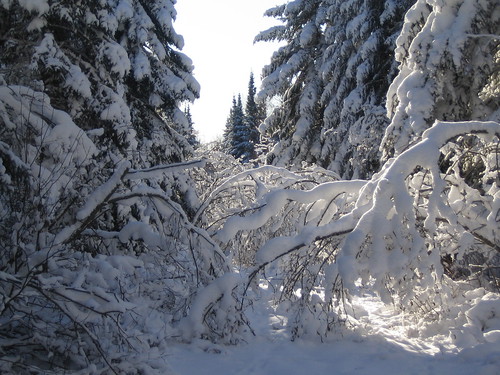
We did manage to get through by shaking the snow off the branches and zig-zagging our way through.
Next time I'll have to remember big nippers and a pruning saw.
What this photo doesn't show is how blue the sky was.
We did manage to get through by shaking the snow off the branches and zig-zagging our way through.
Next time I'll have to remember big nippers and a pruning saw.
What this photo doesn't show is how blue the sky was.
Did the "surge" in Iraq keep the tigers away too?
Sometime ago I wrote a blog or an article about how people connect actions to results without careful examinations of the relationship. Keeping the tigers away is a reference to a hippie sitting on a park bench snapping his fingers to keep the tigers away.
Reading "The War Within" by Bob Woodword I got a good sense of how the "surge" in Iraq was not a major factor in an improvement. The major factor was appointing General David Petraeus as commander in Iraq (pp. 335-337).
Petraeus assembled his own team to evaluate the situation. It included Colonel H.R. McMaster who led the Tall Afar campaign, the only apparent successful clear, hold, and rebuild campaign, and Derek Harvey of the Defense Intelligence Agency, one of the few people who had gone out and spoken, in Arabic, with many of the factions in Iraq. His team went out all over Iraq to assess the situation and find out what was really going on. Petraeus himself went out into the streets to see what had been happening; he was appalled at the "ghost towns" of once prosperous sections.
Now Petraeus is in charge of both Afghanistan and Iraq. Will he bring about lasting change in either?
Wednesday, December 30, 2009
A prime example of the stupidity of war
You won't get through this with dry eyes: "A Mideast Bond, Stitched of Pain and Healing", Ethan Bronner, New York Times, 2009-12-30.
Contradictory parental advice
As I was walking gingerly on slippery, bumpy, ice-and-snow-covered sidewalks, carefully watching where I stepped, slouched over so that I saw the surface only a few feet in front of me, I thought of the parental advice, "Watch where you walk!"
But as I was slouched over, I also thought of the parental advice, "Stand up straight!"
Momma, make up your mind!
But as I was slouched over, I also thought of the parental advice, "Stand up straight!"
Momma, make up your mind!
A famous bartender
When it comes to beer, nobody can outdraw Wyatt Burp.
Oh, no! I thought I was so clever to come up with this, but I'm late to the party again. I searched for "Wyatt Burp" in quotes and had about 10,700 hits!!
Oh, no! I thought I was so clever to come up with this, but I'm late to the party again. I searched for "Wyatt Burp" in quotes and had about 10,700 hits!!
Monday, December 28, 2009
The title of this blog still holds
When I started this blog, I didn't think I would put much in regularly, and so I called it the Irregular Blog. Then I wrote more and more to the point that I felt compelled to write daily.
Meanwhile, as I grew older, my to-do list got longer and longer. But the blog seemed to come first, and I ignored or never got around to many items on the list.
We went to our daughter's lake place for Christmas; a place with no internet access except by smart phone. Plus the social and physical setting is such that it is difficult to go off by oneself to spend time writing.
There is more about the holiday and my to-do list, but let me just say that the snow storm in Duluth changed my to-do list drastically. I still have much snow to clear from in front of our garage and I have no idea when the city will clear the snow boulders from our sidewalk. I know it won't be me!
Let me see: I should sing next, answer some email, copy some documents, find some lost documents, investigate some software problems, work on income tax, make some reservations, … Nah! I think I'll just read some of the books I got for Christmas.
Tuesday, December 22, 2009
More on the changing economy
David Brooks wrote an interesting column on how we are changing from making stuff to creating ideas or protocols, ways of doing things. See "The Protocol Society", New York Times, 2009-12-22.
I checked on the local availability of the books Brooks recommended: "From Poverty to Prosperity" and "Smart World". Neither the Duluth Public Library nor the UMD Library has either book.
Are we changing fast enough? Are we too concerned about jobs for doing the same old things few want to pay for? Shouldn't we be more concerned about opportunities to bring forth new ideas? Is "No Child Left Behind" more about training kids to make stuff rather than to create ideas? Are our politicians more interested about protecting companies and industries that make stuff rather than encouraging companies and industries that make protocols?
Sometimes I think we have more of the prerequisites than any other country to move to a protocol society, and sometimes I think by we are going to let other countries get there first.
Monday, December 21, 2009
Benefits day is coming!
Yep, Tax Day is coming. That is the day in April when our income tax filing is due, as well as any money due. Then there is also "Tax Freedom Day", the day supposedly when the average person has earned enough money to pay all the taxes he or she owes for the year. See also
"The 'Tax Freedom Day' Trick", Dave Johnson, Huffington Post, 2009-01-13. After "Tax Freedom Day", the average person supposedly can enjoy the benefits of his or her work.
What the "Tax Freedom Day" people don't want you to think about is all the benefits you get from government. They want you to think only about the "frivolous" things that government does with your taxes. Of course, they don't mention the "frivolous" things large corporations do with the money you paid for their goods and services, or the money they could have given you in your pay.
We should also celebrate "Benefits Day", the last day of the year, a time when we can look back at all the benefits we have received from government, from corporations, and from individuals. When they all work together for the common good, we all have a better life.
Spam or legit?
I received an eCard from Blue Mountain but no sender name in the subject. I think that Blue Mountain is a legitimate company, but when I looked at the source of the message, I didn't find any name that I recognized.
If it was your card, I'm sorry that I deleted it. If it was really a spam message, then I did the right thing.
If it was your card, I'm sorry that I deleted it. If it was really a spam message, then I did the right thing.
A little word play about chords
I am bored with the chore of finding a cord for my electronic keyboard to make a chord, which I'll probably lose anyway.
Wednesday, December 16, 2009
Whoa to a tale of woe!
This morning I received the following email:
I called her and left a message and then called her stepmother about it. Her stepmother called her and then called me back. Sure enough, her email account was hacked and she is closing the account.
I don't know if I was the first to warn her, but it leaves me feeling better that I know she knows about the problem.
What does bother me is that I could not find any way of reporting this to her email provider. You would think that they would be interested in tracking down crooks like this hacker.
It is with profound sense of sadness i wrote this email to you. I don't know how you will find this but you just have to forgive me for not telling you before leaving. I traveled down to United Kingdom Yesterday for a short vacation but unfortunately,i was mugged at a gun point on my way to the hotel i lodged all my money and all other vital documents including my credit card and my cell phone have been stolen by muggers.It was with the email address of a cousin. Very strange! One, we are not very close and she would have no reason to let me know her travels. Two, she has others who are closer relatives who would be able to find help. Three, she lives in California and wouldn’t go “down to United Kingdom”. Four, why would an American ask another American for money in pounds? Five, I can't believe that the police and embassy were of no help. Six, I do know that my cousin writes much better than this.
I've been to the embassy and the Police here but they're not helping issues at all,Things are difficult here and i don't know what to do at the moment that why i email to ask if you can lend me £1,500.00 so i can settle the hotel bill and get a returning ticket back home. Please do me this great help and i promise to refund the money as soon as i get back home.
I look forward to your positive response.
I called her and left a message and then called her stepmother about it. Her stepmother called her and then called me back. Sure enough, her email account was hacked and she is closing the account.
I don't know if I was the first to warn her, but it leaves me feeling better that I know she knows about the problem.
What does bother me is that I could not find any way of reporting this to her email provider. You would think that they would be interested in tracking down crooks like this hacker.
Tuesday, December 15, 2009
Climate change and so-called bipartisanship
How can there be bipartisanship on any issue when there are more than two sides? Actually, as Stewart Brand writes in "Four Sides to Every Story", New York Times, 2009-12-14 there is a continuum from alarmists who think there is no problem, to those who think caution should be applied to a possible problem, to those who think we should address a given problem, to alarmists who think the problem needs immediate, drastic action.
Brand divides the stances on climate change into the Denialists, the Skeptics, the Warners, and the Calamatists. The real scientists who are Skeptics are often quoted by the Denialists, much to the discomfort of the Skeptics.
This division could be applied to many issues, like health care. We have those who deny there is a problem and even exaggerate the effects of any propose solution and those who exaggerate any problem and deny that proposed solutions will do enough. Then there are all the people who recognize there is a problem, something should be done about the problem, disagree on the severity of the problem and about which solutions are most appropriate.
Unfortunately, the Denialists and the Calamatists too often control the public discourse and make the work of more reasoned minds more difficult. It is even worse when the Deniers and some Skeptics are locked into one political party and the Calamatists, the Warners, and some Skeptics are locked into another political party. With this arrangement how is any real bipartisanship possible?
We would be much better off if we had five political parties: Denialists, Skeptics, Warners, Calamatists, and Referees. The last party would examine the positions of the Skeptics and the Warners, and blend them into politics of the possible. Hopefully, the Denialists and the Calamatists would be marginalized to mere commentators.
Spelling changes from Deniers and Calamitists to Denialists and Calamatists made 2010-01-23.
Monday, December 14, 2009
Is the Web imploding?
Recently have you more frequently received a message like
"Safari can’t open the page “http://www.duluthnewstribune.com/event/article/id/154651/group/Opinion/” because the server where this page is located isn’t responding."
Just a few minutes ago I was not able to access a newspaper server with two different browsers. I have been receiving such messages more and more frequently from a wide variety of sites. I know it is not my connection because I was able to receive email between two attempts.
Could it be my provider has not kept up with the number of subscribers it has? Could it be that many sites are not keeping up with the number of accesses they receive. Could it be we are seeing more denial of service attacks? A search of Google for "denial of service attacks 2009" get over 76,000,000 hits!!!!
I do know that a few minutes later I was able to access the News Tribune again.
Sunday, December 13, 2009
How dumb can I get?
When I went to bed last night my nose was a bit stuffed. I looked for the nasal spray in my toilet kit and couldn't find it. I couldn't believe I had left the nasal spray on my dresser at home. I did have an inhaler and used it. Now I could go to sleep a bit more comfortably.
This morning when I was ready to put my contact lenses in I found the nasal spray. It was on the counter where the lens solution should have been. The lens solution was still in my toilet kit! At least the nasal spray is saline solution and doesn't have menthol and other stuff that would make my eyes burn.
I used the lens solution liberally before putting the lenses in. No problem so far.
I wear old felt boot liners as slippers in the cabin. One seemed to catch as if I a carpet square was up. I'd move my foot and it wouldn't catch again. But this kept happening. Finally I saw that there was a thread coming out of the liner. I pulled the thread up. It was stuck under a box. I moved it out from under the box. It was wrapped around a chair leg. I untangled it from the chair leg. I followed the thread. It was under another chair leg. I picked up the chair and the thread; finally I had found the end. I pulled off the slipper. The sole and upper were not joined from the big toe to the arch! The thread wouldn't break; I had to cut it with scissors. I hope my wife can fix the liner; they are cozy in the cabin.
This morning as the inside temperature dropped quite a bit, I started another fire. But why was it so smokey? Ah, yes, the air intake was partially closed and the damper was shut. Smart people pay attention to details.
Oh well, I took a walk this morning on a trail we haven't kept up for a few years and I remembered all of its twists and turns. I exaggerate a bit. It was the third time I've been on that trail this fall. A few weeks ago we walked it with some friends. Even though several landmark trees had fallen; deer and other animals had used the trail enough to give me a sense where the trail was.
Last week my wife and I walked it and placed yellow flagging tape at several places. Today when I walked it, I couldn't always see the next bit of tape. That was because I had walked forward to pick a place for the next bit. I could see where we had placed the last bit, but I didn't think we might not be able to see the next one from the previous.
I did spend a bit of time noting how the landmarks had changed. For example, I knew we had gone through a thicket of alder, went past a couple of large balsam, stepped over a fallen tree, and then bore left into a grassy area. Animals had changed the path to go above the alder, and the two balsam had been uprooted. Today I was able to identify that place by spending a bit of time looking around.
Am I an expert woodsman. Far from it. But when you do certain things over and over again, you can retain memories long afterwards. Now if I can only find the old trail that went east from where this trail turned west.
Friday, December 11, 2009
Vertical farming: down to earth or pie in the sky?
The Reader Weekly had an article in its 2009-12-03 issue on vertical farming; that is, farming in an agricultural skyscraper. Vertical farming will supposedly solve a lot of agricultural problems, including scarcity of land and cost of delivery to market.
The Reader Weekly article was taken from http://www.emagazine.com/earthtalk/archives.php. I thought I had accessed the original article but can't access it again. It may be in response to a question in the 2009-11-06(?) issue.
One constant reference is to The Vertical Farm Project. This seems to be nothing but design projects, no demonstration projects. I did find "Vertical Farm Built in Iqaluit". but the article is about a nearly completed project and was written in 2008-04-01. Unfortunately, note the date! The story goes on to tout the wonders if the story were true.
I have a hunch that many people took this story for gospel. Hm, something more akin to the "The Age of Unreason". We believe uncritically what we want to believe.
I've lost my way in all the twists and turns of my search for more info on vertical farming. Supposedly there was a vertical farm demonstration project at Cornell University, but a search of the Cornell web site gives nothing on vertical farming.
If the benefits were so great, one would think there would be hundreds of demonstration products by now.
The Age of Unreason
Sarah Palin quit as governor to become a celebrity. Sarah Palin is a Republican. Therefore all Republicans want to become celebrities.
Bad reasoning? Yes, but it is exactly the type of reasoning Sarah Palin uses in her recent article, which I saw in yesterday's Star Tribune. The original article is "Copenhagen's political science", Sarah Palin, Washington Post, 2009-12-09.
She maintains that some scientists in England supposedly falsified data. These scientists are proponents of the idea of global warming. Therefore all scientists who are proponents of the idea of global warming have falsified data.
If you have time, follow the links from the Washington Post. You might be able to find the posted emails, judge for yourself if they all are real, and determine how much they "disprove" global warming, if at all.
For a more balanced view, see "Whose war on science?", Michael Gerson, Washington Post, 2009-12-11.
You also can find many interesting comments by following almost any link.
Before you judge "conservatives" too harshly, consider that many "liberals" take facts out of context to make a point. Sixty some million people do not have health insurance. Sixty some million people are in imminent danger of a health crisis. Sixty some million people will suffer greatly because they don't have health insurance. Yes, there are many people who will suffer because they don't have health insurance, but let's find other justifications for health care being available to all who need it.
Tuesday, December 08, 2009
Racing to the top to reward the top
Bank of America is rushing to repay its government bailout funds, not because it has more money, but it doesn't want a government cap on CEO pay ("Bailout Refund Is All About Pay, Pay, Pay", Andrew Ross Sorkin, New York Times, 2009-12-08).
BofA and other large corporations want to pay their executives "competitively" to attract "top talent". My question is what has happened to "rising through the ranks"? Wouldn't people inside the company know more about running the company than an outsider? And if someone inside the company who was a real contributor, feeling shunted aside in favor of an outsider, quit to go elsewhere for a top job. This person would be contributing to the company's competitors and speeding the upward spiral of executive compensation.
Of course, if the board hires an outsider at a "competitive" salary, then they will have to pay themselves a competitive salary. I often think a board should work only for the long-term benefit of the personal investment they made in shares.
I think this behavior belies the myth of capitalism and free enterprise. Many corporations are run for the benefit of the top executives with employees, small shareholders, customers, and communities coming in a distant second.
See also my columns "Talk about Boards with Conflicts of Interest!", Reader Weekly, 2000-04-27 and. "Sauce for the goose is sauce for the gander", Reader Weekly, 2006-04-27.
But for the real clincher, see "Why Changing the CEO May Not Change the Company", Jason Zweig, Wall Street Journal, 2009-12-01. Hm! this sounds like a liberal opinion coming from the Wall Street Journal:) Note that the link may be temporary.
Smoking is not a private act
I went to the car wash today with a nice-smelling car; I left with a stinky car!
The prep guy is a heavy smoker and in this very cold weather he keeps the overhead doors closed. Just opening my window to give him the sales slip let so much smoke residue into my car from the air and from his clothes that by the time I got home the car still smelled of stale smoke.
See also "Smokers are a dying breed".
Monday, December 07, 2009
I'm not transitioning, prioritizing, or strategizing with neologisms
As you know, I'm not the world's best writer and I don't always write clearly. But I have been jolted by grandiose words that could be replaced with simpler words or more elegant phrases.
When I have time, I report phishing emails to the appropriate authorities. Today's phishing email purported to over four million dollars in accrued interest for me at Abbey Bank in London.
I tracked down Abbey Bank's web site and found the page on reporting spam. It said that one should send details to phishing@abbey.com and then followed it with
The emails are then made available to our colleagues who liaise with the various law enforcement agencies and ISP's.Argh! Can't their colleagues work or co-operate with law enforcement and ISPs?
Sunday, December 06, 2009
Reality in dreams, dreams in reality
Last night I had a dream about wrapping presents. One of the presents was food and we had to hide it from the dog. I suddenly woke up with the thought that we had no dog. We haven't for about nineteen years.
I went back to sleep, probably had some other dreams, and then one in which a salesman was trying to get me to sign for a car. I was reluctant and woke up with the realization we didn't need a car; we had recently bought a car.
I find it interesting how often we have dreams that we think are the real world.
But then in the real world we have dreams about what we will do. Some will come true; some won't.
I long had a dream of visiting Europe again and visiting friends I have living there. Now I've given that up because I don't want to fly again. The last trip to Japan was too much sitting still for too long. And all the security hassle at either end makes the sitting still even more burdensome.
I have all kinds of dreams about what we will do with our Brimson property. We long ago gave up on building a house there. Now it's a lot to fix the floor insulation of the cabin; something I keep putting off every year as we have more squirrels with silicosis. I have a dream of opening up all the trails I once had cut. Will I spend enough time there? Even with the new chipper, it takes about four hours to sixty feet, what with the gathering of the brush and branches to stuff into the chipper. Four hours is about all the time I spend on this activity each two-day stint; there are other tasks to be done, including walking and loafing. I probably had at least two miles of trails.
I have all kinds of small dreams of becoming a better singer. I can't do that if I keep writing these blogs:)
So which is reality? The dreams when I'm sleeping or the dreams when I'm awake?
Saturday, December 05, 2009
Healthy choices equal healthy life, always?
In the last two months several letters in the Star Tribune and the Duluth News Tribune have stated that if people would make healthy choices they would lead healthy lives and we wouldn't need a health care system for all. If this were only so.
A doctor once told me the secret to a long life was to not smoke, drink in moderation, exercise regularly, and pick healthy grandparents.
Granted there are many people who don't follow the first three rules. We see them all the time. These people do make up a large portion of those who need medical care. But should those of us who didn't pick healthy grandparents and didn't pick something else important to our health be left to our fate as described by some of these letter writers.
I have a heart murmur that has raised false alarms a few times. Should my ability to obtain health insurance determine if I get care to be sure the problem was not more serious?
I just read an entry on a Caring Bridges site of a person that almost died at the age of four. Did he have a choice then of a healthy life style?
There is a lot to the "wisdom" of "picking healthy grandparents". Many conditions are genetic and may be detected at a time early enough to prevent more serious consequences. Should this detection be based on the ability to pay or obtain health insurance?
The "something else important to our health" is to pick a good environment to live in. The problem is that we may not know our environment is unhealthy until it is too late.
A school in California had an abnormal number of students and teachers getting cancer, some of who died. See "Is Dirty Electricity Making You Sick?" Prevention Magazine, December 2009. Maybe there is another cause besides excessive radiation, but did those who became ill have any way of knowing they would be in an unhealthy environment.
Minamata Bay in Japan had excessive mercury that poisoned many, including giving children severe birth defects. Did the residents know that their bay was a dumping ground for industry? Did they have sufficient knowledge to relate the health problems to the pollution? Did they have the resources to stop the pollution or to move away?
Over two hundred people contracted pneumonia while attending an American Legion Convention in Philadelphia in 1976; thirty-four of them died. We lived in the area at the time and remember how baffled authorities were. It wasn't until January of the next year that it was determined that the bacteria came from the cooling tower of the hotel. According to Wikipedia there have other outbreaks of Legionnaire's Disease in Europe with fatalities; all traced to problems with the air conditioning. Does this mean that we should all stay away from air-conditioned buildings to stay healthy?
Even if we stay outside or only in our own homes, we don't know what harmful substances may be in our environment. Doctrinaire "free enterprisers" think any control on industrial pollution is bad for business. But sick and dying customers are bad for business. Sometimes we don't know if a product we use in our home is harmful until too late.
I guess the only way to have a guaranteed healthy life is to live in a cocoon. Oh, wait a minute! What is the cocoon made of? What are the nutrients being given to us from the outside?
I guess that leaves the only way to stay healthy is to never be born.
Friday, December 04, 2009
Bureaucracy and email
I had a contact at the Duluth News Tribune to report problems with the DNT and Star Tribune boxes at the corner. Problems like running out very early, missing sections, wrong price settings, and on and on.
Things had been going smoothly until last week. Supposedly the Saturday Star Tribune has the funnies included; they weren't last week. One day this week there was no Variety section in the Star Tribune even though it was mentioned on the front page.
On that day I emailed my contact at the New Tribune, which prints and delivers the Star Tribune in the Duluth area. A day later I got an email from postmaster@forumcomm.com titled "Delivery Status Notification (Failure)" with a copy of the message I sent to my contact.
I assume my contact has either quit or been laid off. In either case, that's too bad because she was a friendly person to work with. However, instead of just bouncing email to her, shouldn't the company forward email to whoever is doing some of what she did? Or, give some notice of an alternate email address?
This just doesn't happen in large corporations like Forum Communications. It happens in small companies, too. I sent email to a salesman that I had bought a computer from; I never received a reply. The next time I went into the store I was told he had left. Shouldn't somebody have received his email? But employees who are still at this company don't always answer their email. I've bought other computers from same company and my current favorite salesman doesn't always answer his email. Maybe I should just go to the Apple Store in Roseville next time instead of buying local.
See also "Bureaucracy can exist in any economic model".
Thursday, December 03, 2009
Inclusiveness is exclusive
Sometime in the fall, I started reading "The Gospel of Inclusion" in UU World, the quarterly magazine of the Unitarian Universalist Association. I started gnashing my teeth part way through and couldn't continue.
It was about a black Pentecostal bishop who became Universalist in his thought, was ostracized in the megachurch he was active in, and brought some of his followers to a large Unitarian church in Tulsa OK. That's OK, but some of the underlying thoughts in the article bothered me.
One was the statement that the only problem with the Unitarian church was that it "was really, really white." Is that a problem? There are churches that are really, really black, and there are churches that are really, really mixed. In fact, the megachurch the bishop came from had four white ministers.
The other was that the new congregants transformed much of the Unitarian church to be more active in the services, saying "Amens" and "Preach it, brother". That's OK if that's what most of the existing congregation wants.
However, what about the people who want a quiet, contemplative service? What about the people who don't want somebody clapping or shouting in their ear? They are being excluded in the name of inclusiveness.
I lay awake much of the night after I read this article thinking about what I would write. I told myself to get up and make some notes. But I didn't want to disturb my wife. In the light of the next day those thoughts just didn't come back to me. But the thought of writing a blog about those thoughts has been hanging over my head since.
I have this feeling that much of the inclusiveness of UUs is more a guilt feeling than a true inclusiveness. All groups by their nature are exclusive. They are made of people with some common interests. If you share those interests you are generally welcome; if you want the group to have other interests, please go elsewhere. For example, would a social bridge club really be interested in having poker players who bet?
Unfortunately, our society has a false division for many things on black and white. On the other hand, for a variety of reasons, cultural interests tend to follow this division. But, color divisions aren't the only divisions. Would these "inclusive" churches welcome practicing Catholics who wanted to bring the mass and cross into their churches. If so, it would be quite a turnabout for churches that have taken crosses out of their sanctuaries and taken "God" out of the hymnals. They were excluding the ideas and words they didn't agree with. "Joy to the world, the word has come…" The "word has come"??? That's not the way I learned that carol.
My own feeling is that inclusiveness is a guilt trip. Some people feel guilty about being white and that having more contact with black people will do their consciences good. I resent this! Not because I think the races should be separate, but because I don't share in their guilt. My contacts with others have been made by circumstance and they are not exclusively white.
The inclusive people don't know the neighborhoods I've lived in, the friends and acquaintances I've had, who I've shared meals with, who my subordinates and my superiors have been, who I've done favors for and who has done favors for me, who I've proven wrong and who has proven me wrong.
So, please, be inclusive in accepting people who share the beliefs of your organization, but don't exclude them on things that are irrelevant to those beliefs.
Tuesday, December 01, 2009
Coffee, tea, and you
After dinner tonight, my wife asked if I wanted coffee in the dining room or wanted it upstairs at my computer. I responded that I would rather have it in the dining room with her. After all, we may have only forty years more together.
Actually, she would have had her coffee at her computer, but having coffee face to face is better than having it back to back.
Actually, she would have had her coffee at her computer, but having coffee face to face is better than having it back to back.
Bureaucracy can exist in any economic model
Many people complain about government bureaucracy as if it went away everything would be so much better. Unfortunately, bureaucracies occur in organizations of all types and sizes. They occur in government, in non-profits, and in profits.
We should also note that some employees have flexibility in almost any type of organization. I had a water inspector accept on my word that our usage dropped because I replaced a washer, not that something had happened to our meter.
The incident that triggered this blog entry was an automated call from a non-profit medical center reminding me of an appointment in two days. Some hours earlier that department had called me to move the appointment to next week. Left hand, please meet the right hand!
A couple of weeks ago I had sent an online problem report to a well-known computer manufacturer. I received a boiler plate response about checking that I had the latest version of the operating system and the latest version of the software with the problem. That information was automatically included in my report.
Today I discovered there was a work around to my problem, but it was not obvious. There were several non-intuitive steps involved. I sent a report to the agent who had initially responded to my problem report, including the suggestion that what I wanted should be a menu item. She thanked me for the report and suggested that I send the manufacturer a feedback suggestion. Duh! Couldn't she and shouldn't she do that herself? Shouldn't somebody in the call center be looking at the reports and extracting trends?
See also my "The Federal Government has no corner on bureaucracy", Reader Weekly, 2008-01-03.
Subscribe to:
Posts (Atom)